25 US states sue Trump administration over Section 301 tariffs; legal challenges expose fragile basis of protectionist agenda: expert
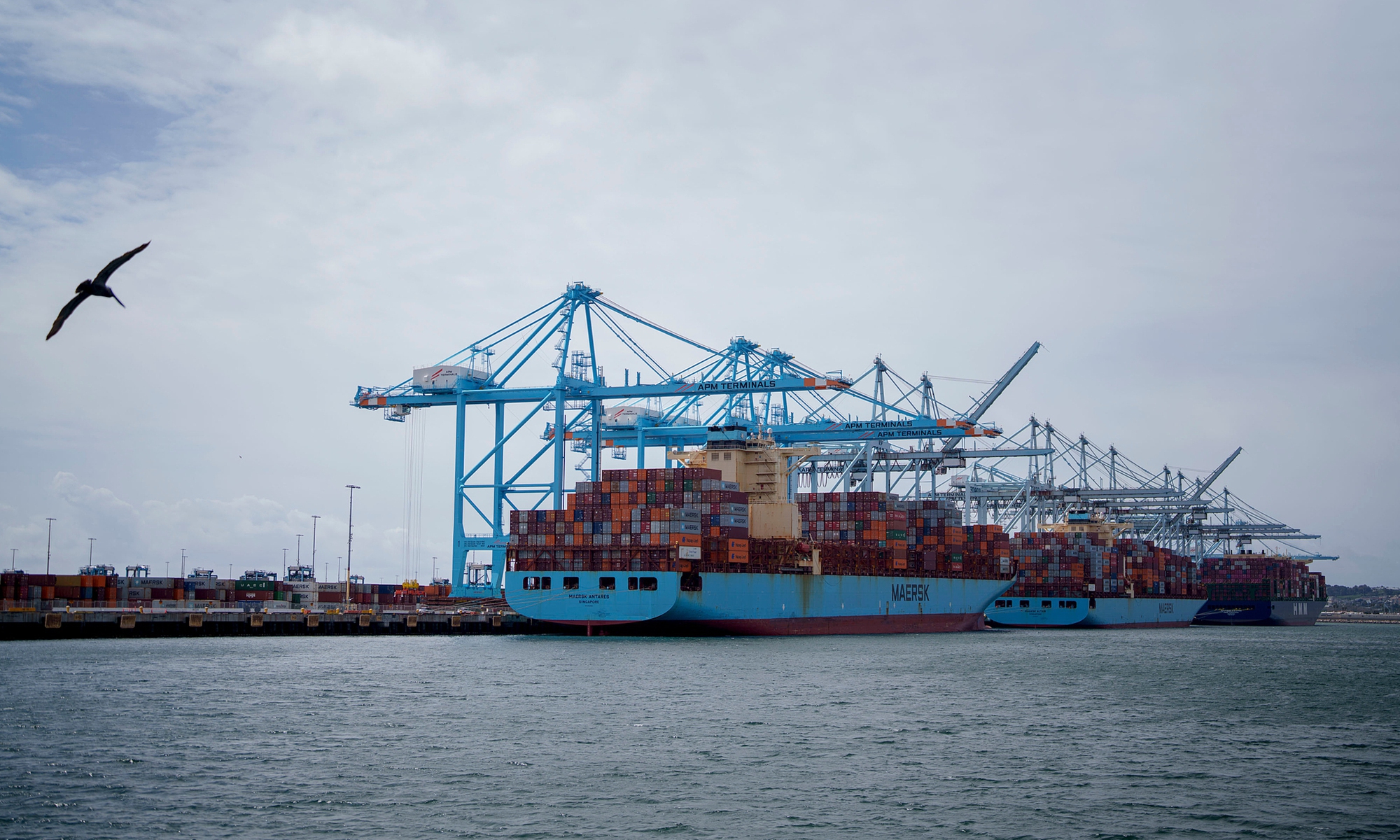
Cranes load containers onto ships at the Port of Los Angeles in Los Angeles, California, US, on March 6, 2025. Photo:VCG
The US' latest round of sweeping tariffs is facing a widening legal backlash at home, with a group of 25 Democratic-led states reportedly suing the Trump administration on Monday. The group alleges that President Donald Trump exceeded his legal authority by imposing duties on 60 trading partners and is asking the US Court of International Trade to block the measures and declare them unlawful.The pushback follows warnings from US companies and industry groups that the measures would raise costs and disrupt supply chains. Small businesses also filed a separate lawsuit seeking to halt the duties on July 24, the day they took effect.
The legal challenge adds to a string of court setbacks for Trump's tariff agenda. In February, the Supreme Court struck down sweeping tariffs he had pursued under a law meant for use in national emergencies, while the US Court of International Trade ruled in May against the temporary 10 percent global tariff imposed to replace them.
Chinese analysts said that the lawsuit exposes both the fragile legal basis of the US administration's tariff policy and the country's deepening partisan divide. They warned that, as with previous rounds, the latest tariffs will ultimately leave US businesses and consumers footing the bill.
Legal fault lines
The 25 states joining the lawsuit included New York, Arizona, California, Colorado, Connecticut, Delaware, Hawaii, according to The Associated Press. They are asking the court to block the tariffs, declare them unlawful and order the administration to refund duties they have paid, according to CNBC.
The states alleged that US Trade Representative (USTR) Jamieson Greer rushed investigations into 60 economies, failed to conduct the country-specific consultations required under US trade law and did not adequately explain why nearly uniform tariff rates were appropriate for economies with widely different policies, CNBC reported.
"There is no rational fit between the purported problem of forced labor in international supply chains and the blanket global tariffs the USTR imposed," the states' complaint said.
The lawsuit was hardly surprising, as each of the US administration's attempts to impose sweeping tariffs has encountered sustained opposition at home, said He Weiwen, a senior fellow at the Center for China and Globalization. "The fact that the latest challenge was brought mainly by Democratic-led states also underscores the deepening partisan divide in the US," He told the Global Times on Tuesday.
The USTR on July 24 imposed new tariffs of 10 percent and 12.5 percent on 60 trading partners, with Chinese goods subject to the 12.5 percent rate, following Section 301 investigations into their alleged failure to ban imports produced with "forced labor." The new tariffs took effect just as a temporary 10 percent global tariff expired
"Imposing across-the-board tariffs on an entire country or economy under the pretext of so-called 'forced labor' lacks sufficient legal and factual grounds," He said. "If the measures were genuinely intended to address forced labor, they could target specific products or companies for which clear evidence exists, rather than broadly covering most goods from an entire economy."
Such a sweeping application of Section 301 amounts to an expansion and abuse of the provision, He said. "The US administration's determination to preserve a broad tariff regime also points to the failure of its previous measures, which neither reduced the US trade deficit nor generated more manufacturing jobs," He added.
Citing official US data and Kearney's Reshoring Index, Cui Fan, a professor at the University of International Business and Economics, said that manufacturing's share of US GDP remained below 10 percent throughout 2025, while the index stayed firmly in negative territory in both 2024 and 2025.
"Taken together, these figures offer little evidence of a broad-based return of manufacturing to the US," Cui told the Global Times on Tuesday.
The US has nevertheless continued to pursue the policy, which shows that its primary objective is not the broader interests of the US economy, but the consolidation of the administration's domestic political base through an increasingly protectionist agenda, He added.
Global pushback
Opposition has also spread well beyond the US. Businesses and industry groups in affected economies, including the Canadian Federation of Agriculture, the German Chamber of Commerce and Industry and the Lima Chamber of Commerce in Peru, have warned that the measures could raise costs, disrupt highly integrated supply chains and penalize trade unrelated to forced labor.
Brazil has taken the dispute to the World Trade Organization, requesting consultations with the US over both a 25 percent tariff on certain Brazilian products and the new tariffs of up to 12.5 percent imposed over alleged failures to enforce forced-labor import bans, according to CCTV News.
Faced with higher US market-access costs and repeated policy shifts, other economies will seek new markets, deepen regional trade and reorganize supply chains, while the US will ultimately bear the cost as higher prices for imported intermediate goods and components are passed on to American manufacturers and consumers, He said.
Global trade data already point to that adaptability. UN Trade and Development said South-South trade expanded around 9 percent, underscoring the growing weight of developing economies on world trade. In the first half of 2026, the value of global goods trade rose an estimated 12.5 percent year-on-year, despite continued US tariff pressure.
China's increasingly diversified trade structure offers a case in point. The country's total goods trade grew 16.9 percent year-on-year in the first half of 2026, while trade with Belt and Road partner countries rose 14.8 percent and accounted for 50.9 percent of the total.
Cui said that, at its core, the US is using tariffs to leverage its remaining dominance and pressure trading partners into sharing the cost of sustaining its global position. "Although some economies have made concessions to Washington, such unequal deals were struck under pressure," he noted.
Their implementation remains uncertain, as some partners appear reluctant to fulfill commitments such as large-scale investment in the US, Cui added.
China's Ministry of Commerce said on July 27 that the US has yet to ratify the Forced Labor Convention of 1930, but has long manipulated the issue of so-called "forced labor." Launching Section 301 investigations and imposing unilateral tariffs under that pretext constituted a typical act of unilateralism and protectionism, which China firmly opposes, a ministry spokesperson said.
The spokesperson said China would continue to closely monitor and comprehensively assess subsequent US actions, and reserve the right to take all necessary measures, urging the US to correct its erroneous approach and completely remove the unilateral tariffs.
RELATED ARTICLES