Illustration: Xia Qing/GT
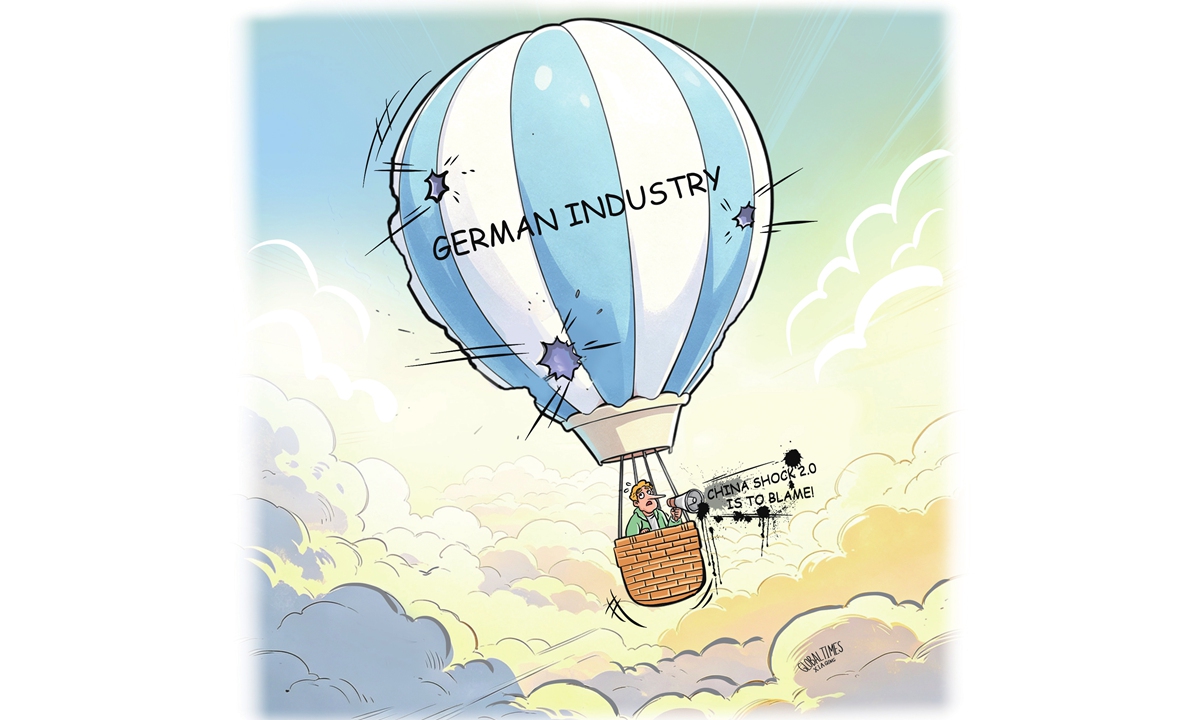
According to German media reports, Tanja Gönner, chief executive of the Federation of German Industries, has touted the "China Shock 2.0" narrative, claiming that the German industry is facing broad and far-reaching impacts as a result.In recent years, Germany's industrial system and even its economic model have faced mounting challenges. While Gönner and others have identified some of the symptoms, they have failed to find the right remedy. Treating domestic problems by blaming external factors and shifting responsibility onto China will not save the German industry.
For a long period of time, Germany built an export-oriented industrial model based on relatively low energy costs, advanced high-end manufacturing capabilities and open global markets. This model not only created millions of jobs but also secured Germany's important position in the European and global economy. However, in recent years, factors including the restructuring of global energy supplies, the accelerating pace of technological and industrial transformation, and growing complexity in the global trade environment have placed pressure on the German economy. Growth has remained sluggish, and the industrial sector in particular is undergoing a severe structural test.
First, changes in the energy supply landscape have pushed up industrial production costs. For years, Germany relied heavily on low-cost natural gas from Russia. However, after the outbreak of the Ukraine crisis, Germany moved to reduce its energy dependence on Russia and turned to alternative energy sources that are more expensive and involve more complicated transportation. Germany's green transition also requires substantial investment. The share of renewable energy in Germany's electricity consumption is expected to rise from 42 percent in 2021 to 80 percent by 2030. Yet domestic infrastructure for renewable energy, power grids and energy storage has not kept pace with the transition, further driving up energy costs and reducing supply stability. Some energy-intensive companies have been forced to suspend operations or even relocate.
Second, the new wave of technological and industrial transformation is reshaping Germany's traditional manufacturing strengths. Emerging digital technologies are rapidly penetrating the manufacturing sector. The automobile industry provides a typical example. Germany has accumulated deep expertise in traditional areas such as mechanical engineering and industrial automation. Yet, it lacks sufficient technological support and talent reserves in areas such as AI and digital platforms. These challenges, combined with shrinking labor supply, have further constrained Germany's technological innovation and industrial upgrading.
Third, changes in the external environment have hit Germany's export-driven economic model. In recent years, sluggish global growth, rising protectionism and increasing geopolitical risks have created new challenges. The US tariff measures against economies including the EU, as well as Western sanctions against Russia, have significantly affected Germany's industrial system, which relies heavily on exports and global supply chains. Meanwhile, the rapid development of emerging economies in related sectors has also narrowed the international market space for German industries.
Finally, Germany's domestic investment environment has become less attractive. The German government has sought to address economic challenges through increased administrative intervention and expanded welfare spending, which has in turn placed greater pressure on public finances and businesses. Complex regulatory procedures have weakened companies' willingness to invest, particularly in emerging industries where technological cycles are moving rapidly.
In response to its economic difficulties, the German government has introduced a series of measures since 2025, including launching a special fund to improve transport, power grid and digital infrastructure, and a 46-billion-euro corporate tax relief package to boost investment in digitalization, green technologies and advanced manufacturing. Yet, analysts generally believe that the reform package still lacks a clear strategic approach to addressing energy issues that are of greatest concern to consumers and businesses.
The challenges facing the German industry are not merely a cyclical downturn in specific sectors, but a profound structural test. The foundations supporting Germany's traditional industrial model are all under pressure. Short-term stimulus measures or support for individual industries are unlikely to fundamentally reverse the situation. Simply attributing Germany's structural difficulties to the so-called "China Shock 2.0" will not solve the problem; it may even prove counterproductive.
Austrian economist Joseph Schumpeter's theory of "creative destruction" highlights innovation as an inherent force driving economic development. Germany needs to continue promoting technological innovation and industrial restructuring, accelerate digital and intelligent transformation of manufacturing, improve energy and digital infrastructure, enhance the investment environment, and rebuild international competitiveness through open cooperation. Through these combined efforts, Germany can cultivate new sources of economic growth and inject fresh momentum into its industrial development.
The author is a professor at the School of Foreign Studies of Northwestern Polytechnical University. opinion@globaltimes.com.cn
RELATED ARTICLES