Japan’s defense white paper sends wrong and dangerous signal to ‘Taiwan independence’ separatist forces: Hai Feng
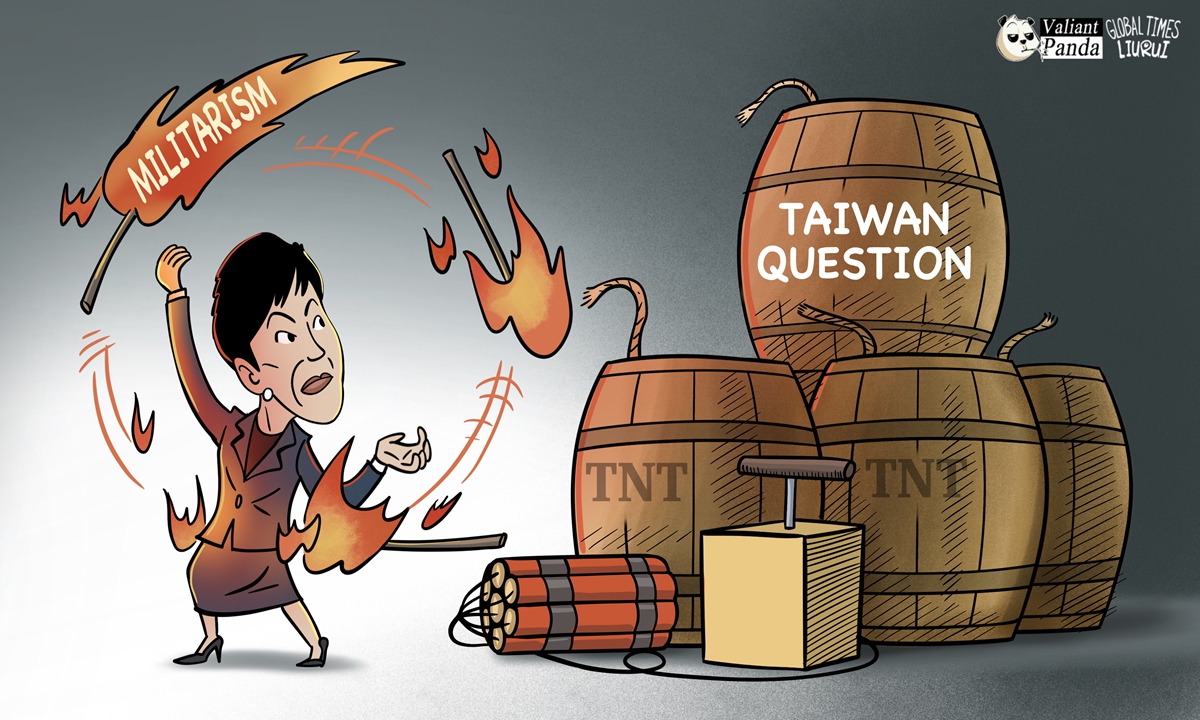
Illustration: Liu Rui/GT
On August 4, Japanese Defense Minister Shinjiro Koizumi delivered a report on the Defense of Japan 2026 at a cabinet meeting. The new white paper once again targets at China, claiming that China's military developments constitute the "greatest strategic challenge ever," while overinterpreting, sensationalizing and deliberately magnifying China's far-seas aircraft carrier operations and People's Liberation Army (PLA) exercises around the Taiwan Straits.On the surface, the new white paper appears to be Japan's "security assessment" in response to the latest developments. In reality, it can be seen as a carefully packaged "political mobilization order": hyping up the so-called "China threat" to create public support for Japan's military expansion; deliberately exaggerating risks in the Taiwan Straits to seek justification for intervention; and using so-called "regional security concerns" as a pretext to fuel the resurgence of militarism in Japan.
It is worth noting that in a recent interview, US Secretary of State Marco Rubio said that any US-China conflict would be "catastrophic" for the world. He said that China and the US are the world's two most powerful powers. They must establish a relationship, maintain dialogue and reduce the risk of conflict as much as possible; otherwise, the consequences could be extremely serious. If Rubio can recognize this reality, one has to wonder where Japanese right-wing politicians get their confidence and sense of entitlement to provoke China?
This is certainly not the first time Japan has made an issue out of the Taiwan question. The key issue is what ulterior motives Tokyo seeks to achieve through these petty moves. Japan knows full well that the Taiwan question is purely China's internal affair and that the root cause of risks in the Taiwan Straits does not lie with the Chinese mainland. Yet it continues to distort China's legitimate efforts to strengthen its defense capabilities, conduct military exercises and carry out joint combat readiness patrols, portraying them as "destabilizing factors" in the region. The real purpose of such a narrative is to confuse right and wrong, shift responsibility, and ultimately portray Japan as an external force that can "play a role" in the Taiwan question.
It must be pointed out that the white paper's interpretation of China's military development is itself based on a distorted presupposition. China's navy expanding into distant waters and aircraft carrier groups sailing into ocean are normal manifestations of safeguarding China's sovereignty, security and development interests. The regular operations of the Chinese navy in the western Pacific are by no means "abnormal activities," but rather a natural outcome of China's growing maritime capabilities. By portraying these actions as so-called "expanding threats," Japan is revealing a logic of double standards: What China does is unacceptable, while what others do is permissible. In other words, Japan not only claimed that China allegedly challenges the so-called rules or status quo; it is even more concerned that China is increasingly capable of breaking the long-standing monopoly held by certain countries over the interpretation of maritime power in the Asia-Pacific region.
More worrying is that Japan's distorted interpretation sends an extremely wrong and dangerous signal to "Taiwan independence" separatist forces. By repeatedly hyping up the possibility that cross-Straits tensions could "escalate," Japan is implicitly suggesting to separatist forces on the island that Japan may intervene and that they have "backing." This will undoubtedly encourage a gambler's mentality among "Taiwan independence" separatist forces, leading them to repeatedly test red lines and create provocations based on miscalculations. Clearly, what truly harms peace and stability across the Taiwan Straits is not China's legitimate actions carried out in accordance with law, necessity and the situation, but rather the mistaken "encouragement" given to "Taiwan independence" separatist forces by external forces.
According to Taiwan's "defense authority," starting at 9:18 am on Tuesday, various types of PLA aircraft, including J-10 and J-16 jets, KJ-500 early warning aircraft and drones, conducted 17 sorties, with 12 entering airspace around northern, central and southwestern regions of the island. The aircraft coordinated with mainland naval vessels in joint combat readiness patrols. The operation took place on the eve of Taiwan's "Han Kuang" exercises, making its timing highly significant and carrying clear practical implications. It clearly demonstrates that if separatist forces on the island attempt to use military drills for political posturing, and external forces exploit the opportunity to escalate tensions and provoke confrontation, the PLA possesses both the capability and determination to send the clearest and most direct message: Red lines are not drawn on paper, and bottom lines are not meant to be tested.
What truly needs to be clarified is: What is the root cause of the escalating tensions across the Taiwan Straits today? Is it because China has more aircraft carriers, more advanced fighter jets, or naval task forces that operate farther afield? Of course not.
The root cause of cross‑Straits tensions does not lie in China's legitimate and just efforts to uphold national unity and territorial integrity. Rather, it lies in the "Taiwan independence" separatist forces' persistent push for "de-Sinicization" and their plots for de facto secession. It also comes from the mindset of external forces such as the US and Japan, which view the Taiwan question as a pawn in their efforts to contain China's development, as well as the political manipulation, military collusion, and inflammatory posturing they engage in on that basis.
Without "Taiwan independence" provocations, there would be no accumulation of crises; without external interference, there would be no magnification of risks. Who is undermining peace across the Taiwan Straits and stoking cross‑Straits tensions? The answer could not be clearer.
The stronger the Chinese People's Liberation Army (PLA) becomes, the better‑guarded peace across the Taiwan Straits will be. Building a strong military has never been about proactively instigating war, but rather about preventing war, deterring recklessness, and dispelling miscalculations.
China has always been committed to the prospect of peaceful reunification, which represents its utmost sincerity. Yet sincerity must be backed by capability, and peace must be safeguarded by strength. Without a powerful people's military, external forces would assume they could play the "Taiwan card" continuously without constraints; without a powerful strategic deterrent, "Taiwan independence" forces would mistakenly believe their provocations would come at no cost.
It is precisely because the PLA has grown increasingly capable, with all‑domain deterrence and system‑of‑systems combat capability, that the situation in the Taiwan Straits has not been completely pushed to the brink of chaos by separatist forces and external interveners.
Today, as China firmly advances the cause of reunification, its efforts are no longer limited to a single military front but have formed a synergistic momentum across multiple domains, including diplomacy, law, maritime governance, and integrated development.
As highlighted in a recent special report by Singapore's Lianhe Zaobao, Beijing's approach to Taiwan features a distinct "interlocking, four-pronged" framework with diversifying tools for peaceful reunification. This demonstrates that China's approach to creating favorable conditions for reunification is shifting from single-dimensional military deterrence toward the comprehensive deployment of integrated governance capabilities.
This is precisely what causes Japan the greatest anxiety. What Japan perceives is not merely the rise of China's military power, but also China's steadily growing ability to seize the strategic initiative regarding the Taiwan question. It is for this very reason that Japan is attempting to use its white paper to portray all of China's legitimate measures as "threats," with the sole aim of delaying and disrupting this process. The more Japan acts in this manner, the more it demonstrates that it has clearly recognized a reality: Control over the situation in the Taiwan Straits is increasingly returning to China's own hands.
Japan's continued overstepping of boundaries on the Taiwan question is no longer merely a matter of "excessive rhetoric" in the abstract, but rather a constant testing of the political red lines in China-Japan relations. It not only misleads public opinion within Japan but also encourages separatist forces on the island, while sending an extremely irresponsible signal to the region.
Japan must see clearly: Peace and stability in the Taiwan Straits do not depend on intimidation or exploitation of the situation by external forces, nor on the opportunism of "Taiwan independence" forces, but rather on the PLA's increasingly powerful deterrence capabilities and on China's historical initiative in continuously shaping the conditions for reunification across political, legal, maritime and integrated‑development dimensions.
History will not allow militarism to make a comeback, nor will reality tolerate external forces turning the Taiwan Straits into a gambling table. If Japan truly wishes to uphold regional peace, it must stop reviving the old militarist fantasies and quit stoking tensions and crossing red lines on the Taiwan question. Otherwise, what awaits it will certainly not be any "strategic rewards," but nothing short of historical reckoning and tangible real‑world punishment.
RELATED ARTICLES