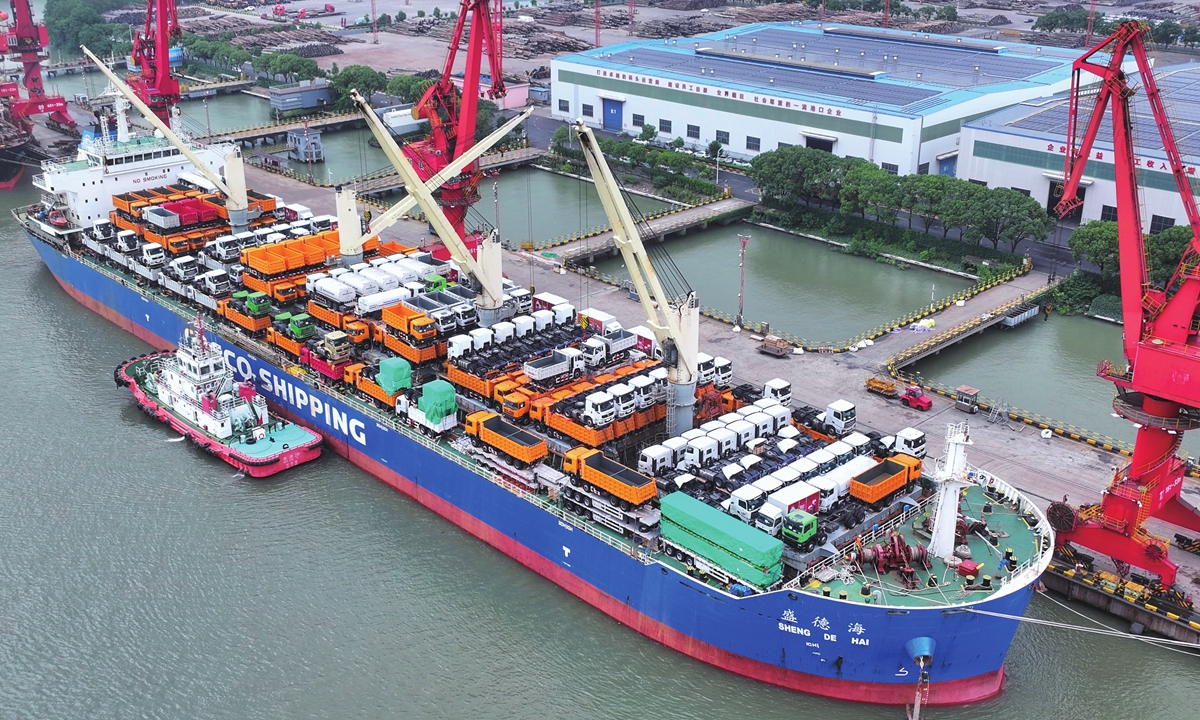
A cargo vessel carrying engineering vehicles for export is seen at a port in Zhangjiagang, East China's Jiangsu Province, on July 21, 2026. Photo: VCG
Cooperation in automotive industrial chains between China and South Korea has been gaining momentum. The latest example is the signing of a $75 million investment agreement between South Korean automaker KG Mobility (KGM) and China's Chery Automobile Co, the Yonhap News Agency reported on Monday. The Chinese automaker's global vehicle platforms and extensive supply chain are expected to support KGM's efforts to accelerate new model development and expand its overseas business, the report said.
Numerous cooperation cases have already been built up between the two countries' auto sectors. Chinese smart‑driving component suppliers have secured positions in the supply chains of South Korean automakers, while some South Korean parts companies have delivered components for China's new‑energy vehicle manufacturers.
In the first 11 months of 2025, China's exports of auto parts to South Korea rose by 8.9 percent year-on-year, according to customs data. Samsung Electro-Mechanics, the electronic components arm of Samsung Electronics, secured a major supply deal with Chinese electric vehicle giant BYD for its multilayer ceramic capacitors.
These developments point to a clear trend: in the face of rising global trade protectionism, the East Asian automotive industrial chain is actively pursuing pragmatic cooperation to unlock mutual benefits.
The South Korean vehicle industry is at a critical crossroads, beset by both internal and external pressures. The continuously escalating tariff barriers in the European and American markets have sharply raised the costs and market‑access thresholds for overseas expansion. With the US wielding the tariff stick and the EU weighing policy shifts to protect local industries, South Korean automakers can hardly remain immune to these shocks, given their high dependence on Western markets for exports.
Caught in the dual squeeze of sluggish domestic market growth and rising overseas challenges, the South Korean vehicle industry is in urgent need of a new breakthrough for transformation, and deepening cooperation with Chinese automakers just provides a practical and feasible new solution to this dilemma.
It is all too easy to interpret China-South Korea automotive engagement through a narrow competitive lens, but doing so misses the distinct and irreplaceable advantages that both industries have accumulated over the years. These very disparities serve as a robust underpinning for sustained collaboration. South Korean carmakers boast rich experience in vehicle manufacturing, brand operation and global supply‑chain operations. China, for its part, has demonstrated robust capabilities in electric and intelligent‑vehicle research and development as well as large‑scale production.
These cooperative moves come amid sweeping shifts in the global automotive landscape. As electrification and intelligent transformation gain momentum worldwide, going it alone makes it difficult to keep pace with rapid technological upgrades and mounting cost pressures. A fixation on pure competition may expose companies to the risk of being marginalized.
Some Western economies seek to fragment global automotive supply chains through steep tariffs and technical barriers. Such de‑globalization measures will only lift car‑purchase costs for local consumers and slow down the global green transition.
By contrast, Chinese and South Korean automakers choose to meet challenges through cooperation, a powerful response to protectionism. East Asia is one of the most concentrated and complete automotive manufacturing regions, encompassing everything from precision components to vehicle assembly, and from battery technology to intelligent systems. When these critical elements are efficiently integrated within the region, they build not only a resilient bulwark against external shocks, but also an alternative development model distinct from supply‑chain fragmentation.
The path ahead is not entirely smooth. Geopolitical tensions, divergences in technical standards, and market access hurdles could all pose obstacles along the way. Yet the direction is clear: for both China and South Korea, deepening automotive industrial integration is not merely a mutually beneficial economic choice; it is also an opportunity for the East Asian automotive industry to embrace a more pragmatic and open posture, exploring a win‑win route through collaboration.
RELATED ARTICLES