No need to show courtesy to the enforcers and accomplices of US sanctions against China: Global Times editorial
Listen
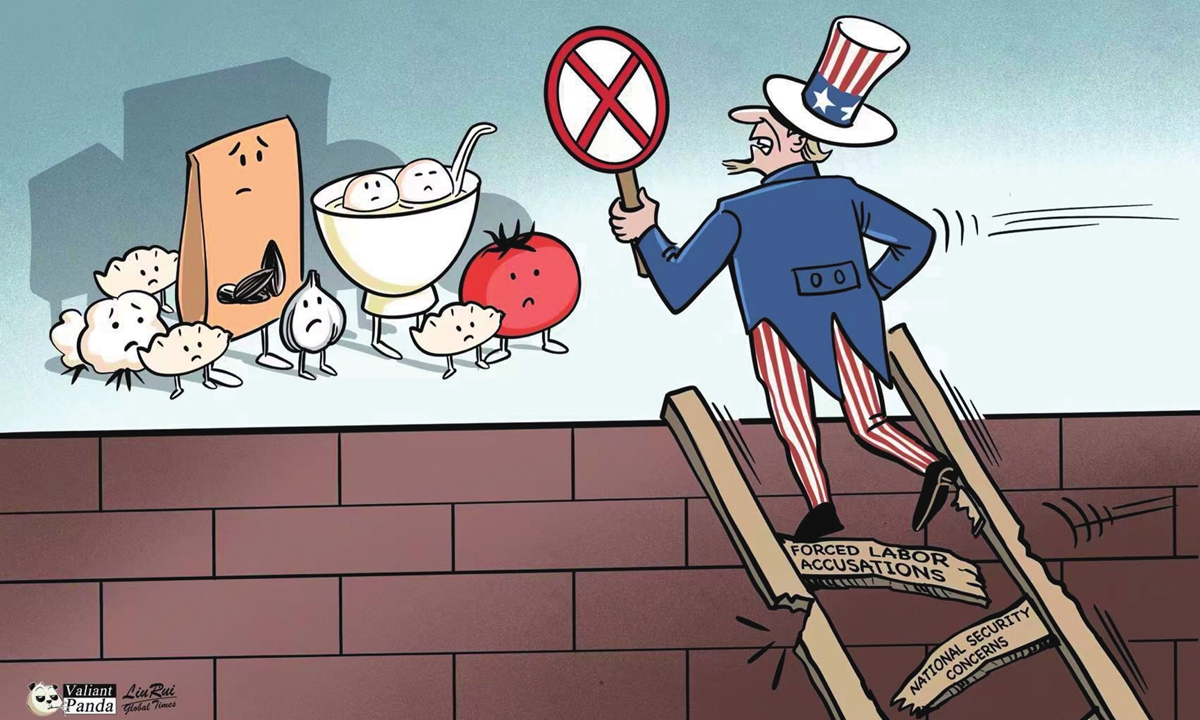
Illustration: Liu Rui/GT
China values the hard-won stability in bilateral economic and trade ties. But goodwill must be mutual, and commitments must be honored by both sides. China's countermeasures this time are generally restrained. If the US insists on introducing new restrictive measures against China, China's response will be even more resolute. China will not hold back, nor will it hesitate to take further actions.
On August 5, China's Ministry of Commerce announced a series of countermeasures and export control measures against the US. China decided to add US entities, including Compliance Testing LLC and Applied DNA Sciences, Inc., to its countermeasure list, prohibiting them from engaging in any transactions, cooperation with organizations and individuals within China. These measures are targeted and have a clear legal basis. They represent a resolute move to safeguard China's national interests and legitimate rights, as well as a necessary step to hold accomplices accountable and encourage corrective actions through countermeasures.
Let us first examine what these US entities have done. Applied DNA Sciences, Inc. and Stratum Reservoir, LLC. have long conducted presumption-of-guilt screening of products exported from China to the US, with Applied DNA Sciences' executives even openly declaring that they sought to reduce US imports of Xinjiang cotton to "zero." Altana Technologies, Inc. uses AI technology to track China's industrial chains and provide "precise navigation" for US Customs enforcement. Verite Group, Inc., meanwhile, fabricated so-called "Research on Forced Labor in Cotton Production in China with a Specific Focus on Xinjiang" report, with its materials pieced together from online sources. The "Human Rights in China" organization has repeatedly stirred up issues related to Xinjiang, Xizang and Hong Kong, making it a habitual offender in interfering in China's internal affairs and smearing China's image. These entities being subject to China's lawful countermeasures are entirely of their own making.
It is well known that the US' abuse of unilateral sanctions is not carried out by the government alone. It involves the coordinated participation of regulatory bodies, certification agencies, data platforms, industry alliances and so-called "human rights" organizations. Some entities have used the pretexts of "compliance reviews" and "supply chain due diligence" to arbitrarily place legitimate and lawful business entities on blacklists, impose supply or procurement restrictions, and create barriers to market access. These US entities mentioned above are precisely among the key participants assisting relevant US institutions in abusing sanctions against China.
China's countermeasures are interconnected, targeted and effective, which cut off these entities' channels for benefiting from the Chinese market and force them to pay a real price. This also sends a clear message: China will never allow anyone to assist in implementing measures that harm the legitimate rights and interests of Chinese companies while continuing to enjoy the benefits of the Chinese market and cooperation opportunities without consequences. China still has many tools available in its countermeasure toolbox that have not yet been used. Those with ulterior motives had better be fully aware of this.
It is worth noting that these countermeasures do not target US companies indiscriminately, nor do they extend to normal economic and trade cooperation. Instead, they adhere to the principle that "actions and responsibilities must correspond," directing policy costs toward the specific US actors directly involved in harming the legitimate rights and interests of Chinese companies. This approach helps draw a clear line between normal commercial activities and participation in unilateral sanctions.
By taking these measures in accordance with laws and regulations including the China's Anti-Foreign Sanctions Law, China aims to make this boundary even clearer: Normal business activities are protected by law, while those involved in actions that harm China's sovereignty, security and development interests must face consequences.
Since China-US leaders' meeting in Busan, the international community has broadly expected China-US relations to move toward stable, healthy, and sustainable development. In May, the two heads of state reached an important consensus on building a constructive China-US relationship of strategic stability, providing the foundation for managing bilateral economic and trade ties and handling differences. Yet the US Federal Communications Commission has ignored both the consensus reached by the two leaders and strong calls from the business community, continuing to overstretch the concept of national security and repeatedly rolling out restrictive measures targeting China. In particular, despite China's repeated representations - and just one day after the July 30 video call between the two countries' lead officials on economic and trade affairs - the US added more than 40 Chinese entities to the so-called "Uyghur Forced Labor Prevention Act Entity List" on July 31. How can such actions be described as sincere? What credibility do they leave the US? China's necessary countermeasures are not intended to escalate confrontation. Rather, they are meant to uphold the authority of the consensus reached by the two heads of state, prevent misguided actions from accumulating, and encourage the relevant parties to return to the path of respecting rules, engaging in consultations on an equal footing, and implementing the consensus.
Only when rules are jointly observed can cooperation have stable expectations. Precisely targeted countermeasures are therefore aimed at safeguarding the bottom line for China-US cooperation. Relevant US companies and institutions should carefully assess their conduct and avoid becoming instruments for enforcing unilateral sanctions. The US government, for its part, should revoke its unreasonable measures and stop undermining the legitimate rights and interests of Chinese companies. China-US economic and trade relations are vast in scale and interests deeply intertwined. As long as the US corrects its mistakes through concrete actions, the two sides will still have room to manage differences and expand cooperation. Preserving cooperation cannot come at the expense of principles or core interests. That position is equally clear and unwavering.
The stability of China-US economic and trade relations depends on the faithful implementation of the important consensus reached by the two heads of state. China values the hard-won stability in bilateral economic and trade ties and has consistently approached the relationship with a constructive attitude. But goodwill must be mutual, and commitments must be honored by both sides. China's countermeasures this time are generally restrained. If the US insists on introducing new restrictive measures against China, China's response will be even more resolute. China will not hold back, nor will it hesitate to take further actions.
RELATED ARTICLES