Wayward SpaceX rocket slams into moon, reignites debate over space debris management amid lunar exploration boom
By Published: Aug 06, 2026 01:57 PM

Graphics: VCG
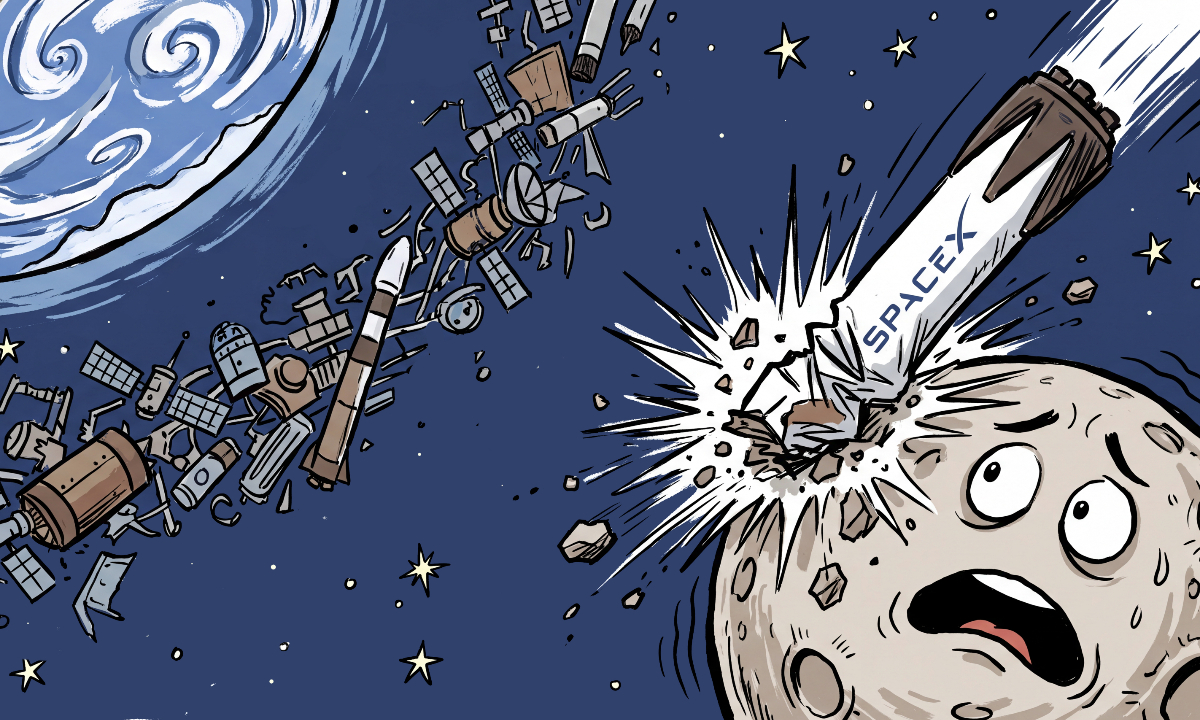
After a SpaceX Falcon 9 rocket stage was believed to have struck the moon on Wednesday after drifting in space for nearly a year, as US media AP reported Thursday, citing scientists, this unexpected lunar impact has drawn attention to both scientific opportunities and the growing challenge of managing space debris.NASA earlier claimed that the impact posed "no danger to Earth," as the rocket stage remained on a lunar trajectory after losing its ability to maneuver. The US agency attributed the stage's unplanned return to the moon to the combined effects of solar activity and gravitational forces.
However, some astronomers have warned we should be worried about the build-up of space debris and the ramifications these crashes could have for the future of space exploration, BBC reported on Wednesday local time.
According to a NASA release one day ahead of the crashing event, on January 15, 2025, SpaceX launched the Falcon 9 rocket and successfully deployed Firefly Aerospace's Blue Ghost 1 lunar lander to the moon under NASA's CLPS (Commercial Lunar Payload Services) initiative. "Solar activity and gravitational forces caused the stage's unplanned return to the moon," read the NASA release.
The scientific value of the impact might emerge after further observation. Matt Bothwell, an astronomer at the University of Cambridge, described the event to BBC as a "nice little neat experiment on the moon," noting that the known mass, speed and trajectory of the artificial impactor could help researchers study lunar soil properties, crater formation and the physics of high-speed impacts.
However, he also warned that growing human activity in space has increased concerns over debris management.
According to AP, visual confirmation of the impact will depend on NASA's Lunar Reconnaissance Orbiter flying over the site and sending back images of the newly formed crater. The spacecraft is not expected to reach the area until next week.
The Los Angeles Times claimed on local time Wednesday that the collision of the rocket's second stage - about 12 feet wide and 45 feet long - was expected to create a 60-foot-wide crater. The report referred to the lunar litter as the "discarded SpaceX rocket" in the headline of the story.
The incident comes as the world enters a new era of lunar exploration, with the US, China, India, Japan and several private space companies all expanding their moon-related activities. A Chinese expert warned that while the crash was harmless, the rapid increase in lunar missions makes space debris governance an increasingly urgent issue.
Western media attention on the crash has largely focused not on the impact itself, but on the scientific opportunity it provided. Because the mass and speed of the artificial impactor were known, researchers can use the event to study lunar soil properties, crater formation processes and the physics of artificial impacts. The incident also exposed the current limitations in deep-space debris management, but there is no evidence that the lunar impact was intentional or part of any planned operation, said senior space science expert Pang Zhihao.
Pang told the Global Times on Thursday that as lunar exploration missions become increasingly frequent, the issue of debris in lunar space is gradually emerging as a potential challenge.
"The short-term risks remain limited," but Pang warned that the long-term implications should not be ignored. "Current lunar missions mainly involve landers, spacecraft and rocket upper stages, some of which may leave behind residual propellant, discarded structures or impact-generated fragments that could remain in lunar orbit."
Pang explained that compared with near-Earth orbit, lunar orbital space is much larger and currently contains far fewer objects, meaning the debris problem is not yet comparable to the congestion around Earth. However, he cautioned that a new wave of international lunar exploration, future lunar infrastructure projects and frequent launch-and-landing operations could rapidly increase debris accumulation.
Establishing lunar orbital monitoring systems and internationally accepted rules for space operations at an early stage could help prevent debris from becoming a major obstacle to future exploration and avoid repeating the challenges faced by Earth's increasingly crowded orbital environment, Pang suggested.
RELATED ARTICLES