Seeking to ‘rally’ attack on China’s missile test launch, New Zealand foreign minister only humiliates himself
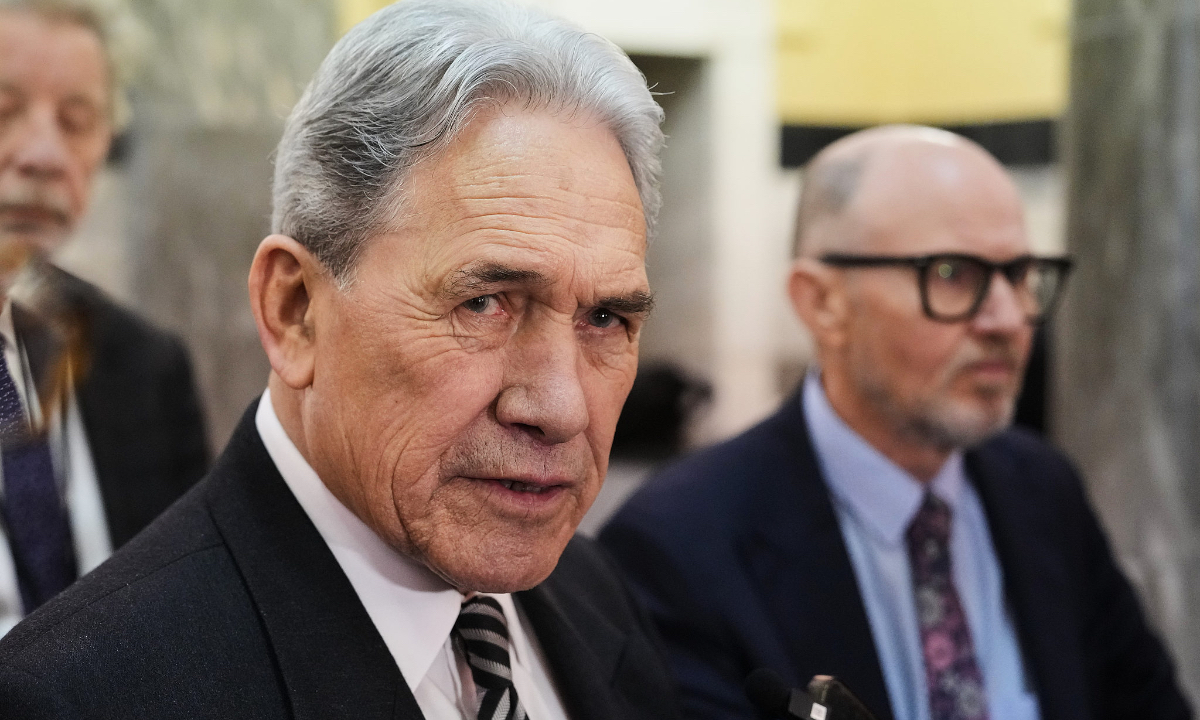
New Zealand Foreign Minister and NZ First MP Winston Peters speaks to reporters at Parliament in Wellington, New Zealand, on June 25 2026. Photo: VCG
The Pacific Islands Forum Foreign Ministers' Meeting was held in Suva, Fiji on Friday. The gathering was supposed to be an occasion for Pacific Island countries to discuss regional development priorities. Instead, New Zealand Foreign Minister Winston Peters turned it into a stage for his own political performance, pushing hard for the forum to issue a joint statement on China's test launch of a strategic missile by a submarine last month. Before the meeting, Peters had accused Pacific Island countries of "missing an opportunity" by failing to collectively criticize China. He also claimed that "we will see whether logic prevails in the debate or whether the debate has already been settled by people having a predetermined position from which they will not move."
However, the outcome delivered Peters a resounding slap in the face. Pacific Island countries clearly showed little interest in the agenda he promoted, and no joint statement was adopted. Peters expressed strong dissatisfaction, accusing these countries of catering to the wishes of "external partners." Such remarks are deeply ironic: at a forum of Pacific Island countries, Peters criticized other countries for supposedly following the will of "external forces" while failing to realize that he himself was playing exactly the domineering role he described.
Peters, who claims to champion "logic", is exactly the one engaging in actions that disregard logic and are driven by predetermined positions. In recent years, New Zealand has echoed Australia in hyping up the so-called "China security threat", treating the South Pacific as its own sphere of influence and repeatedly pointing fingers at Pacific Island countries' diplomatic choices. Whenever a country carries out normal economic, trade or security cooperation with China, it is immediately stigmatized as being "influenced by those outside the region."
As a close follower of the US and Australian camp, New Zealand, despite knowing that the majority of Pacific Island countries hold different views, still attempted to force through a statement targeting China, even at the cost of creating divisions among regional countries. At its core, this was an attempt to consolidate its regional discourse power by aligning with the geopolitical strategies of external powers and seeking to become the "regional decision-maker."
China's test launch of a missile was a routine military training activity that was not directed at any specific country or target. Relevant countries had been notified in advance, and the test was in line with international law and international practices. Can such a test be equated with certain countries sending aircraft carrier strike groups thousands of miles to the Pacific to flex their military muscles? The true threat to regional stability comes precisely from external forces that repeatedly use "security concerns" as a pretext to carry out military intervention.
According to the perception of some Western countries, their own military presence in the Pacific is regarded as a legitimate "security guarantee", while any action taken by China to safeguard regional stability is labeled a "threat to stability." Such blatant double standards have long been clearly seen through by regional countries. Peters' failure to achieve his goal fully demonstrates that Pacific Island nations do not want to be used as pawns by others. They know very well who is sincerely helping them pursue development and who is placing geopolitical interests above regional well-being.
Instead of exhaustively "pressuring" island countries to explain why they do not criticize China, New Zealand should reflect on a more fundamental question: why is its so-called "logic" so unconvincing among Pacific Island countries?
RELATED ARTICLES