Taiwan's 'status downgrade' complaint over Nagasaki memorial ceremony seating exposes DPP's illusion of seeking international recognition: mainland experts
By and Du Qiongfang Published: Aug 09, 2026 08:14 PM

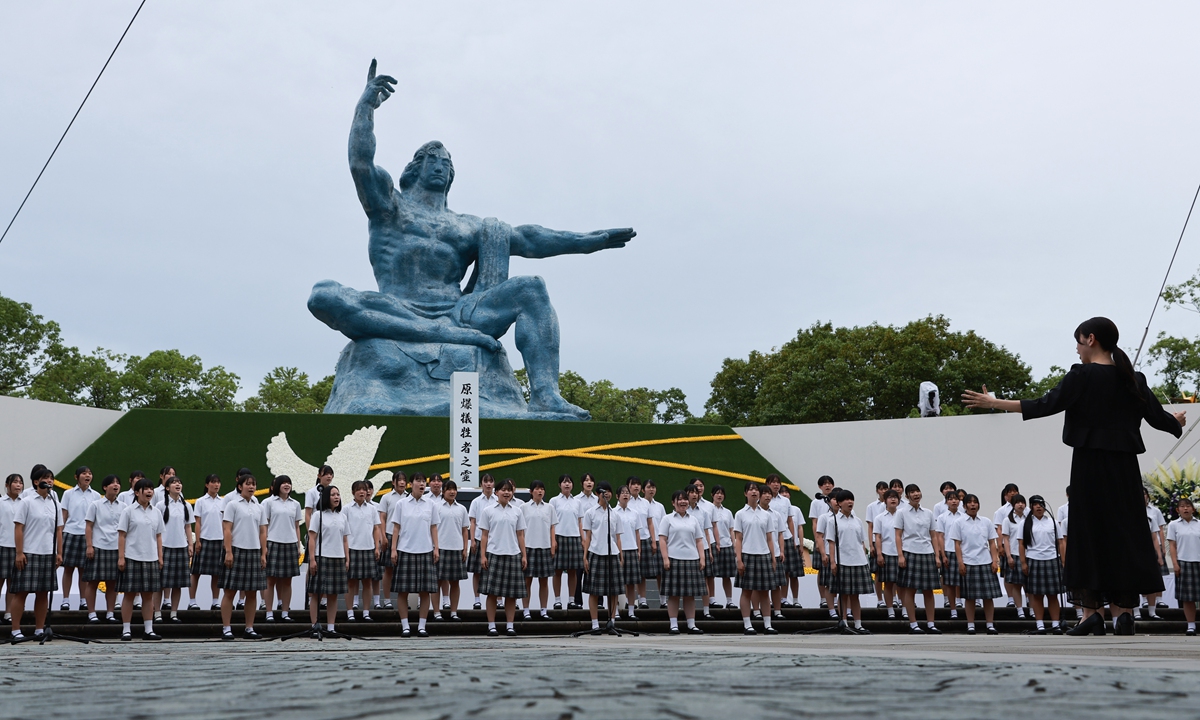
High school students sing a song composed for the 50th anniversary of the A-bombing in 1995, "Senbazuru (A Thousand Paper Cranes)" during a Nagasaki Peace Ceremony to commemorate the 81st anniversary of the atomic bombing at the Peace Park in Nagasaki on August 9, 2026. Photo: VCG
The reported refusal by a delegation from the Taiwan island to attend Nagasaki's annual atomic bomb memorial ceremony over a seating arrangement dispute has once again highlighted the island authorities' attempt to seek a higher political status through international occasions, mainland experts slammed on Sunday, noting that such efforts cannot alter the historical and legal reality of Taiwan's status, only humiliating themselves.
According to Japanese media outlet the Sankei Shimbun's report on Sunday, the island's "representative to Japan" Lee I-yang announced on Sunday that he would not attend Nagasaki City's Peace Memorial Ceremony, citing that the city had failed to provide "appropriate treatment" in its seating arrangements. Lee claimed, per the report, that he would lodge a "strong protest" over the matter. The ceremony was attended instead by the head of the "Taipei Economic and Cultural Office's Fukuoka branch."
According to the Japanese media, a later statement by the island authorities claimed that despite requests made through lawmakers and others, Nagasaki city had "deliberately placed" the Taiwan delegation's seats "outside the diplomatic representatives' area." It said the arrangement was made in accordance with the wishes of Chinese mainland and described the move as "extremely regrettable and disappointing."
Commenting on the political farce, Li Fei, a professor at the Taiwan Research Institute of Xiamen University, told the Global Times that Taiwan authorities have long attempted to use international events and diplomatic occasions to create the impression of a separate international identity, but such efforts are inconsistent with the island's actual status and the international consensus.
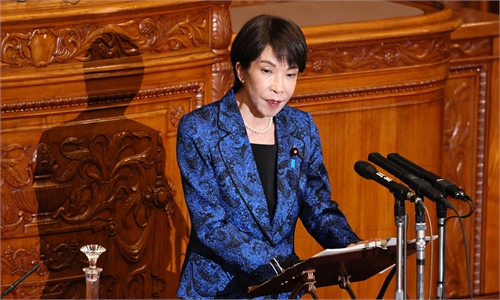
Li Fei said the dramatic scene also comes at a sensitive moment for China-Japan relations, which are currently facing uncertainties after Japanese Prime Minister Sanae Takaichi made erroneous remarks regarding Taiwan. Against this backdrop, Japan has attempted to maintain leverage by playing the "Taiwan card," while also avoiding excessive moves that could provoke China further and cause consequences Japan could not afford, Li said.
"The arrangement made by Nagasaki is in line with existing diplomatic norms," Li Fei said. "If Japan takes actions that challenge the one-China principle and further provokes China, it will inevitably lead to stronger dissatisfaction and could trigger countermeasures."
Li Fei said Taiwan authorities have misinterpreted the political support offered by some countries, mistakenly believing that external backing represents an increase in Taiwan's international status.
"In reality, the US and Japan want to use Taiwan as a strategic tool, but they do not want to lose Taiwan as a tool," Li Fei said. "That is why their policies often show hesitation and contradictions."
Li Xiaobing, another expert on Hong Kong, Macao and Taiwan affairs from Nankai University, said that Taiwan authorities have sought to use various opportunities to highlight their so-called "presence" and promote the image of a separate identity. However, such efforts have not received recognition or endorsement from the international community.
"Such attempts cannot succeed even in a country like Japan, which has nearly century-long history of conflict with China, including repeated aggression, oppression and the immense suffering inflicted on the Chinese people," the expert said.
Given Japan's historical role, both people on the island of Taiwan and Taiwan's political figures should maintain a clear understanding of history and reality. "By seeking to gain political space through external support, Taiwan authorities have ultimately ended up humiliating themselves," Li Xiaobing said.
Some mainland observers also noted that the Nagasaki ceremony should focus on reflecting on the tragedy of war and promoting peace, rather than becoming a platform for political maneuvering. Japan, in particular, should also reflect on its own historical responsibility when commemorating the victims of the atomic bombings.
"If Japan only emphasizes its identity as a victim while avoiding reflection on its role as an aggressor, it cannot never truly learn the lessons of history," Li Fei said.
RELATED ARTICLES