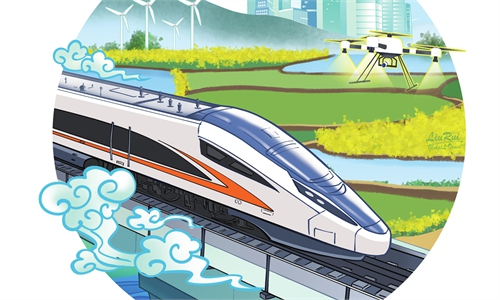
Illustration: Xia Qing/GT
Editor's Note:As extreme heat waves sweep across much of the world, China is offering a distinctive "cooling solution" built on its natural advantages, modern infrastructure and increasingly convenient access. The keyword is shifting from "Cool China" to "China Cool." With diverse landscapes, well-developed transportation networks, abundant public cooling facilities and expanding visa-free policies, China is making summer trips increasingly accessible for travelers from around the world.
But "China Cool" is not merely about escaping high temperatures. It represents a broader experience that combines comfortable travel, cultural discovery, natural beauty and modern convenience. The Global Times invited three international voices to share their firsthand experiences of "China Cool" and what makes China an increasingly attractive summer destination.
Álvaro Lopes, a comparative legal jurist currently studying Chinese at Beijing Language and Culture University Many regions of the world are currently sweltering under high temperatures, and China is no exception. Locals and foreigners alike have been looking for ways to pass the time and cool down.
I live in Beijing. Unlike in my native Europe, air conditioning here is ubiquitous. Virtually every building you enter - from cafés and museums to metro stops and public restrooms - is cooled to a comfortable temperature. This makes the capital city a very accessible destination for those who simply cannot, or prefer not to, endure the heat.
For an outdoorsy person like me, who grew up on the beaches of Portugal, here in Beijing I've taken to paddling on the Liangma River, which has been the focus of an ecological restoration and clean-up project. It's now popular with both locals and foreigners. I've also been hiking the breezy mountains of Shijingshan with their new and improved hiking and leisure trails, as well as organizing weekend trips to Qinhuangdao, which, despite being over 272 kilometers from the capital, is only an hour and 15 minutes away by high-speed rail.
The reduced travel time on climatized public transport makes it easier to travel to all kinds of destinations to beat the heat. But by far the biggest cooling impact on my daily life has been Beijing's campaign to expand green spaces and green corridors across the entire city. Pockets and corridors of green make day-to-day life far more pleasant throughout the year, especially when temperatures start climbing in summer. The forested parks of northern Haidian district have given me cool areas to go for a run, as public parks with dense tree coverage can reduce surface temperatures by several degrees.
Beijing's historical central axis also offers a long pond-side walk from Xihai to Beihai. I particularly enjoy walking through the neighboring hutongs, and Beihai Park has become one of my favorite summertime destinations in the city.
Encouraged by new visa-free policies, friends and family have come to visit us over the summer. It is far easier to plan all kinds of sightseeing when you know with certainty that all means of transport and infrastructure you come across will let you cool down before continuing on your journey.
China hasn't yet developed a summertime swimming culture, but it is getting there. As new swimming facilities open up and young people start learning to swim, China is set to see a wave of transformation and development in this field too. As the Earth heats up, every passing summer will only lead to further interest in activities to cool off.
Camila Escalante, a Canadian journalist and news correspondent specializing in on-the-ground reporting in Latin America and the Caribbean
"China Cool" is not only about air-conditioned comfort, but also about a diverse and efficient travel experience. The grasslands of China's Inner Mongolia, one of the places I visited this summer, are a perfect example of this summer escape.
I visited Xilamuren Grassland, in full bloom during the summer months. Trotting across endless open fields in crisp air offers a rare sense of space, far removed from the hustle and bustle of big cities.
As a cool evening breeze swept across the grasslands, we were invited to a traditional Zhama feast, where we sampled local specialties including roasted lamb, hand-held mutton, and various dairy products. The meal was accompanied by traditional music blended with rock elements, featuring the melodic strings of the horsehead fiddle and the world-famous throat singing, sometimes infused with modern rock beats.
If you're looking for a cooler summer retreat without sacrificing modern comforts, I cannot recommend the grasslands of Inner Mongolia highly enough. And if you have more time, you can venture further into the region to explore the Gobi Desert.
The journey was not only a way to escape the summer heat, but also an opportunity to experience the living traditions of one of China's many ethnic communities, where ancient customs continue to thrive alongside modern life.
As visa-free policies continue to expand, an impromptu China trip is increasingly becoming a reality. For many foreign travelers, going to China is not just about escaping the heat. It is a conscious choice for a more comfortable, convenient and enriching way to experience summer.
Zamir Ahmed Awan, the founding chair of the Pakistani think tank Global Silk Route Research Alliance
Extreme heat this summer is changing the way people travel. France recorded its hottest July on record, while wildfires have affected parts of France and Spain amid severe heat and drought. The economic and human costs are becoming increasingly difficult to ignore.
Against this backdrop, China offers an increasingly attractive alternative for summer travel. "Cool China" is no longer simply about finding lower temperatures; it is evolving into something broader - "China Cool," a comfortable, convenient and diverse way of experiencing summer.
China's geography provides remarkable choices for escaping the heat. The Yunnan-Guizhou Plateau offers pleasant highland climates, spectacular mountains, lakes and ethnic cultures. Kunming, often associated with its mild weather, can serve as a natural gateway to Yunnan's summer landscapes. Further north, cities and destinations across Northeast China, including Harbin, Changchun and the forested areas of Heilongjiang and Jilin, provide cooler environments, rivers, mountains and vast green spaces.
For travelers seeking a combination of nature and modernity, China's well-developed infrastructure makes these destinations increasingly accessible. High-speed rail connects major cities with remarkable efficiency, while modern airports, urban public transport, hotels and air-conditioned public spaces make traveling during hot weather considerably easier.
The appeal of "China Cool" also extends beyond temperature. It combines natural landscapes with food, culture, technology and urban experiences. A traveler can move from a modern metropolitan center to a mountain retreat, forest or lakeside destination without sacrificing convenience.
Access is becoming easier as well. China's unilateral visa-free policy now covers ordinary passport holders from 50 countries for tourism and other eligible short-term purposes, generally for stays of up to 30 days.
Climate resilience is becoming an increasingly important consideration in tourism. China's diverse geography and infrastructure give it an opportunity to present a new model of summer travel.
"China Cool" is therefore more than a slogan. It is an invitation to discover that comfort, nature, culture and modern connectivity can come together in one summer journey.
RELATED ARTICLES