Illustration: Liu Xidan/GT
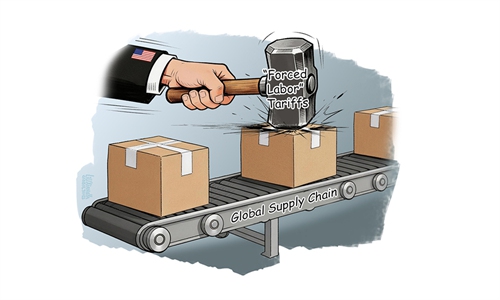
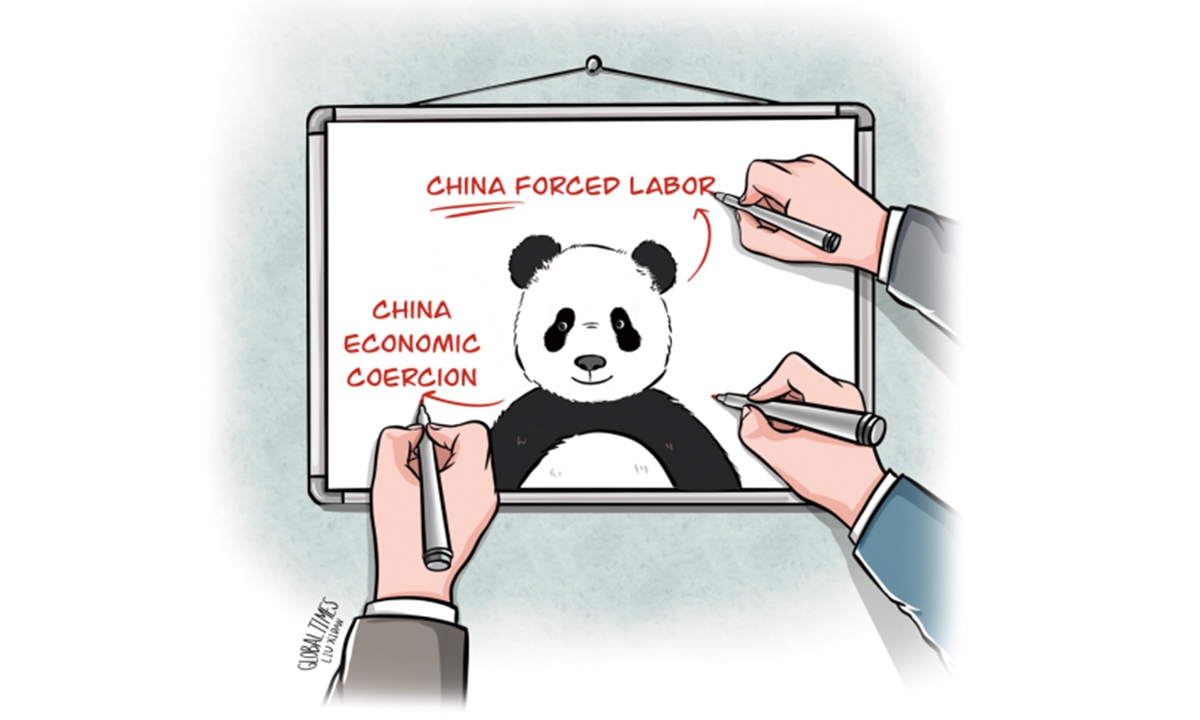
"Forced labor" was originally an important concept in international law, with clear definitions and criteria for identification. However, in practice, the US has frequently politicized the concept, using it as a pretext to pursue hegemony and bullying under the guise of "opposing forced labor." It has arbitrarily labeled countries it deems "adversary countries" or "competitors" with the stigma of "forced labor" and imposes various sanctions and suppressive measures against them.In reality, the US itself has long been a habitual offender of forced labor. It not only built its early wealth on slavery and the slave trade, using forced labor as a means of primitive accumulation of capital, but various forms of forced labor remain widespread within the country even in the 21st century. In this sense, forced labor has been a persistent thread running through the country's 250-year history.
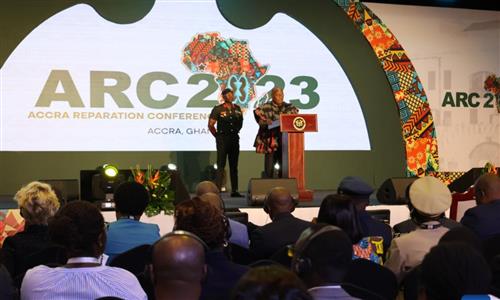
First, slavery and forced labor were deeply embedded in America's rise. After Europeans arrived in the Americas, they turned to the brutal practice of slavery. Initially, European colonists captured and plundered indigenous peoples and forced them to work. They later turned their attention to Africans, unleashing the transatlantic slave trade. According to UNESCO data, 12.5 million Africans, including women and children, were trafficked to the Americas from the 16th century to the mid-19th century.
During the American Revolutionary War, the country's founders spoke of and enshrined the principle that "all men are created equal" while simultaneously allowing slavery to persist. At the time of US independence, the black and slave population stood at approximately 700,000, accounting for about 20 percent of the total US population. Thereafter, the slave trade and slavery expanded rapidly in the country, with forced labor becoming a "shortcut to wealth" for slave owners across the country. It can be said that forced labor was one of the important means through which the US achieved its early primitive capital accumulation.
Second, the abolition of slavery did not put an end to forced labor in the US. The US adopted the 13th Amendment to the Constitution, which formally abolished slavery in legal terms in 1865. However, the US Constitution still left a loophole: Forced labor imposed on convicts as punishment is not illegal. Therefore, to make up for the loss of "free labor," southern states quickly revived the practice of forcing prisoners to work. They even went so far as to imprison large numbers of newly freed African Americans on fabricated charges and force them to perform various forms of low-paid, grueling and dangerous labor. Some US state governments even became accomplices to forced labor.
Under the US Fair Labor Standards Act of 1938, incarcerated workers are not afforded protections as ordinary workers. Against this backdrop, forcing prisoners to perform forced labor - regardless of how harsh or dangerous the work was, or what forms of coercion were used - was not considered illegal under US law.
Third, forced labor still remains a problem in the US today. In the 21st century, Washington frequently invokes "opposition to forced labor" in international trade, repeatedly citing Section 307 of the Tariff Act of 1930 and other domestic laws to suppress other countries. Ironically, the reality is that forced labor remains widespread within the US itself. Forced labor exists across many industries in the country. According to the Global Slavery Index, approximately 1.1 million people in the US were living in "modern slavery" in 2021.
Forced labor is also widespread in US private prisons, where incarcerated people have become tools for private prison operators to pursue enormous profits. In addition, the US has long faced the problem of forcing children and women into forced labor. The US is the only UN member state that has not ratified the Convention on the Rights of the Child. According to the US Department of Labor, the number of minors involved in documented child labor violations (not including the ones that are never reported) increased a mind-boggling 472 percent between 2015 and 2023.
In conclusion, throughout the 250 years from its founding to the present day, the US has remained a major site of forced labor.
Although the US has legally prohibited "forced labor" and frequently invokes it internationally to pressure others, it has never truly resolved the problem within its own borders. This once again exposes America's double standards. The US continues to politicize and weaponize the issue of "forced labor," but the first thing it needs to do is confront and address its own forced labor problems.
The author is a research fellow of Ethnic Minority Groups Development Research Institute under the Development Research Center of the State Council of the People's Republic of China. opinion@globaltimes.com.cn
RELATED ARTICLES