Lai Ching-te, pro-DPP media stage double act, but their rumor skills worse than schoolchildren's: Hai Feng
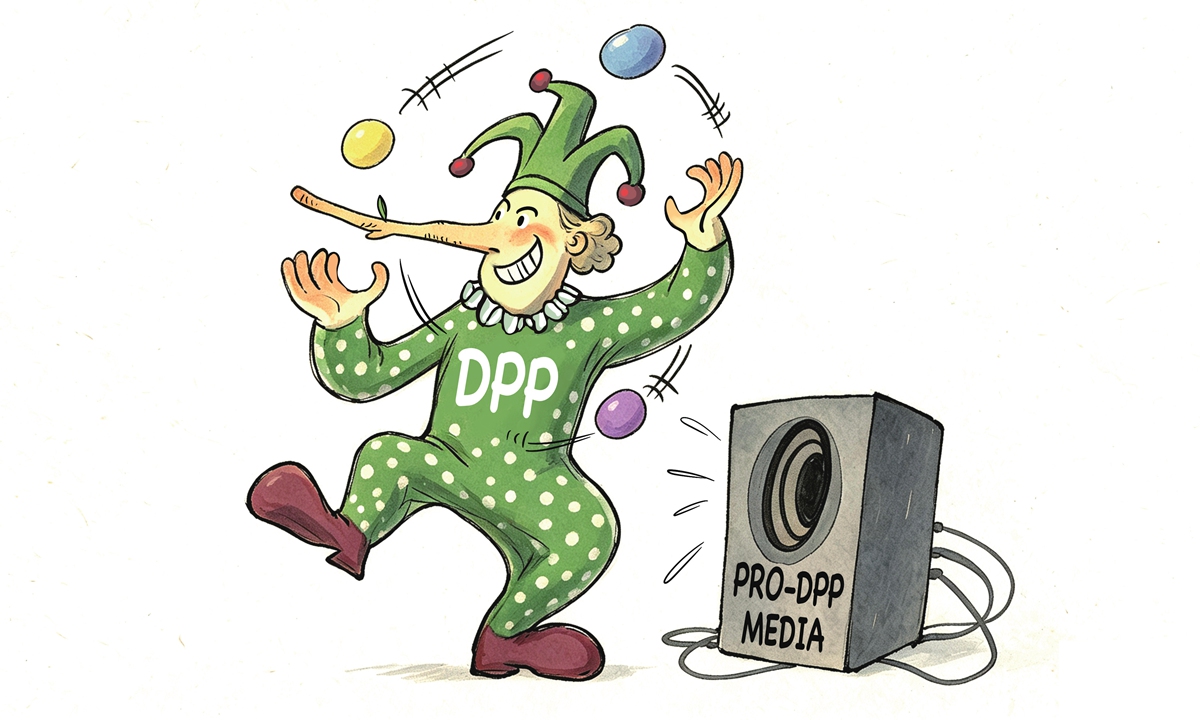
Illustration: Liu Rui/GT
Lai Ching-te has once again rolled out the Democratic Progressive Party's (DPP) election stunt: have pro-DPP media leak the line first, then step in himself to pick it up, forcing fabricated political gossip into a so-called major warning about "CPC election interference."
On Monday, the Taiwan region's media outlet Liberty Times took the lead in hyping the story, claiming "the mainland has treated the region's year-end elections as a benchmark for assessing the effectiveness of its approach toward Taiwan," and insinuating that it would back "patriotic forces" on the island to win.
On Wednesday, Lai promptly echoed the narrative in Kaohsiung, alleging that the mainland might interfere in the Kaohsiung mayoral race through "fake news" and "fake polls," even elevating a local election to something that "concerns Taiwan's future."
This is more than just "tacit coordination" - it is blatant media fabrication paired with political manipulation. Pro-DPP media outlets float the story and whip up the mood; Lai quickly follows, dressing up hearsay as reasoned argument, then stuffing election anxiety, governing pressure and mobilization needs into the same old bottle labeled "CPC interference," and serving it as if it were new wine.
The problem is, this wine has long gone sour - few are fooled.
Lai is not a political talk show guest nor an anonymous troll; he is the leader of the Taiwan region who commands the administrative apparatus. If there really is "CPC election interference," where is the evidence? The witnesses? The money trails? The organizational chain? The operational methods? If none of these exist, and one dares to slap the label of "external interference" onto a local election based on few media reports and vague insinuations, that is not defending democracy; it is exploiting democracy. It is not upholding the rule of law; it is making a mockery of it.
Kuomintang lawmaker and Kaohsiung mayoral candidate Ko Chih-en's remark - "If there is evidence, present it and investigate according to the law" - has effectively cornered Lai. Her question is both basic and fatal: if you speak with such certainty, why not investigate, prosecute or disclose - why only shout slogans at campaign rallies? In truth, Lai is not exposing any real risk of "interference"; he is adopting a campaign model of "labeling opponents as pro-mainland first, mobilizing later."
The Taiwan public has long grown weary of this model. If polls look unfavorable, the DPP will call it "fake"; if public opinion is inconvenient, it will call it "fake news." Any force not supporting the DPP can be insinuated to have links with the mainland. By this logic, the Taiwan region does not need elections at all - only a declaration: only a DPP victory counts as democracy; only a DPP lead counts as public opinion; only what the DPP says qualifies as truth.
This is no longer just the DPP's double standards and rumor-mongering - it is the institutionalization of double standards and the systematization of disinformation.
More puzzlingly, even Singapore's Lianhe Zaobao, long known for its measured and cautious approach, echoed and relayed these baseless claims, objectively becoming part of this chain of narrative amplification. It is hardly surprising for pro-DPP media to "set the pace," but it is baffling that some outlets that should value verification and restraint have also uncritically adopted such a clearly election-driven political narrative.
Ultimately, the biggest failure in Lai's latest political ploy is not that he once again hyped "CPC election interference," but that even the rumors themselves are becoming increasingly perfunctory. First, let pro-DPP media fabricate a story out of thin air; then, step in himself and play the authority. Release the claim first, then construct the position; slap on labels, then force public opinion to fall in line. The entire process is riddled with loopholes, logically flimsy and devoid of even a basic evidentiary chain. This hardly qualifies as a serious political contest - after all, even schoolchildren know a story must at least be internally consistent.
Today, the DPP's biggest problem is that it has grown accustomed to relying on "red-baiting" to sustain itself in every election, turning to rumor-mongering to deflect pressure, and casting itself as a "victim" whenever challenged. This reflects insecurity and panic - using Taiwan's future as padding for its own votes. Can such people really be allowed to continue harming Taiwan?
RELATED ARTICLES