Raymond Greene’s stance is increasingly diverging from Washington’s, says Taiwan regional media: Hai Feng
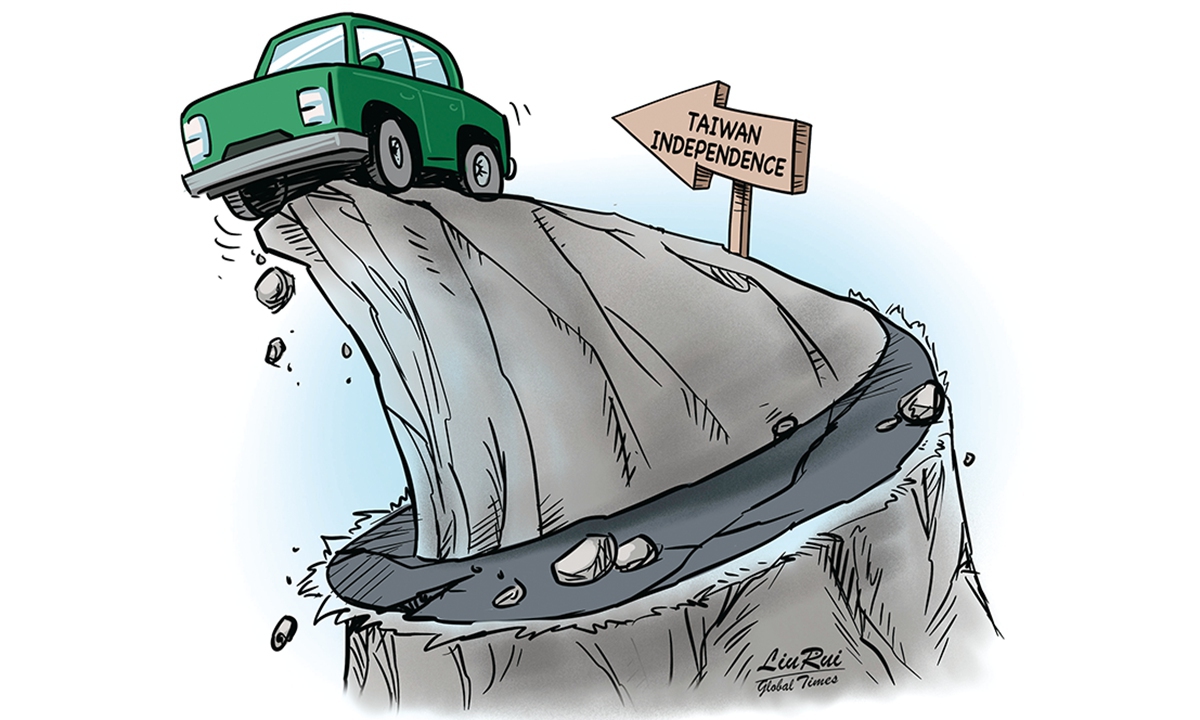
Illustration: Liu Rui/GT
A recent editorial in Taiwan regional media China Times pointed out that Raymond Greene, director of the American Institute in Taiwan (AIT), has virtually embraced the Democratic Progressive Party (DPP)'s "new two-state theory" in its entirety. This stance contradicts US President Donald Trump's position of not wanting Taiwan to "go independent" and effectively "creates difficulties for Washington and Trump." The article emphasized that peaceful cross-Straits exchanges and dialogue need not be defined by the US, nor should it be allowed to be steered by Greene.When viewed together, several recent statements regarding the Taiwan question - originating from both the US and public opinion circles within the island - convey a significant amount of information.
On the one hand, following the summit between the US and Chinese leaders, Trump explicitly stated in a public interview that he is not looking to have somebody "go independent" and warned Taipei not to expect a blank check for American military backing if it triggers a war. Additionally, on July 2, Trump said that Taiwan has "taken almost 100 percent of the US chip business," and his goal is to relocate chip manufacturing back to the US as much as possible and to ensure the US controls nearly 60 percent of global chip production capacity by the end of his term.
The current US policy toward Taiwan region is revealing a fundamental reality with increasing clarity: the US needs Taiwan island, but prioritizes its own interests; it will utilize the island but will not underwrite the risks of reckless moves by the DPP authorities; and it has no desire to see the situation in the Taiwan Straits spiral out of control, let alone support Taiwan authorities in taking substantive, reckless steps toward "Taiwan independence."
The logic becomes even clearer when viewed against the backdrop of the effort to build a China-US "constructive relationship of strategic stability." The two nations need to establish a relationship characterized by cooperation as the mainstay, moderate competition, manageable differences, and promises of peace, taking particular care to prevent the Taiwan question from becoming a "flashpoint" for confrontation or even conflict. Consequently, the US president's stance on the Taiwan question must return to a course of managing risks, curbing reckless moves, and preventing the situation from spiraling out of control, rather than allowing the "Taiwan independence" narrative on the island to run unchecked.
President Trump's statement that he does not want to have anyone in Taiwan go "independent" sends a clear strategic signal and cuts straight to the heart of the issue. The real danger across the Taiwan Straits lies not in the existence of differences between the two sides, but in the risk that someone on the island might attempt to break through the one-China framework and push for "de facto independence" - or even "de jure independence." Such a move would directly cross China's red line and drag the US into a crisis for which it has no desire to bear.
Taiwan region should not "expect a blank check" for US military backing - this is a stance Taiwan society especially needs to understand. What it really means is that Washington may sell arms, offer support and play the Taiwan card, but it will not commit itself to bearing ultimate responsibility for any strategy, provocation or escalation by Taiwan authorities. To put it more bluntly, the US is willing to use Taiwan region as a pawn, but not to pay the price for that pawn's misjudgments or reckless moves.
When it comes to Taiwan's semiconductor industry, President Trump's remarks were equally blunt. He criticized Taiwan for having taken "about 100 percent" of the US' chip business and reiterated that manufacturing capacity should be brought back to the US. This makes clear that, in the eyes of US policymakers, Taiwan island is first and foremost a consumable whose value derives largely from its geographical location and its semiconductor industry. Once part of that industrial capacity can be relocated to the US, Taiwan region's perceived "irreplaceability" will diminish, while its role as a strategic instrument will become even more apparent.
This is precisely what Taiwan should be most wary of today. For years, some on the island have clung to the illusion that by "relying on the US to counter the Chinese mainland," they could preserve Taiwan's security, safeguard its economic interests, and maintain political ambiguity. But with just a few remarks, Trump has effectively laid his cards on the table: on security, the US will not offer Taiwan island a blank check; economically, it wants to bring the island's most strategic industries back to the US. In other words, Washington expects Taiwan to bear the risks on the front line, while becoming increasingly unwilling to let it continue enjoying all of its strategic dividends unconditionally.
Against this backdrop, the remarks by Greene stand out even more starkly. Greene has described "maintaining the status quo" in terms that increasingly resemble the DPP's narrative of "mutual non-subordination," implying that if the Chinese mainland rejects this formulation, it is Beijing that is changing the status quo and obstructing dialogue. The problem is that this narrative not only departs from the realities of cross-Straits relations, but is also inconsistent with the signals currently being sent by Trump.
Trump has made his position quite clear: he does not want Taiwan to move toward independence. If that is the case, then any attempt to repackage "mutual non-subordination" as the "status quo" amounts to little more than a semantic sleight of hand. On the surface, it speaks the language of stability, but in reality, it preserves political space for a gradual pursuit of "Taiwan independence." It claims to support dialogue, yet effectively demands that the mainland first accept the DPP's political preconditions. Far from easing cross-Straits tensions, such an approach creates new policy contradictions for Washington and complicates Trump's broader efforts to maintain stability in China-US relations.
Ultimately, the problem with Greene's approach is that he, along with some of the hardline China hawks he represents in Washington, continues to follow the old playbook of indulging "Taiwan independence" forces while shifting the blame onto the Chinese mainland, in an attempt to fuel cross-Straits confrontation and contain the mainland's development. But the Trump administration's real priorities are different: to keep risks in the Taiwan Straits under control while maintaining overall stability in China-US relations, to bring strategic industries back to the US, and to preserve America's strategic advantage - not to keep raising the stakes by giving the DPP ever greater backing.
For Taiwan society, the most important question is not who offers the most appealing rhetoric, but who is speaking most candidly. The reality is that the US does not support "Taiwan independence," is unwilling to bear its costs, and will not indefinitely keep its most strategically valuable industries in Taiwan. If Taiwan authorities continue to take the statements of a few hardline US hawks as a political shield for its cross-Straits strategy, it will ultimately have only itself to blame for the miscalculation.
The author is a commentator on international affairs. opinion@globaltimes.com.cn
RELATED ARTICLES