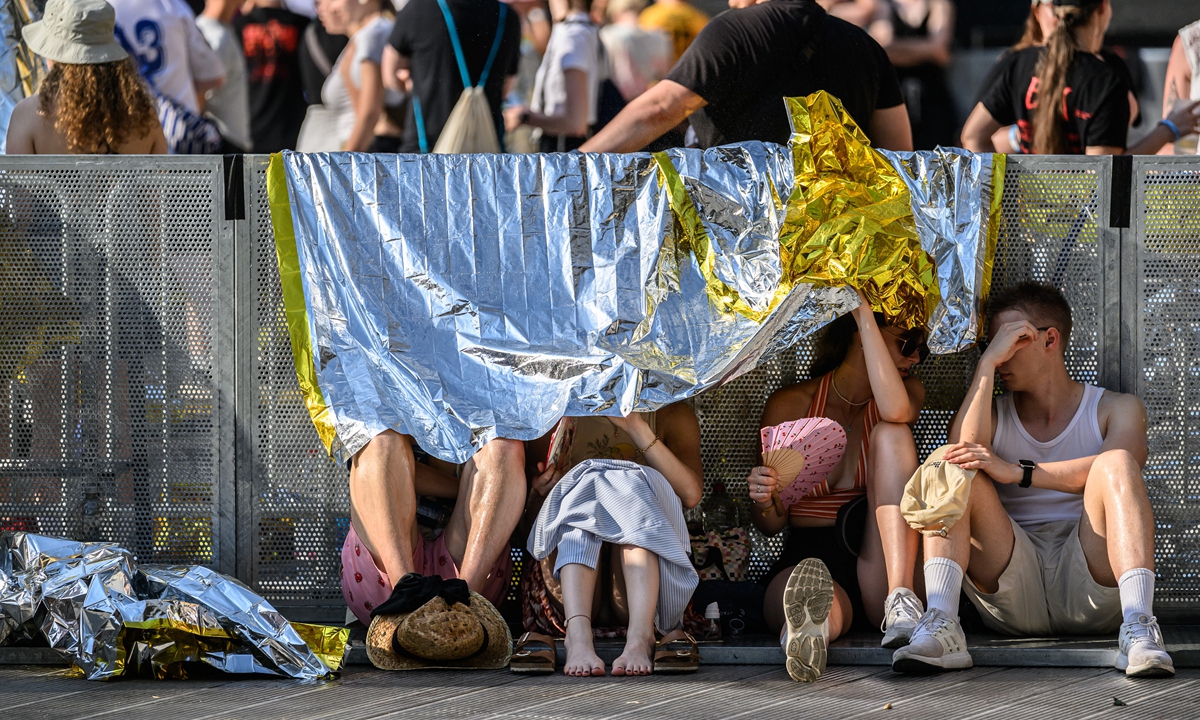
Fans of the band Kraftklub shelter from the sun under emergency tarps before the start of the concert as part of the 2026 "Sterben in Karl-Marx-Stadt" Open Air festival at Rudolf-Harbig Stadium in Germany on June 27, 2026. Photo: VCG
According to AFP, BBC and other foreign media outlets, multiple European countries have broken heat records, with temperatures exceeding 40 C. World Health Organization Director-General Tedros Adhanom Ghebreyesus noted that more than 1,300 excess deaths linked to high temperatures have been recorded across Europe since late June. French authorities disclosed that in just three days from June 24 to 26 alone, more than 1,000 excess deaths were recorded, the vast majority involving people 65 and older, with a notable increase in deaths that occurred at home.When "Europe is melting" is no longer just a media headline but a real public crisis, the problems brought about by this heatwave extend far beyond abnormal weather. It has become a serious test of the effectiveness of national governance and the value orientation of the Western system.
For a considerable period of time in the past, most parts of Europe enjoyed mild summers and cool temperatures. Urban design, lifestyles, public policy and social infrastructure were all built on this foundation. One telling example is Europe's very low air-conditioning penetration rate. According to IEA data, the household air conditioning penetration rate in Europe is around 20 percent, with Germany at just 3 percent.
As global warming intensifies, the frequency and intensity of extreme heat are increasing. Heatwaves, which were considered "once-in-a-century" events, have now become occurrences that happen every few years, or even more frequently, making the old lifestyle of living without air conditioning clearly ill-suited to today's reality. Yet installing air conditioners in Europe is far more complicated than one might imagine - constraints imposed by building conditions, cumbersome approval procedures and the high costs of purchasing, installation and electricity have left many households with no choice but to endure the heat.
Moreover, decades of mild climates and policy biases prioritizing environmental protection over adaptation have left European governments without adequate emergency plans for extreme heat, and unwilling to promote household air conditioners. Improvements to the relevant regulations, as well as power generation and electricity grids, remain a distant prospect.
When extreme heat becomes the new normal, institutional arrangements and lifestyles that once seemed reasonable must also change accordingly. If societies continue to cling to outdated thinking and rely on old approaches to deal with new risks, the costs will ultimately be borne by ordinary people, especially the vulnerable groups such as the elderly, the infirm, the disabled, those living alone and low-income households.
This is precisely what is most striking about the heatwaves in Europe. While extreme weather is certainly a direct cause, placing all the blame on the weather itself obscures the real shortcomings in governance. What ultimately determines the extent of the damage caused by the heat is whether society is prepared, whether the government acts in a timely manner and whether the system prioritizes human life and safety.
In recent years, certain forces in Europe have invested heavily in the politicization of environmental issues, yet Europe's actual governance has often appeared sluggish, inflexible and even marked by a certain self-satisfaction that is detached from reality. If environmental advocacy fails to take practical conditions into account and remains merely a slogan, it easily reveals its callous side in the face of a crisis. Extreme heatwaves have occurred in recent years, yet the policy framework has failed to keep pace with the times. This is not simply a matter of "running out of time," but rather a deviation in the system's value orientation.
A country can certainly discuss values and future visions, but if it cannot even provide the most basic protection of life when extreme weather strikes, then all grand narratives will ring hollow. A truly mature system does not create a dichotomy between "environmental protection" and "survival," nor does it shift public responsibility onto individuals. Whether a system is "people-centered" may not be immediately apparent in ordinary times, but it is rapidly magnified in the face of a public crisis.
Ultimately, the primary purpose of any system is to ensure that, when risks arise, people can survive - and do so with dignity and security. Being "people-centered" is not an empty slogan; it should be the starting point for institutional design, the guiding principle for policy adjustments, and the bottom line for government action - as well as a mandate every country must fulfill.
RELATED ARTICLES