Illustration: Xia Qingi/GT
Editor's Note:2026 marks the commencement of China's 15th Five-Year Plan (2026-30), a pivotal phase in the nation's medium- to long-term development. A successful venture starts with a good plan and clear goals set. At this critical juncture, where a profound restructuring of the global order converges with a tipping point in the technological revolution, China's Five-Year Plan is poised to inject momentum and certainty into global development, charting a steady course for the new journey ahead.
In its newly launched "New Blueprint, New Opportunities" series, the Global Times (GT) invites Nobel laureates in economics, former central bank governors, core decision-makers of international organizations and renowned economists from countries with diverse civilizations, different economic systems and stages of development to deeply analyze how the 15th Five-Year Plan will reshape the underlying logic of China's interaction with the rest of the world and to explore the "anchor of certainty" and "new paradigm of development" this plan offers for a turbulent world.
In the ninth installment of the series, GT reporter Wang Wenwen talked to Rudy Aernoudt (Aernoudt), a former chief economist at the European Commission, about the most notable features of China's long-term planning approach, and how China and Europe can cooperate under the Five-Year Plan.
GT: You once praised China's long-term vision, noting that it has enabled China to take leading positions in electric vehicles (EVs), as well as other areas. As China is on its way to fulfill its 15th Five-Year Plan, what do you see as the most notable features of this planning approach?
Aernoudt: I would say the key word is enlightenment. A planning approach like China's aligns all stakeholders - universities, governments, companies, industries and research institutes - in the same direction, precisely toward where the country wants to go in the next five years. When everyone moves together toward a shared goal, the capacity to succeed increases exponentially. That is the real value of a plan.
In Europe, by contrast, we are constantly debating: Should we do this or should we do that? There is no such ambivalence in China. The country has a clear vision of which sectors to prioritize and importantly, it pursues quality, not just quantity. The fact that China has a multi-year plan is one of the main reasons its growth has been so successful.
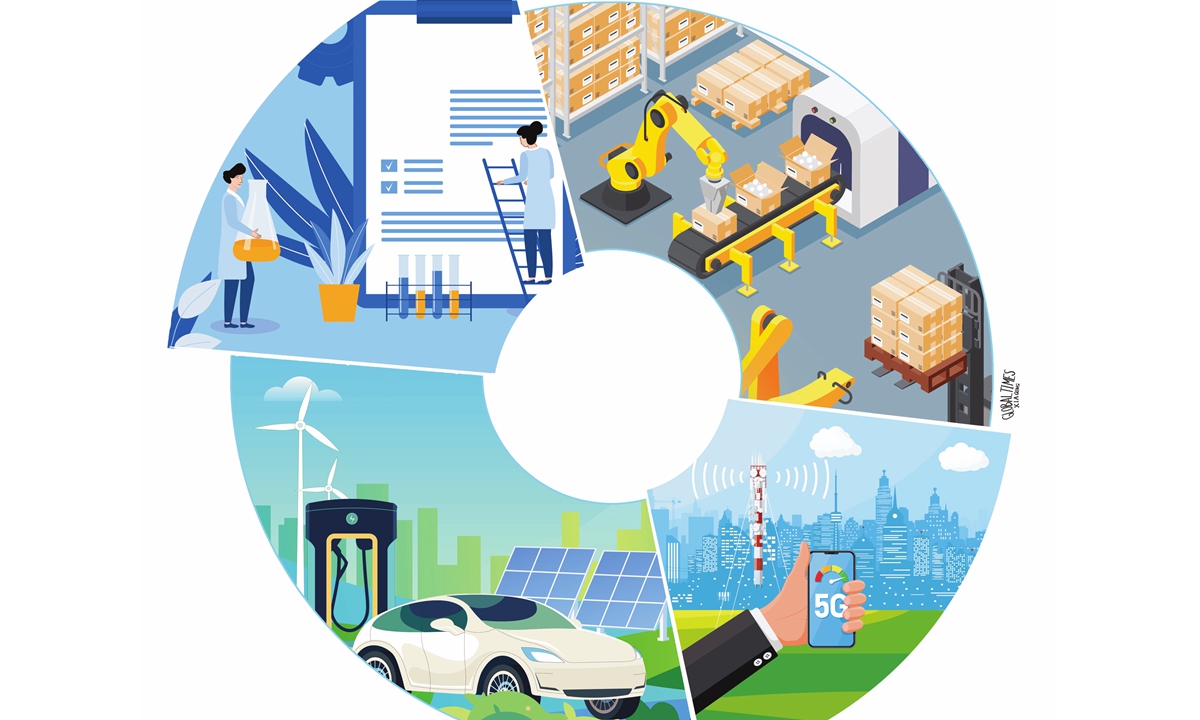
If you look back at the last Five-Year Plan, some of its priorities were EVs, batteries and solar panels. And where are those three sectors today? They are leading the world. That's the efficiency that planning brings. Looking ahead, I believe China will take the lead in quantum computing, 5G, nuclear fusion and more.
GT: You have described the global economy as a "perma-crisis" that moves "like a roller coaster." In such an unpredictable environment, how do you assess the value of long-term national planning in withstanding uncertainties?
Aernoudt: We are in a permanent state of crisis. The economy is not like a flood that moves steadily in one direction. It's more like a relationship - sometimes good, sometimes bad. That's just how it works. We face multiple crises simultaneously: energy crises, mineral shortages, trade tensions. The impact of all these is like a roller coaster. This makes for an extremely complex situation. And the more complex the situation becomes, the less the past can serve as a reliable guide for forecasting the future. What we need is foresight - an intuition about which sectors will shape the future. That is why it is so important for a country like China to clearly identify where it wants to excel.
The word "crisis" comes from the Greek "kraisis," which means seeing opportunities and making decisions. My message to both companies and governments is this: Stop thinking about short-term profits. What matters is how to survive and how to benefit from the next crisis. Resilience is far more important than short-term gains.
GT: After your recent visit to Shenzhen, where you saw DJI, UBTECH and Dobot, you noted that Shenzhen's strength lies not just in individual companies but in its "complete industrial ecosystem." What does this ecosystem model offer that Europe's industrial policy framework does not? And what lessons does it hold for the 15th Five-Year Plan period?
Aernoudt: If you look at Shenzhen in 1979, it was a fishing village with just 30,000 people. Today, it is known as the "Silicon Valley" of China. It has developed an ecosystem that brings together research institutes, public servants, manufacturing capabilities and productivity. All these elements working together make it succeed.
In Europe, we also have good universities, research institutes and infrastructure. The problem is that we lack the right mind-set. We don't have the drive or the willingness to scale up, and we don't have the capital. Our regulations tend to hinder innovation, whereas in China, regulation serves to make innovation better. What we are missing is speed and vision.
What we should learn from China is this: We should not just look for "hidden champions," we should look for "hidden ecosystems" and bring them together. That is the secret behind Shenzhen's success. I think that going there and feeling the atmosphere firsthand is invaluable. That is why the Five-Year Plan feels tangible to you. The most important factor for growth today is not capital or labor. It is what I call the "third factor": entrepreneurship, creativity, mind-set and new business models. And that is where China's strength lies.
GT: What makes you confident about China accomplishing its objectives outlined in its 15th Five-Year Plan?
Aernoudt: The first lesson is the power of setting clear objectives. The second is this: As the Chinese often say, strategy without implementation is just a hallucination. In China, you have all the necessary ingredients working together - factories, research institutes, policymakers, officials, manufacturing capabilities and talent. When you put all these pieces together, success is all but guaranteed.
GT: What do you see as the most urgent area for China-EU cooperation during the 15th Five-Year Plan period? How can both sides move beyond existing frictions toward the "more intelligent form of globalization" that you have called for?
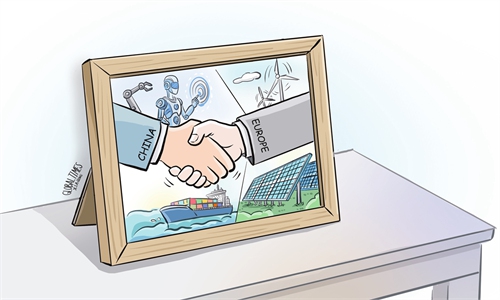
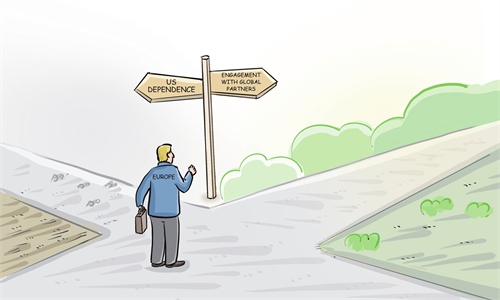
Aernoudt: I think the first thing we should do is stop seeing China as a problem and start seeing China as a solution. Cooperation is built on mutual respect and mutual understanding, so let's try to understand each other. China should understand that Europe cannot become the "recreation park" of the world - we need industry. Europe, in turn, should understand that China needs growth. Is this a contradiction? No. Because we share the same challenges. So, what can we do? We can work together. Look at BYD in Germany or CATL in Hungary. This is the industry coming to Europe, rooted in China. These companies are creating welfare and prosperity for China, while also building industrial capacity for Europe. The Five-Year Plan is an opportunity for Europe.
There are many clichés about China, and perhaps just as many about Europe. The best way to overcome these clichés is simply to get to know each other.
RELATED ARTICLES