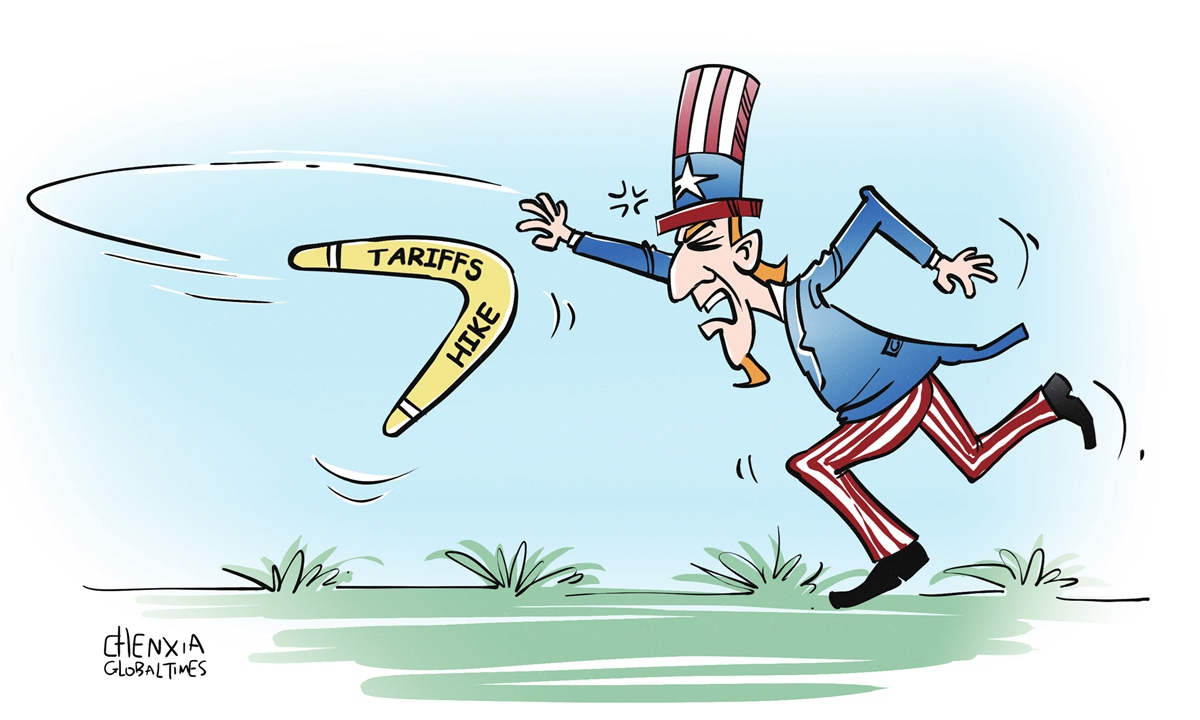
Illustration: Chen Xia/GT
On August 13 local time, the White House Office of Trade and Manufacturing Policy released a report that labeled more than 40 countries and regions around the world as part of a so-called Chinese "shadow transshipment network," singling out these trading partners for allegedly helping the Chinese mainland circumvent US tariffs. At the same time, the US said it is developing an AI-powered "detective border" in an attempt to use technology to trace the origins and destinations of every shipment.
From the EU, Canada and Japan to Mexico, Vietnam and Malaysia, those Washington has branded as part of the so-called "shadow transshipment network" include both US allies and a broad range of emerging markets and developing countries. The economies publicly named by the media alone account for nearly 40 percent of global GDP and close to half of global merchandise trade. If China itself is included, those shares would be even higher. So, which is it: Is the entire world somehow picking a fight with the US, or has Washington put itself at odds with the international community?
One can't help but be reminded of an old saying when reading this report: If you see every car on the highway driving in the wrong direction, perhaps you are the one going the wrong way. That is precisely what the US is doing today - driving against the flow on the highway of free trade. Rather than reflecting on whether it has chosen the right direction, Washington is blaming the rest of the world for supposedly working against it.
The core accusation in the White House report is that after the US imposed steep tariffs on Chinese goods, Chinese mainland companies began shipping products to third countries before exporting them to the US in order to evade tariffs. But viewed from another angle, the report is actually "evidence" of the enormous contribution Chinese trade makes to the global economy. It is precisely because China's manufacturing sector offers complete industrial chains, highly efficient logistics and unparalleled overall cost advantages that businesses around the world are willing to remain deeply integrated with China.
The real problem facing the US is not how many trading partners are "working against it," but that it cannot use a stick to stop the flow of a surging river. Washington wants to use AI technology to plug every "loophole," even going so far as to analyze X-ray images at ports. Yet even if it is "armed to the teeth," it will still find that "loopholes" are everywhere. That's because no matter how advanced the technology, it cannot reverse the direction in which people and businesses choose to trade, nor can it overturn the underlying laws of economics.
There are not that many "conspiracies" in this world. In a globally integrated supply chain, goods passing through third countries for assembly, processing or re-export are a normal part of international trade. Instead of looking for the root cause in its own tariff policies, the US is stigmatizing ordinary transshipment and processing trade within global supply chains. At its core, this is unilateral trade bullying. Unless Washington changes course, its growing sense that it's "losing control of the pack" is only inevitable.
RELATED ARTICLES