Illustration: Liu Xiangya/GT
At the 48th World Heritage Committee session in Busan, South Korea, Kim Ji-hee, South Korea's Ambassador to UNESCO, pressed Japan over its failure to fulfill a decade-old commitment to present the "full history" of Korean laborers forcibly mobilized during Japan's colonial rule. She said displays at Tokyo's Industrial Heritage Information Center failed to reflect the experiences of Koreans brought against their will and forced to work in harsh conditions.
Behind that question lies a historical debt stemming from Japan's wartime past that has remained unresolved for decades.
During World War II (WWII), to secure supplies for its war effort, Japan forcibly mobilized 1,519 workers from the Korean Peninsula between 1940 and 1945 to perform forced labor at the Sado Gold Mines in Sado, Niigata Prefecture. They endured oppression and discrimination; many died as a result of the brutal working conditions, while others later succumbed to illnesses such as pneumoconiosis.
In 2024, Japan pledged to cooperate with South Korea on a memorial ceremony for victims of forced labor in exchange for Seoul's support for the Sado Gold Mines' World Heritage bid. After the site was inscribed, however, Japan refused to acknowledge the "forced mobilization" of workers, prompting South Korean protests. Japan has also failed to fully present this history at the heritage exhibition, referring only briefly to foreign workers while omitting Japan's colonial rule and their suffering.
In fact, Japan's right-wing forces were key drivers of the Sado Gold Mines' World Heritage bid. Although the plan began in February 2021, the government initially hesitated over concerns about damaging ties with South Korea and potential disputes over "comfort women" sites. Under pressure from then-LDP policy chief Sanae Takaichi, former prime minister Shinzo Abe and LDP Vice President Taro Aso, then-prime minister Fumio Kishida ultimately pushed ahead with the bid.
Ironically, Taro Aso's great-grandfather, Takichi Aso, who founded the Aso Coal Mine, forcibly mobilized more than 10,000 workers from the Korean Peninsula during WWII. The exploitation of these workers helped the family amass enormous wealth.
But this was only the tip of the iceberg when it comes to Japan's forced mobilization of laborers.
Japan's 1910 annexation of the Korean Peninsula began 35 years of colonial rule. After starting the full-scale invasion of China in 1937, Japan enacted the National Mobilization Law in 1938, enabling the large-scale forced mobilization of laborers by the government and companies, including Mitsubishi, Mitsui and Aso. Japanese historian Yasuto Takeuchi estimates, based on government archives, that some 800,000 Koreans were forcibly brought to Japan between 1939 and 1945.
Between 1943 and 1945, about 40,000 Chinese laborers were also forcibly brought to Japan, including children as young as 11. As many as 6,830 died. Sent to mines, shipyards and other sites, they endured grueling work in brutal conditions.
After the war, Japan swiftly repatriated most of the laborers, but it never formally acknowledged this chapter of history, let alone admitted wrongdoing.
In 1965, Japan and South Korea signed the Treaty on Basic Relations between Japan and the Republic of Korea, under which Japan provided South Korea with a total of $500 million in economic assistance. Japan unilaterally declared that the issue of compensation to South Korea had been "completely and finally" resolved, using this as a legal shield to reject all individual claims for compensation.
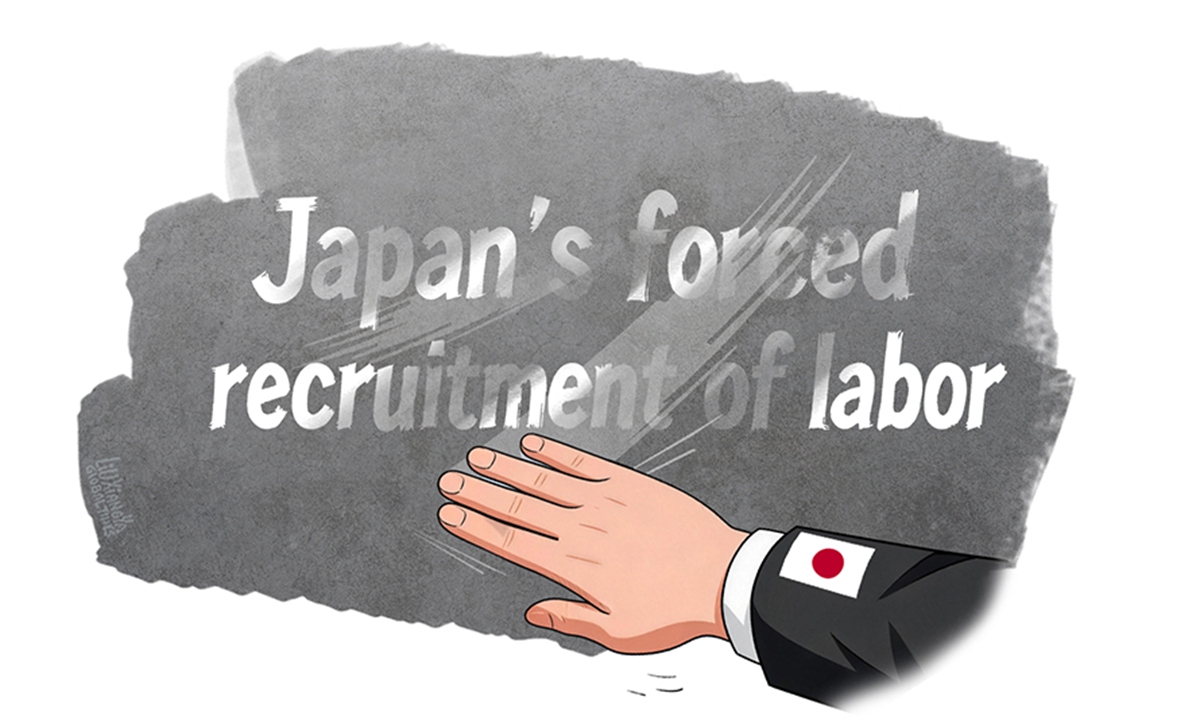
In July 2015, at the 39th session of the World Heritage Committee, 23 sites associated with Japan's "Sites of Japan's Meiji Industrial Revolution," including Hashima Island, were successfully inscribed on the World Heritage List. It marked the first successful World Heritage inscription of facilities associated with the issue of "forced labor." To avoid opposition from South Korea and other countries, Japan pledged to make efforts to explain the "full history" of each facility to the world. Yet the very next day, Japan immediately changed its tune, arguing that the term it acknowledged - "forced to work" - was not equivalent to "forced labor." Under the prestigious banner of "World Heritage," former sites of forced labor were effectively whitewashed as "testaments to Japan's modernization."
But the world is not blind. History must not be forgotten, crimes cannot be erased and such schemes will not succeed.
Shortly before the 48th session of the World Heritage Committee, the World Heritage Committee reviewed Japan's report on the state of conservation of the Sado Gold Mines. It explicitly pointed out significant shortcomings in Japan's efforts to provide a comprehensive historical interpretation of the site and enrich its historical exhibits, particularly the inadequate presentation of the history of the forced mobilization of laborers during the colonial period. It urged Japan to fully consult with the countries concerned and further improve the site's interpretive materials, exhibition layout and related facilities. Japan was required to submit an implementation report by December 1, 2027.
Japan made empty promises to secure the World Heritage inscription, only to go back on its word almost immediately. It has even resorted to deceptive tactics to deliberately erase historical crimes such as the forced mobilization of laborers. In doing so, it has betrayed historical truth and the countries and peoples that suffered Japanese aggression, as well as human conscience, fairness and justice. Japan's persistent downplaying, evasion and denial are, at their core, products of a militarist view of history and a familiar tactic of right-wing forces seeking to whitewash the history of aggression.
Yet the bones buried in the mines do not lie, and the blood and tears of the laborers have not dried. History will not disappear simply because it is deliberately concealed. Justice may be delayed, but it will never be absent.
The author is an international affairs observer. opinion@globaltimes.com.cn
RELATED ARTICLES