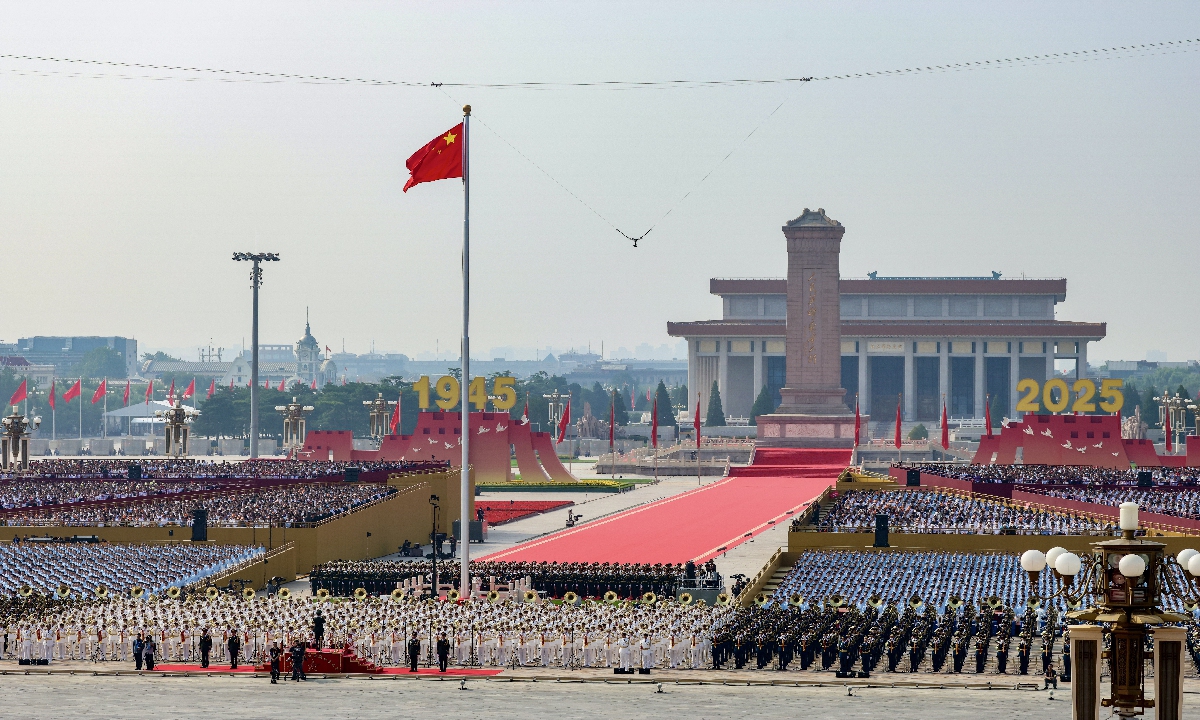
A grand gathering to commemorate the 80th anniversary of the victory in the Chinese People's War of Resistance against Japanese Aggression and the World Anti-Fascist War is held in Beijing on September 3, 2025. Photo: VCG
On August 17, General Secretary of the Communist Party of China (CPC) Central Committee Xi Jinping delivered an important speech at the ceremony commemorating the centenary of the birth of late Chinese leader Jiang Zemin. What Taiwan society should take most to heart about this speech is not only the historical significance of the centenary commemoration of the late Chinese leader Jiang Zemin, but also a particularly weighty statement in the speech: The Chinese nation will be rejuvenated due to the motherland's complete reunification and the establishment of a prosperous, strong, democratic, culturally advanced and modern socialist country.
In the speech, Xi specifically quoted this vision for the future expressed by Comrade Jiang Zemin. He then pointed out that, through long-term efforts, the cause of the Party and the country has flourished, China enjoys stability and peace, and people's lives keep on improving. The great rejuvenation of the Chinese nation holds bright prospects, and the dream pursued with resolve by generations of people is steadily turning into reality.
These two passages are not merely parallel statements. Together they form a clear historical logic: National rejuvenation is becoming a reality, and achieving the complete reunification of the motherland is a historical task that must be fulfilled in the process of national rejuvenation. If Taiwan society understands this, it will realize that the Taiwan question has never been an isolated matter that can be detached from the process of the great rejuvenation of the Chinese nation or indefinitely postponed; nor is the reunification of the motherland a "superfluous" add-on option to be considered only after national rejuvenation has been achieved. On the contrary, achieving the reunification of the motherland is crucial for realizing the great rejuvenation of the Chinese nation, and it is a crucial link in bringing this historical process to completion and fulfillment.
First, Taiwan society needs to understand that reunification is not an issue "to be discussed only after national rejuvenation."
For a long time, some people on the island have been accustomed to viewing national rejuvenation and the Taiwan question as separate matters. They believe that the Chinese mainland's development is the mainland's own business, and that Taiwan can continue to maintain the status quo; they view the mainland's talk of national rejuvenation as an internal narrative about its own development; and they regard the issue of cross-Straits reunification as something that can be discussed slowly, dragged out, or even left to the next generation.
This understanding clearly misinterprets the CPC most fundamental strategic stance on the Taiwan question. The report to the 20th National Congress of the CPC made it clear that resolving the Taiwan question and realizing China's complete reunification is, for the Party, a historic mission and an unshakable commitment. It is also a shared aspiration of all the sons and daughters of the Chinese nation and a natural requirement for realizing the rejuvenation of the Chinese nation.
The term used here is "natural requirement" - not a mere aspiration, and certainly not an option. Why is it a natural requirement? Because the great rejuvenation of the Chinese nation lies not only in the enhancement of economic strength, breakthroughs in scientific and technological capabilities, and improvements in people's livelihoods, but also in the resolution of historical legacy issues and the unification of the nation's territorial sovereignty. Therefore, the quote - that the Chinese nation will be rejuvenated due to the motherland's complete reunification and the establishment of a prosperous, strong, democratic, culturally advanced and modern socialist country - is a solemn reaffirmation of a historical coordinate: Reunification and rejuvenation are not two separate and disconnected events, but rather an interconnected historical undertaking that advances together.
Second, Taiwan society must understand that the Taiwan question cannot be passed down from one generation to the next.
The Taiwan question arose from national weakness and turmoil; it is a legacy of the Chinese civil war in the 1940s. When a nation is weak, it is subject to division; when a nation is in turmoil, it leaves behind regrets. The long-standing separation of Taiwan from the mainland is precisely part of the Chinese nation's history of suffering in modern times.
Today, historical conditions are undergoing fundamental changes. China is no longer the China of a century ago - a nation at the mercy of others, with its territory fragmented. Chinese modernization is advancing steadily, the nation's comprehensive national strength continues to rise, people's livelihoods are constantly improving, and national rejuvenation has entered an irreversible historical process. Against this backdrop, the Taiwan question cannot remain "unresolved" forever, nor can it be left to future generations indefinitely.
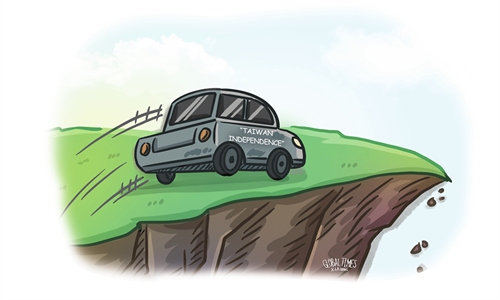
This is the true meaning of "Time and history wait for no one!" - a clear-eyed assessment of this entirely new historical phase. In the past, due to factors such as China's development process, the balance of power across the Taiwan Straits, and the international environment, many issues required patience and long-term accumulation. But now that national rejuvenation has entered a critical stage, the historical significance of the reunification will grow ever heavier, and its practical urgency will become ever more pressing. Taiwan society should understand that the so-called "maintaining the status quo" is a false proposition. Treating delay as "security," ambiguity as an "answer," and external intervention as a "guarantee" will ultimately lead only to a misjudgment of the times, the prevailing trends, and one's own position.
Third, Taiwan society needs to understand that reunification is not merely a formal union, but also a spiritual harmony.
China's reunification is, first and foremost, a matter of national sovereignty and territorial integrity. There is absolutely no room for ambiguity on this point. However, a reunification that is truly lasting, stable, and in line with the common interests of compatriots on both sides of the Straits must necessarily include the reconnection of national sentiments, the recalibration of historical perceptions, and the reestablishment of national identity. This is why the Chinese mainland has always emphasized that "We Chinese on both sides of the Taiwan Straits belong to one and the same family"; why it has consistently emphasized "promoting the peaceful and integrated development of cross-Straits relations"; and why it has consistently emphasized "enhancing the well-being of Taiwan compatriots and strengthening spiritual bonds." Reunification is intended to end division, but even more so to enable all Chinese people to share a more complete nation, a more stable future, and broader opportunities for development.
Spiritual bonds cannot be achieved by avoiding problems, nor can they possibly be realized through "de-Sinicization," historical nihilism, or dependence on external forces. If a society downplays its national memory, severs its cultural roots, and constantly frames cross-Straits relations as adversarial, it is in fact eroding the foundation for achieving spiritual bonds across the Straits - and, moreover, squandering Taiwan's own future. What Taiwan society truly needs to consider is not how to permanently lock cross-Straits relations into confrontation, but how to find its proper place within the broader context of national rejuvenation.
Fourth, Taiwan society should in particular be wary of three misconceptions.
The first is the belief that national rejuvenation is solely a matter for the mainland and has nothing to do with Taiwan. This deliberately separates Taiwan from the broader historical trajectory of the Chinese nation. Taiwan's development, the well-being of its people, and its security and future can never exist separately from the overall destiny of the Chinese nation.
The second is the belief that reunification can be postponed indefinitely. History will not stop simply because of the subjective wishes of some people. Cross-Straits relations may experience twists and turns, and the reunification process may unfold in stages, but the direction toward the complete reunification of the motherland will not change, nor will the Chinese nation's march toward great rejuvenation come to a halt.
The third is the belief that external forces can alter the course of history. External powers may be able to create tensions and foment confrontation, but they cannot decide Taiwan's destiny on its behalf, much less alter the historical trend toward China's complete reunification. Entrusting Taiwan's future to the strategic calculations of external forces will ultimately reduce Taiwan to a bargaining chip in geopolitical competition.
This important speech delivered on August 17 reminds Taiwan society that the Taiwan question must be reconsidered within the broader historical context of national rejuvenation. In the past, many viewed reunification as a distant issue; today, reunification is becoming increasingly clear as part of the overall process of national rejuvenation. In the past, some believed that delaying the process could buy more room for maneuver; today, reality has shown that the longer reunification is delayed, the greater the likelihood of missing opportunities for peaceful development and shared prosperity. In the past, some understood reunification simply as a political question; today, it is becoming increasingly clear that reunification concerns the integrity of the nation, national dignity, and Taiwan's future - and, more broadly, the shared destiny of every Chinese.
Comrade Jiang Zemin once envisioned that the Chinese nation will be rejuvenated due to the motherland's complete reunification and the establishment of a prosperous, strong, democratic, culturally advanced and modern socialist country. Today, General Secretary Xi has revisited this statement, pointing out that the dream of national rejuvenation is becoming a reality. This reaffirms the direction of national rejuvenation at a new historical juncture and once again clarifies the strategic position of the reunification of the motherland within this great process. As national rejuvenation enters a critical stage, reunification is no longer merely an issue awaiting discussion. It has become part of the historical process itself. For Taiwan society, it is time to reassess the situation and truly abandon the illusion that "delaying reunification can preserve the status quo of cross-Straits division indefinitely."
RELATED ARTICLES