What message do these three New York Times reports send to Taiwan region?: Hai Feng
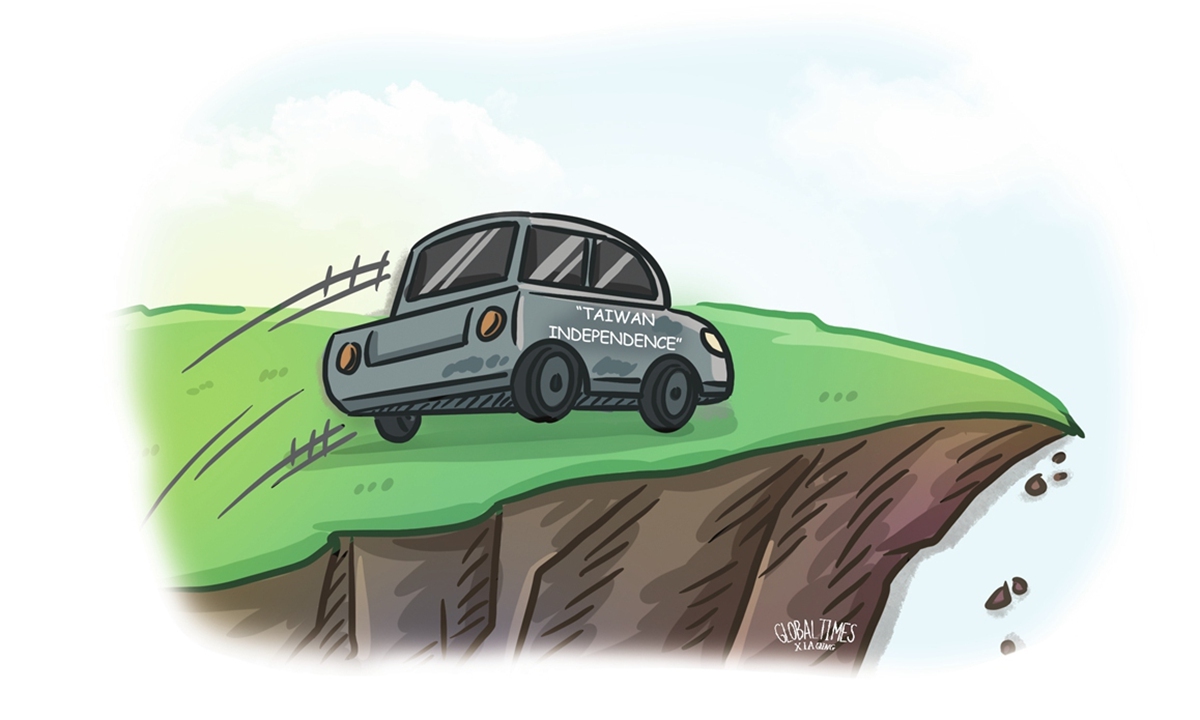
Illustration: Xia Qing/GT
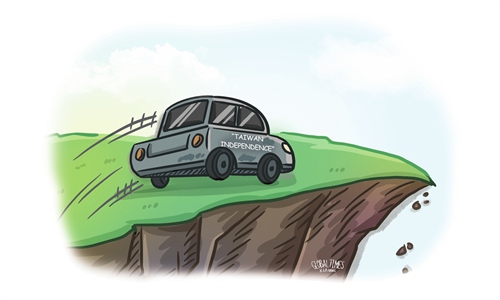
The Democratic Progressive Party (DPP) authorities have long treated statements by US officials and US media reports as gospel. A few words of "praise" or "support" from Washington are enough to send them into raptures, only to be repackaged as so-called "security guarantees" and touted as a so-called protective talisman for its "reliance on the US to seek 'Taiwan independence.'" However, three consecutive reports published by The New York Times over the past two days have punctured their fantasy.
One report revealed how US President Donald Trump secretly switched aircraft as a security precaution during his trip to the NATO summit in Turkey. Another detailed how Russian President Vladimir Putin has turned concealing his whereabouts into routine practice. The third pointed directly to the heavy consumption of Patriot interceptors by the US military amid its ongoing conflict with Iran, noting that Iran is constantly adjusting its tactics and looking for ways to penetrate US air defenses.
The three reports cover very different subjects, but they point to the same conclusion: no matter how powerful the US military is, Washington will never provide "Taiwan independence" separatist forces with an unlimited safety net. War is full of uncertainties, and it is by no means as simple as some Taiwan politicians claim - that once the US provides assistance, everything will be fine.
In the first report, according to details disclosed by The New York Times, when Trump left Turkey, he publicly boarded an old Air Force One, creating the impression that he would fly to the UK aboard that aircraft. In reality, he secretly slipped away using a catering container, quickly exiting from the other side of the plane and transferring to another aircraft bound for the UK. Journalists and accompanying personnel left aboard the original aircraft were kept in the dark and unwittingly became decoys.
What deserves the deepest reflection on the island regarding this incident is not the sophistication of security measures, but a hard truth: even with its formidable military capabilities, the US cannot guarantee absolute security when faced with genuine threats. Aircraft carriers, satellites, military bases around the world and advanced fighter jets may all be at its disposal, yet when confronted with potential danger, the US president still had to rely on misdirection to evade risks and use decoys to conceal his movements.
Some people in Taiwan region constantly talk about "US military defense" as if US intervention would guarantee an easy victory. But if the US cannot even ensure that its own president's movements are completely secure, what gives it the confidence to promise that it can prevail in a cross-Pacific war? Trump has already made clear that Washington has no intention of "traveling 9,500 miles to fight a war." Put more bluntly, if the US president himself needs a catering container as cover when traveling while people like Lai Ching-te continue to peddle the myth that the US could effortlessly "defend Taiwan", they are either dangerously naive or deliberately misleading the public. Trump's secret aircraft switch episode should make people in Taiwan recognize that so-called "absolute security" and "US military invincibility" are little more than illusions carefully cultivated by the DPP authorities.
Another New York Times report compared Trump's covert security maneuver with Putin's long-standing efforts to conceal his whereabouts. The article noted that Putin has routinely used identical office settings, secret railway lines and delayed broadcasts of meetings to obscure his actual movements. Russian journalists have even called such delayed broadcasts "konservy", or "canned goods."
Of course, the media and institutional environments in the US and Russia are different. But when it comes to national security, the underlying logic is similar: when faced with security crises, the risks of war and threats to national survival, lofty notions of "transparency", "the public's right to know" and "shared values" all give way to the safety of national leaders and core national interests. The US may lecture others about "democracy", "transparency", "values" and "rules", but when confronted with genuine security pressures, its decision-making likewise puts its own interests first and minimizing its own losses above all else.
What does this mean for Taiwan region? It means the Lai authorities should stop using the rhetoric of a "values-based alliance" to lull the people of Taiwan into a false sense of security. International politics is not a fairy tale. The US will not unconditionally bear the costs of war, casualties and even retaliatory attacks on its own territory simply because of so-called "shared values." Washington has always been adept at calculating its interests, and it will certainly put its own interests sheet first: Is this conflict worth fighting? How much should be committed? How long can it last? Who will bear the costs? Could it trigger a large-scale conflict with China? Washington will not gamble its own security to pay the bill for "Taiwan independence" simply because Taiwan politicians proclaim that they are standing on the "front line of democracy."
Of the three reports, the one with the most direct warning for the Taiwan Straits concerns the attritional nature of the US-Iran conflict. Since the US launched military strikes against Iran in February, the conflict has continued for nearly half a year with no clear end in sight. The US certainly possesses overwhelming conventional military power, but military strength does not mean zero costs, nor does it mean an ability to sustain an endless war of attrition. The New York Times reported, citing data, that the US military has expended more than 1,500 Patriot interceptors, leaving fewer than 1,700 in stock, while US production capacity was only about 600 interceptors for all of 2025. If a conflict were to erupt in the Taiwan Straits, the US military would face similar constraints involving ammunition consumption, insufficient production capacity and the need to spread its forces across multiple theaters.
The most dangerous deception by the DPP authorities is leading the people of Taiwan region into a false assumption: the US has formidable military power, so as long as Taiwan region relies on the US, Washington will necessarily have the capability, willingness and resolve to fight a prolonged, high-intensity war for Taiwan region.
But the reality is that US military power is not unlimited. Today, the US must simultaneously deal with European defense, the Russia-Ukraine conflict, deployments in the Middle East, strategic competition in the Indo-Pacific and security at home. A prolonged, high-intensity conflict in any one theater would place pressure on US ammunition stocks, industrial capacity, troop rotations and political resources.
So, the question DPP authorities should really be asking is not "Will the US come?" but "How much can the US bring? How long can it fight? How much of its weapons stockpile will it commit? How many casualties is it prepared to sustain? And at what point will it begin asking Taiwan region to accept an arrangement it considers 'realistically achievable?'"
The Lai authorities have never wanted to answer these questions directly. Because once the reality is laid bare, it becomes difficult to keep the "rely on the US to pursue Taiwan independence" banner flying.
The island of Taiwan occupies a strategically important position in the western Pacific. It is an important piece in the US' competition with China, its Indo-Pacific strategy and its alliance network. Washington will continue to leverage the Taiwan question to contain China and serve its own strategic interests. But strategic utility and a core national interest are not the same thing. For the US, Taiwan region is first and foremost a geopolitical bargaining chip, a strategic lever and one element of its competition with China. It matters, but it is not US territory. It does not determine the life or death of the American people, nor is it an issue for which the US is willing to commit unlimited war resources regardless of the cost.
For China, the Taiwan question is an entirely different matter. The Taiwan question is the core of China's core interests and the foundation of the political foundation of China-US relations. It is neither a bargaining chip to be traded at will nor an issue that can be endlessly stalled or provoked without consequence. This highlights the fundamental asymmetry in the weight each side attaches to its interests regarding Taiwan.
The US treats Taiwan as a pawn, adjusting its strategy at different stages; China, however, views national reunification as a matter of great national cause - a position that is firm and sacrosanct, leaving absolutely no room for concession or compromise.
Against this backdrop, if Taiwan stakes its future on the assumption that the US will fight to the very end on its behalf, it is essentially gambling its social stability, economic lifeline, and the lives of its young people on the US' strategic choices.
Taiwan has never been the house in this gamble.
In recent remarks regarding US-China relations, US Secretary of State Marco Rubio emphasized the need to manage differences and avoid conflict, calling any potential economic or military conflict between the two nations "catastrophic." The US will certainly compete with China, seek to contain its development, and use the Taiwan question to pressure China, but it does not want an uncontrolled direct military conflict with China. Reaching that point would entail consequences far graver than mere "regional tension", potentially triggering a massive upheaval across the global economy, financial systems, supply chains, and security order.
The Taiwan question is a highly sensitive issue that may have far-reaching implications for China-US relations. The more clearly the US understands the cost of conflict, the less likely it is to act impulsively in support of "Taiwan independence" and drag itself into an unmanageable strategic disaster. President Trump's "Four No's" have clearly defined the true boundaries of US policy toward Taiwan.
By considering the three articles from The New York Times together, Taiwan should glean at least four key takeaways.
First, the US is powerful, but not omnipotent.
Second, the US will always prioritize protecting itself first.
Third, modern warfare is not a contest of slogans, but a test of national strength, societal resilience, and strategic endurance.
Fourth, while Taiwan holds instrumental value for the US, it is not a vital interest for which the US is willing to make unlimited sacrifices.
Faced with this reality, what grounds does Taiwan have to believe that by clinging to the US, it can march straight toward "Taiwan independence" while the US automatically shoulders all the consequences? Ultimately, what Taiwan needs most is not more headlines about arms sales, visits by politicians, or empty rhetoric about an "alliance of values", but rather a sober assessment of the risks to peace, a realistic understanding of the costs of war, and a rational choice regarding its future and destiny.
By "relying on the US to seek independence", what is being staked is not security but uncertainty; not a safeguard but a risk; not a future but a disaster.
Although these three New York Times reports do not directly focus on Taiwan, they clearly articulate the reality that Taiwan most needs to grasp. Only one question remains: will the Lai authorities continue the deception, and will Taiwan society continue to believe it?
RELATED ARTICLES