China’s long-term planning offers valuable lessons for strategic vision and consistency in execution

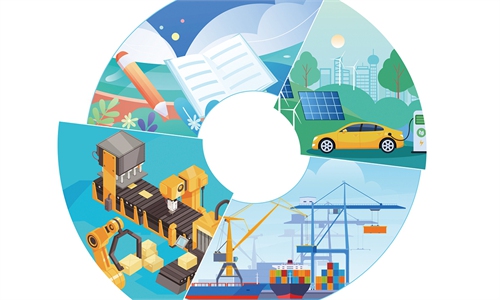
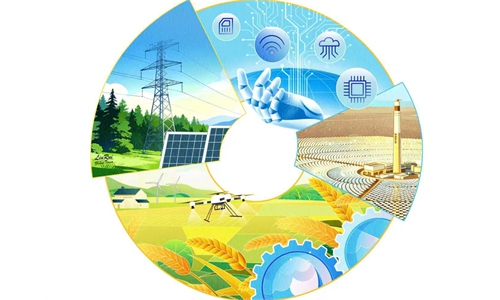
China's 15th Five-Year Plan. Illustration: Xia Qing/GT
Editor's Note:2026 marks the commencement of China's 15th Five-Year Plan (2026-30), a pivotal phase in the nation's medium- to long-term development. A successful venture starts with a good plan and with clear goals set. At this critical juncture, where a profound restructuring of the global order converges with a tipping point in the technological revolution, China's Five-Year Plan is poised to inject momentum and certainty into global development, charting a steady course for the new journey ahead.
In the "New Blueprint, New Opportunities" series, the Global Times (GT) invites Nobel laureates in economics, former central bank governors, core decision-makers of international organizations and renowned economists from countries with diverse civilizations, different economic systems and stages of development, to deeply analyze how the 15th Five-Year Plan will reshape the underlying logic of China's interaction with the world and to explore the "anchor of certainty" and "new paradigm of development" that this plan is to offer for a turbulent world.
In the 12th installment of the series, GT reporter Wang Zixuan talked to Rahma Gafmi (Gafmi), an economics professor at Indonesia's Airlangga University. Gafmi shared her insights on how China uses five-year plans as a key tool for national development and the certainty that China injects into the global economy.
GT: China utilizes five-year plans as a key tool for national development. What's your take on this approach?
Gafmi: A structured long-term planning approach indeed serves as one of the primary pillars distinguishing China's development model from most other emerging market economies. By combining long-term strategic visions, such as the five-year plans, with disciplined execution, I observe that China has achieved massive structural transformation in just a few decades.a
The tangible impacts of this approach on Chinese society and the economy include: when the central government establishes clear priorities, for instance, the green energy transition, industrial upgrading (downstream processing), or high-tech development, the direction of fiscal policy, monetary policy and industrial incentives moves synchronously. This minimizes policy fragmentation at the regional level.
China's five-year plan system represents one of the most influential long-term economic planning efforts in modern history. Although market economies excel in short-term price discovery, they often struggle with capital-intensive, multi-decade transitions. The five-year plans enable China to plan far ahead for massive infrastructure, energy and industrial shifts such as building the world's largest high-speed rail network or systematically greening its electrical grid, which the private market might underinvest in due to short-term risk aversion.
GT: You once noted that China's growth targets are meant to "create room for reform, transformation and risk management." In today's volatile world, how can long-term national plans deal with uncertainty? How do you feel about the certainty China injects into the world?
Gafmi: Amid a world marked by geopolitical fragmentation, global supply chain disruptions and financial market volatility, the five-year target-based approach serves a dual function: acting as an anchor for domestic stability while functioning as a strategic navigational instrument against external shocks.
The impact of the certainty that China injects into the global economy gives rise to two starkly contrasting perspectives: For many countries, the production certainty provided by China, particularly in the energy transition, namely solar panels, EV batteries, and affordable EVs, acts as a vital global public good. While Western nations are trapped in short-term political cycles, China's consistent investment in green technology provides price and supply certainty that helps reduce the costs of global decarbonization. This certainty also serves as an economic anchor for trading partners in Asia, Africa and Latin America.
In an increasingly turbulent world, China's long-term planning offers valuable lessons on the importance of strategic vision and consistency in execution.
GT: According to the 15th Five-Year Plan, China aims to expand two-way investment and cooperation in the next five years. How do you see the current investment climate in China for foreign investors? And what kinds of opportunities do you see for Chinese companies in Indonesia and Southeast Asia more broadly?
Gafmi: The investment climate in China is currently undergoing a profound structural transition. Incoming foreign capital flows are increasingly shifting away from low-value-added assembly toward high-tech services and manufacturing sectors, including advanced electronics, pharmaceuticals and digital infrastructure.
The Chinese government continues to ease market entry barriers, such as reducing the negative list for manufacturing investments and encouraging profit reinvestment. The Chinese market is no longer focused on low-cost scale, but rather provides room for foreign players capable of deeply integrating into the domestic innovation ecosystem and high-end supply chain.
In tandem with China's drive to expand outbound direct investment to build high-quality global supply chains, Southeast Asia, particularly Indonesia, has emerged as a primary destination. This expansion opens up several strategic opportunities, such as downstream processing and critical mineral integration.
Proven successful integrated industrial park models, such as Morowali or Weda Bay in Indonesia, provide a blueprint for Chinese companies to replicate manufacturing clusters abroad. Wide opportunities are open for expanding logistics infrastructure, self-reliant energy supplies and processing facilities, not only in the metal sector but also in consumer manufacturing and machinery.
With Southeast Asia's digital economy growing rapidly, Chinese technology and infrastructure giants see high demand in cloud computing, data centers, 5G networks, fintech integration and utility-scale renewable energy projects, namely solar and wind.
GT: What could China and Indonesia do together to strengthen multilateral trade during the period of the 15th Five-Year Plan and beyond?
Gafmi: Rejecting unilateralism and protectionism by emphasizing the need to uphold the multilateral trading system, Beijing and Jakarta voice their opposition to unilateral tariff policies, artificial supply chain barriers and global economic fragmentation that harms developing nations.
On a practical level, China and Indonesia can combine their economic strengths through several strategic steps: maximizing the full implementation of frameworks such as the Regional Comprehensive Economic Partnership and accelerating the upgrade of the ASEAN-China Free Trade Area to lower both tariff and non-tariff barriers while streamlining the flow of goods and services in the region; jointly advocating for the restoration of the WTO dispute settlement system including the function of the Appellate Body and championing fairness and special treatment for developing countries within global trade rules; engaging in close cooperation on green product standards and the digital economy including Mutual Recognition Agreements for technology certification and the energy transition to ensure that trade in future strategic sectors remains inclusive and avoids isolation within exclusive blocs.
RELATED ARTICLES