IN-DEPTH / IN-DEPTH
From public space to opera stage, two artists turn Chinese traditions into shared experience
By in Shenzhen Published: Aug 18, 2026 09:48 PM
Editor's Note:
In an era marked by unprecedented global transformations, the world stands at a critical crossroads, grappling with deepening deficits in peace, development, security and governance. As humanity faces unparalleled challenges during this tumultuous period, Xi Jinping, general secretary of the Communist Party of China (CPC) Central Committee and Chinese president, has put forth a solemn call to action through the Global Development Initiative, the Global Security Initiative, the Global Civilization Initiative and the Global Governance Initiative. The four pivotal initiatives address the pressing issues of our time, offering viable pathways and robust support for building a community with a shared future for humanity.
Rooted in the rich historical experiences of the CPC's century-long struggle and infused with the wisdom of China's traditional culture, these initiatives are expected to unite the world in the pursuit of common progress and stability. To offer a deeper understanding of the four major global initiatives and elaborate on their global significance, the Global Times is launching a series of articles.
In this installment, Global Times reporter Xu Liuliu talks with architect Ma Yansong and tenor Shi Yijie, exploring how their work in space and sound embodies the core principles of the Global Civilization Initiative: respect for civilizational diversity, people-to-people exchange, and the joint inheritance and innovation of cultural heritage; while reimagining how civilizations speak to one another.
Nearby, a cleaner was finishing her shift. Not long before, a photo of her standing on a transparent section of the roof, mop in hand, had gone viral. Online she was called "the auntie who cleans the heavens." Liao raised his phone and took a picture of his own.
The architect who designed these stone-like forms felt a deeper satisfaction when he saw the same image.
"An environment that makes ordinary people think like artists," Ma Yansong said in an interview with the Global Times. "The person holding the camera becomes a creator. The cleaning woman performs on a vast stage of her own."
Hundreds of miles away in Shanghai, the tenor Shi Yijie guided young singers through a single line: "Gong Yin Chang Jiang Shui" - we drink from the same Yangtze River. "Do not close the vowel too soon on the word for water," he told them. "Let the breath carry it and finish slowly." Filtered through the breath control of Italian bel canto, the line from Song Dynasty (960-1127) remained thoroughly Chinese yet needed no translation.
One man shapes space with stone and grass. The other shapes sound with breath and language. Both pursue the same quiet question: how can you speak the deepest layers of Eastern culture in a language the whole world can understand.
Yet their answers are not simply aesthetic choices. They are working examples of the kind of cultural dialogue the Global Civilization Initiative calls for: not a one-way announcement, but an invitation to shared experience. Ma and Shi arrive at this principle from opposite directions - one by emptying a city's skyline, the other by filling a concert hall with breath. Together they suggest that cultural confidence is not measured by how loudly a civilization announces itself, but by how much space it leaves for others to listen.
The architect who learned to step back
Ma grew up in the hutongs of Beijing. As a boy, he climbed onto gray-tiled roofs to watch pigeons circle and catch sight of the Western Hills in the distance. "City and nature were still connected then," he recalled.
After graduating from Yale's School of Architecture and working in New York and London, Ma's sense of loss grew sharper. In 2006, his design for the Absolute Towers in Canada became the first major international commission won by a Chinese architect. Recognition arrived. Yet for a long time afterward, Ma found himself designing in a mode of insistence. "I just want to be different from other people," he once said.
The shift came gradually. After 51, he began speaking more often of "stepping back."
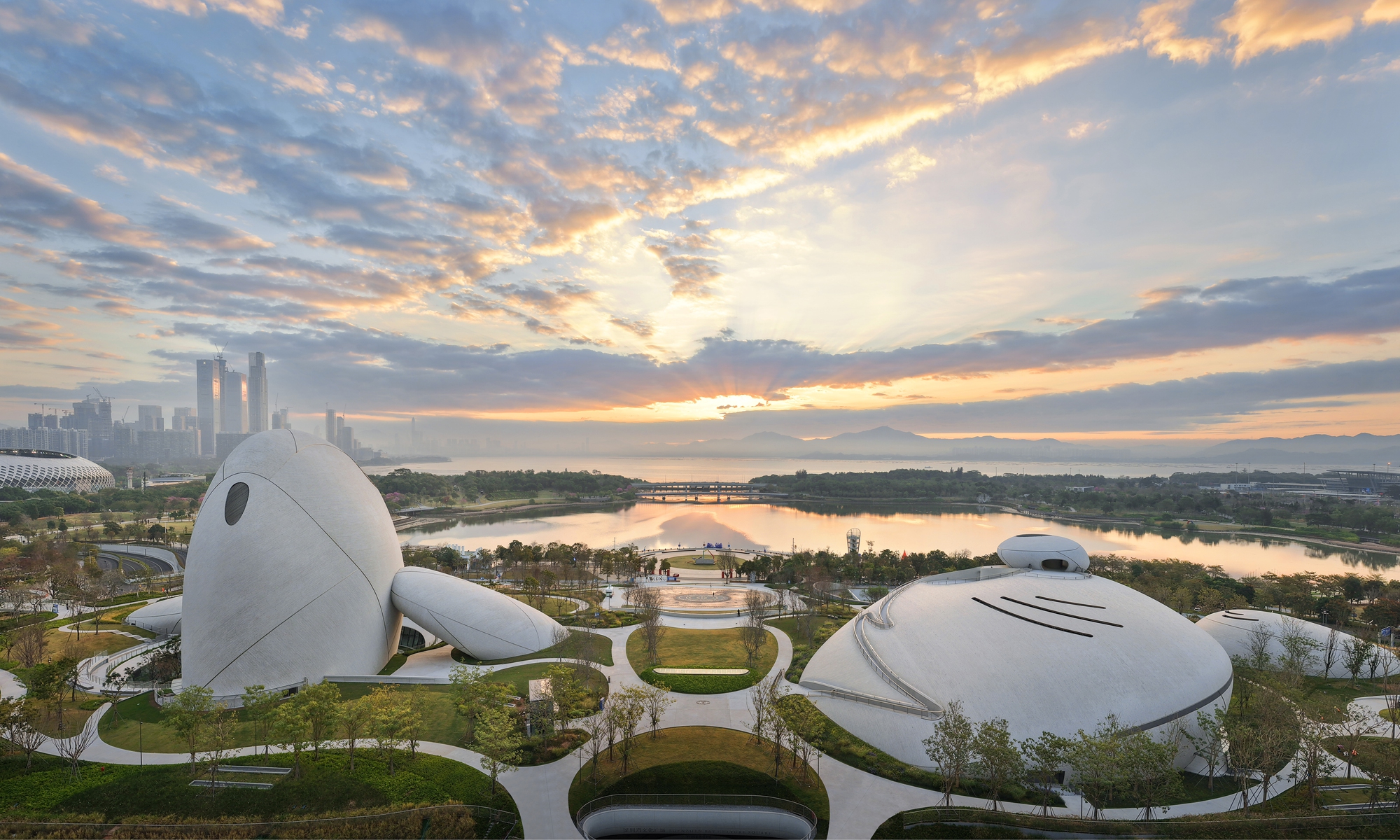
The Shenzhen Bay Cultural Plaza is the clearest expression of that change. The site covers more than 50,000 square meters. Conventional thinking would have produced a prominent landmark. However, Ma pressed most of the building underground.
Above ground he left only a few massive volumes that resemble weathered coastal rocks. The greater part of the roof became continuous grassy slopes that merge with the neighboring Shenzhen Talent Park and remain open to the public 24 hours a day.
Few visitors realize that the lawn where Liao and his daughter rest occupies land worth several billion yuan. In London or New York, such a waterfront would likely hold glass towers whose top floors sell for tens of millions of dollars. Shenzhen chose differently. It returned the horizon to grass. No office towers, no luxury residences - only a cultural plaza.
"There is no formula that told them a cultural space was the right answer," Ma observed. "They simply felt it mattered. Our imagination and our emotions need open places."
What gives Ma the greatest pride is not the engineering but the life that unfolds inside his spaces: young people climbing the stone forms wearing Monkey King masks and families simply lying on the grass.
"Architecture is a stage," he said. "Different dramas can take place on it. You enter not only as an audience member; you become a performer yourself."
He resists monumental buildings that make people feel small. "Traditional classical architecture concerned the relationship between humans and the gods," he noted. "Future architecture should concern the relationship between humans and themselves, and between humans and nature." The move from the scale of the divine to the scale of the human is, in his view, a profound change.
That change speaks directly to a larger question facing the world: whether different civilizations will seek to dominate one another or learn to listen. The China-proposed Global Civilization Initiative answers with the second choice - respect for diversity, dialogue across cultures, and the shared work of inheritance and innovation. Ma's stones and grass offer an architect's version of the same principle: step back first, and leave the stage open.
The singer's road home
Shi Yijie's path began in the old streets of Zhangjiang, Pudong, Shanghai. As a boy, he was selected for the school choir; in junior high, he joined the Chuansha Children's Palace choir and sang there for six years before turning professional.
He studied in Japan, washing dishes in restaurants while training his voice. Later he reached the central stages of European opera. He became the first Chinese singer to appear at the Rossini Opera Festival and headlined the Festival for five straight years with resounding success, quickly emerging as a prominent star in the world of opera.
For years he sang Western stories, Italian, French, German, in the most authentic style.
Yet a quieter question grew louder. "Did I not also want to use the universal language of classical music to tell Chinese stories?" In 2010, he first portrayed a Chinese character on the operatic stage, as Tang Qisheng in Ye Xiaogang's Song of Farewell. In the opera, Tang Qisheng, a refined, well-born playwright and Peking Opera devotee, pours his unrequited love into writing the new Peking Opera play Farewell My Concubine. The role felt like a door opening.
He paused, then continued: "To take bel canto as a meeting ground, so that Chinese art songs and Chinese opera can reach world audiences with a familiar texture, allowing them to feel the different emotional colors and aesthetic values of Chinese music - that is another kind of confidence."
The first path proves that Chinese artists can excel at Western forms. The second invites the world to listen to Chinese forms on equal terms. Shi chose the second. He began placing Chinese art songs deliberately into his overseas programs: "Homesickness," "How Can I Not Think of Her," "Red Bean Poem."
The work is never simple transplantation. The tones and final consonants of Putonghua sit uneasily with the pure vowel flow of Italian. Shi neither abandons Chinese flavor for vocal ease nor sacrifices technical line for linguistic accuracy. He seeks a precise balance in which every syllable remains clear and every melodic arc still moves like silk.
He likens Western art song to oil painting - dense and richly colored - and Chinese art song to ink landscape: spare, translucent, attentive to empty space and atmosphere. Its deepest quality, he believes, is restraint. "This is not the suppression of feeling," he said. "It is rooted in a cultural character cultivated over a thousand years."
As president of the Shanghai Opera House, he has launched a national training program for young Chinese opera artists in partnership with Italian houses. Plans include a joint production of an opera based on the Butterfly Lovers legend with the Teatro Lirico di Cagliari.
The movement has shifted from going out to growing roots. "I hope the experience and resources I gathered can truly return to the development of Chinese opera," he said.
At first glance, a grass-covered roof in Shenzhen and a bel canto rehearsal in Shanghai appear to belong to different worlds. But both men are engaged in the same delicate translation: turning an inheritance into a living grammar, rather than a fixed symbol. Ma translates the hutong memory of distant hills into a public meadow; Shi translates the restraint of a Song-dynasty line into a vowel that can be heard in any opera house. Neither is exporting an image. Both are offering an experience.
A shared practice of listening
In the hands of Ma and Shi, the principles at the heart of the Global Civilization Initiative, respect for the diversity of civilizations, stronger people-to-people exchange, and the shared work of transmitting and renewing cultural heritage, become concrete. Neither man remains at the stage of proving that Chinese practitioners can master Western models.
Ma no longer needs to demonstrate that Chinese architects can design skyscrapers. He asks how Chinese understandings of nature and empty space can become spatial languages that other cultures can feel. Shi no longer needs to prove that Chinese singers can perform Rossini. He asks how the deep feeling and restraint of classical Chinese poetry can travel through the shared grammar of music into hearts that do not speak Chinese.
Behind their work lies a quieter cultural awareness: not the one-way announcement "I am here," but the invitation "let us make it together." Ma now places greater weight on understanding another culture's traditions, its anxieties and the difficulties it faces in the present. Shi structures his training program so that Italian and Chinese creative forces meet at the same table.
Both men, through their own disciplines, answer a common question: how should a confident civilization conduct itself in the world?
As evening approaches, the stones of Shenzhen Bay take on the warm color of sunset. Liao's daughter grows tired and returns to sit beside him. She points at the great rock forms. "Papa, were they always growing here?" Liao pauses, then smiles and touches her head. "Maybe."
The cleaner gathers her cleaning equipment and pushes her cart past a stone wall that she had polished all afternoon. The low sun stretches her shadow across the smooth surface until it looks like a mirror.
Ma likes to watch quietly. He expected these scenes. Or rather, he designed the place so that they could occur.
In another city, Shi may be preparing for an evening performance. On stage he will close his eyes for a moment and send the breath to the farthest row.
What the listeners hear, Chinese or not, is not a statement. It is a long, sustained exhalation that carries the river with it, asking to be understood on its own terms.
In an era marked by unprecedented global transformations, the world stands at a critical crossroads, grappling with deepening deficits in peace, development, security and governance. As humanity faces unparalleled challenges during this tumultuous period, Xi Jinping, general secretary of the Communist Party of China (CPC) Central Committee and Chinese president, has put forth a solemn call to action through the Global Development Initiative, the Global Security Initiative, the Global Civilization Initiative and the Global Governance Initiative. The four pivotal initiatives address the pressing issues of our time, offering viable pathways and robust support for building a community with a shared future for humanity.
Rooted in the rich historical experiences of the CPC's century-long struggle and infused with the wisdom of China's traditional culture, these initiatives are expected to unite the world in the pursuit of common progress and stability. To offer a deeper understanding of the four major global initiatives and elaborate on their global significance, the Global Times is launching a series of articles.
In this installment, Global Times reporter Xu Liuliu talks with architect Ma Yansong and tenor Shi Yijie, exploring how their work in space and sound embodies the core principles of the Global Civilization Initiative: respect for civilizational diversity, people-to-people exchange, and the joint inheritance and innovation of cultural heritage; while reimagining how civilizations speak to one another.
The view of Shenzhen Bay Cultural Plaza by Ma Yansong Photo: Courtesy of MAD Architects
On a mild weekend morning in South China's Shenzhen, Liao Sheng, who is in his 40s, and his eight-year-old daughter stepped onto the undulating green roof of the Shenzhen Bay Cultural Plaza. The girl slipped off her shoes and ran barefoot across the grassy slopes. Liao sat and watched the water, fine waves moving like silk under the sun.Nearby, a cleaner was finishing her shift. Not long before, a photo of her standing on a transparent section of the roof, mop in hand, had gone viral. Online she was called "the auntie who cleans the heavens." Liao raised his phone and took a picture of his own.
The architect who designed these stone-like forms felt a deeper satisfaction when he saw the same image.
"An environment that makes ordinary people think like artists," Ma Yansong said in an interview with the Global Times. "The person holding the camera becomes a creator. The cleaning woman performs on a vast stage of her own."
Hundreds of miles away in Shanghai, the tenor Shi Yijie guided young singers through a single line: "Gong Yin Chang Jiang Shui" - we drink from the same Yangtze River. "Do not close the vowel too soon on the word for water," he told them. "Let the breath carry it and finish slowly." Filtered through the breath control of Italian bel canto, the line from Song Dynasty (960-1127) remained thoroughly Chinese yet needed no translation.
One man shapes space with stone and grass. The other shapes sound with breath and language. Both pursue the same quiet question: how can you speak the deepest layers of Eastern culture in a language the whole world can understand.
Yet their answers are not simply aesthetic choices. They are working examples of the kind of cultural dialogue the Global Civilization Initiative calls for: not a one-way announcement, but an invitation to shared experience. Ma and Shi arrive at this principle from opposite directions - one by emptying a city's skyline, the other by filling a concert hall with breath. Together they suggest that cultural confidence is not measured by how loudly a civilization announces itself, but by how much space it leaves for others to listen.
The architect who learned to step back
Ma grew up in the hutongs of Beijing. As a boy, he climbed onto gray-tiled roofs to watch pigeons circle and catch sight of the Western Hills in the distance. "City and nature were still connected then," he recalled.
After graduating from Yale's School of Architecture and working in New York and London, Ma's sense of loss grew sharper. In 2006, his design for the Absolute Towers in Canada became the first major international commission won by a Chinese architect. Recognition arrived. Yet for a long time afterward, Ma found himself designing in a mode of insistence. "I just want to be different from other people," he once said.
The shift came gradually. After 51, he began speaking more often of "stepping back."
The Shenzhen Bay Cultural Plaza is the clearest expression of that change. The site covers more than 50,000 square meters. Conventional thinking would have produced a prominent landmark. However, Ma pressed most of the building underground.
Above ground he left only a few massive volumes that resemble weathered coastal rocks. The greater part of the roof became continuous grassy slopes that merge with the neighboring Shenzhen Talent Park and remain open to the public 24 hours a day.
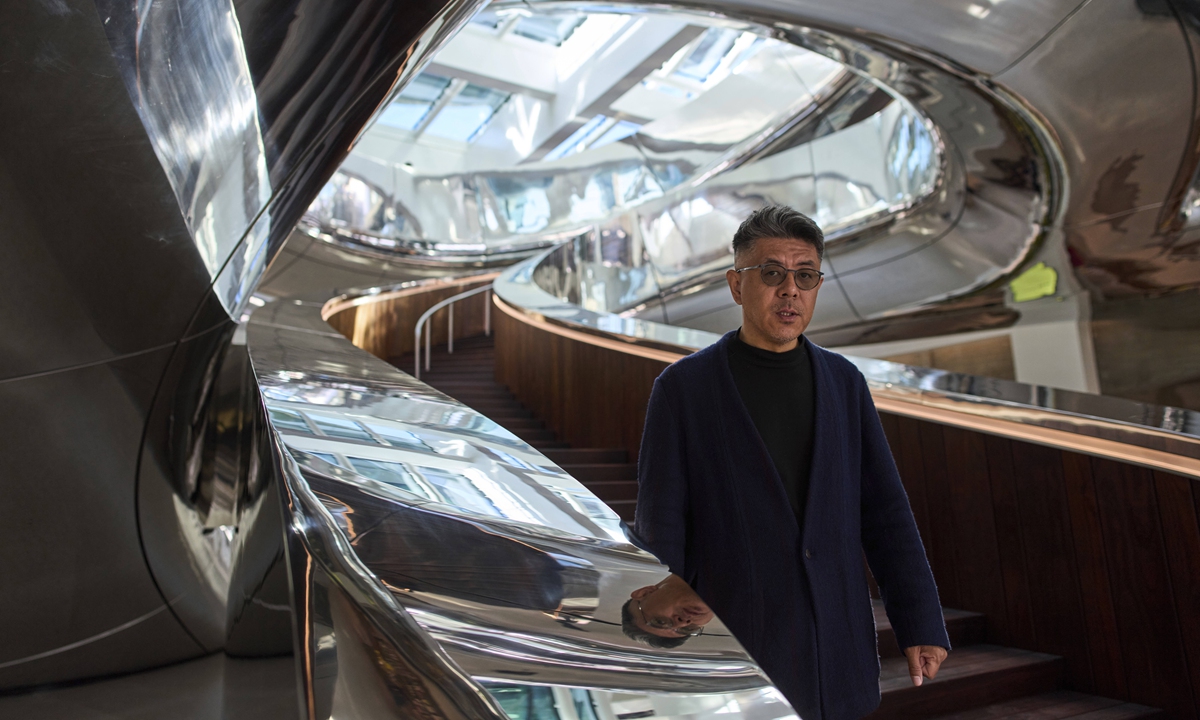
Architect Ma Yansong poses for a portrait at the Fenix Migration Museum in Rotterdam, Netherlands, on May 14, 2025. Photo: VCG
"I wanted a decentralized environment," he explained. "Very few places in the world still do this."Few visitors realize that the lawn where Liao and his daughter rest occupies land worth several billion yuan. In London or New York, such a waterfront would likely hold glass towers whose top floors sell for tens of millions of dollars. Shenzhen chose differently. It returned the horizon to grass. No office towers, no luxury residences - only a cultural plaza.
"There is no formula that told them a cultural space was the right answer," Ma observed. "They simply felt it mattered. Our imagination and our emotions need open places."
What gives Ma the greatest pride is not the engineering but the life that unfolds inside his spaces: young people climbing the stone forms wearing Monkey King masks and families simply lying on the grass.
"Architecture is a stage," he said. "Different dramas can take place on it. You enter not only as an audience member; you become a performer yourself."
He resists monumental buildings that make people feel small. "Traditional classical architecture concerned the relationship between humans and the gods," he noted. "Future architecture should concern the relationship between humans and themselves, and between humans and nature." The move from the scale of the divine to the scale of the human is, in his view, a profound change.
That change speaks directly to a larger question facing the world: whether different civilizations will seek to dominate one another or learn to listen. The China-proposed Global Civilization Initiative answers with the second choice - respect for diversity, dialogue across cultures, and the shared work of inheritance and innovation. Ma's stones and grass offer an architect's version of the same principle: step back first, and leave the stage open.
The singer's road home
Shi Yijie's path began in the old streets of Zhangjiang, Pudong, Shanghai. As a boy, he was selected for the school choir; in junior high, he joined the Chuansha Children's Palace choir and sang there for six years before turning professional.
He studied in Japan, washing dishes in restaurants while training his voice. Later he reached the central stages of European opera. He became the first Chinese singer to appear at the Rossini Opera Festival and headlined the Festival for five straight years with resounding success, quickly emerging as a prominent star in the world of opera.
For years he sang Western stories, Italian, French, German, in the most authentic style.
Yet a quieter question grew louder. "Did I not also want to use the universal language of classical music to tell Chinese stories?" In 2010, he first portrayed a Chinese character on the operatic stage, as Tang Qisheng in Ye Xiaogang's Song of Farewell. In the opera, Tang Qisheng, a refined, well-born playwright and Peking Opera devotee, pours his unrequited love into writing the new Peking Opera play Farewell My Concubine. The role felt like a door opening.
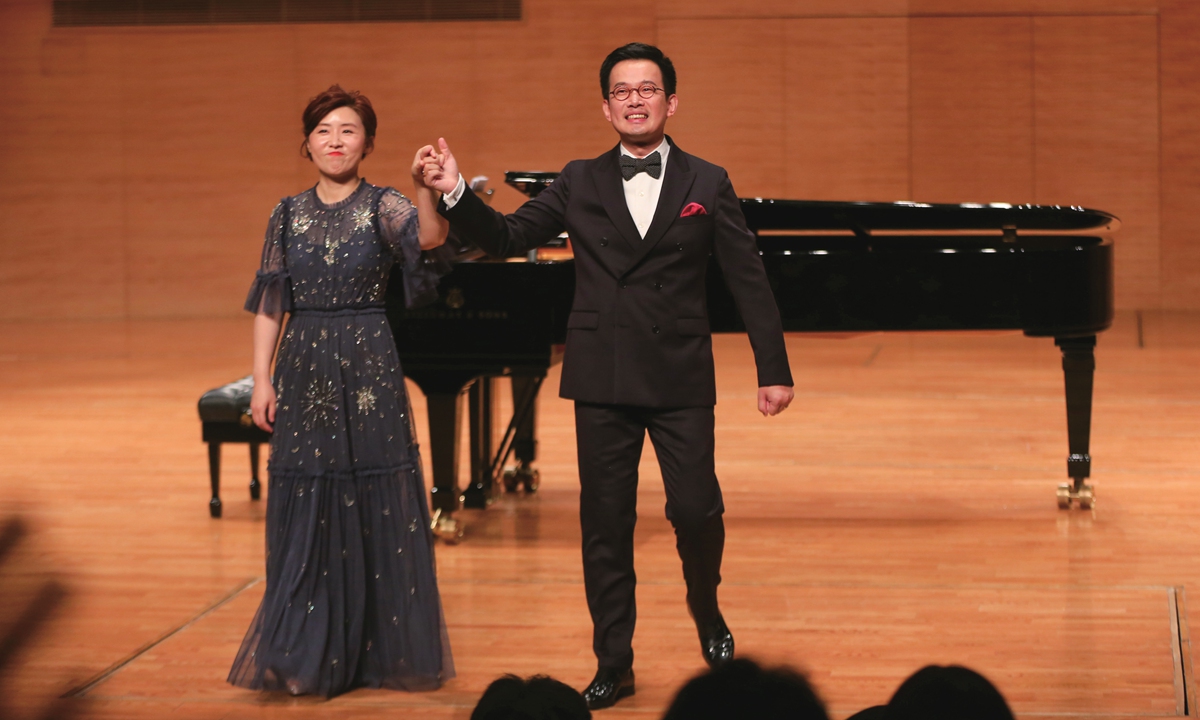
Chinese tenor Shi Yijie (right) performs in a theater in Shenyang, Northeast China's Liaoning Province. Photo: VCG
Around the same time, he began examining what cultural confidence truly required. "To stand on international stages, to master the shared technical system of Western vocal music, and to perform the great European operas with genuine authority - that is one form of confidence," he said. "But for me it is not the destination."He paused, then continued: "To take bel canto as a meeting ground, so that Chinese art songs and Chinese opera can reach world audiences with a familiar texture, allowing them to feel the different emotional colors and aesthetic values of Chinese music - that is another kind of confidence."
The first path proves that Chinese artists can excel at Western forms. The second invites the world to listen to Chinese forms on equal terms. Shi chose the second. He began placing Chinese art songs deliberately into his overseas programs: "Homesickness," "How Can I Not Think of Her," "Red Bean Poem."
The work is never simple transplantation. The tones and final consonants of Putonghua sit uneasily with the pure vowel flow of Italian. Shi neither abandons Chinese flavor for vocal ease nor sacrifices technical line for linguistic accuracy. He seeks a precise balance in which every syllable remains clear and every melodic arc still moves like silk.
He likens Western art song to oil painting - dense and richly colored - and Chinese art song to ink landscape: spare, translucent, attentive to empty space and atmosphere. Its deepest quality, he believes, is restraint. "This is not the suppression of feeling," he said. "It is rooted in a cultural character cultivated over a thousand years."
As president of the Shanghai Opera House, he has launched a national training program for young Chinese opera artists in partnership with Italian houses. Plans include a joint production of an opera based on the Butterfly Lovers legend with the Teatro Lirico di Cagliari.
The movement has shifted from going out to growing roots. "I hope the experience and resources I gathered can truly return to the development of Chinese opera," he said.
At first glance, a grass-covered roof in Shenzhen and a bel canto rehearsal in Shanghai appear to belong to different worlds. But both men are engaged in the same delicate translation: turning an inheritance into a living grammar, rather than a fixed symbol. Ma translates the hutong memory of distant hills into a public meadow; Shi translates the restraint of a Song-dynasty line into a vowel that can be heard in any opera house. Neither is exporting an image. Both are offering an experience.
A shared practice of listening
In the hands of Ma and Shi, the principles at the heart of the Global Civilization Initiative, respect for the diversity of civilizations, stronger people-to-people exchange, and the shared work of transmitting and renewing cultural heritage, become concrete. Neither man remains at the stage of proving that Chinese practitioners can master Western models.
Ma no longer needs to demonstrate that Chinese architects can design skyscrapers. He asks how Chinese understandings of nature and empty space can become spatial languages that other cultures can feel. Shi no longer needs to prove that Chinese singers can perform Rossini. He asks how the deep feeling and restraint of classical Chinese poetry can travel through the shared grammar of music into hearts that do not speak Chinese.
Behind their work lies a quieter cultural awareness: not the one-way announcement "I am here," but the invitation "let us make it together." Ma now places greater weight on understanding another culture's traditions, its anxieties and the difficulties it faces in the present. Shi structures his training program so that Italian and Chinese creative forces meet at the same table.
Both men, through their own disciplines, answer a common question: how should a confident civilization conduct itself in the world?
As evening approaches, the stones of Shenzhen Bay take on the warm color of sunset. Liao's daughter grows tired and returns to sit beside him. She points at the great rock forms. "Papa, were they always growing here?" Liao pauses, then smiles and touches her head. "Maybe."
The cleaner gathers her cleaning equipment and pushes her cart past a stone wall that she had polished all afternoon. The low sun stretches her shadow across the smooth surface until it looks like a mirror.
Ma likes to watch quietly. He expected these scenes. Or rather, he designed the place so that they could occur.
In another city, Shi may be preparing for an evening performance. On stage he will close his eyes for a moment and send the breath to the farthest row.
What the listeners hear, Chinese or not, is not a statement. It is a long, sustained exhalation that carries the river with it, asking to be understood on its own terms.
RELATED ARTICLES