Xi urges China, Ecuador to strengthen alignment of devt strategies in meeting with Noboa
Two sides sign cooperation documents covering green industries, trade, digital economy
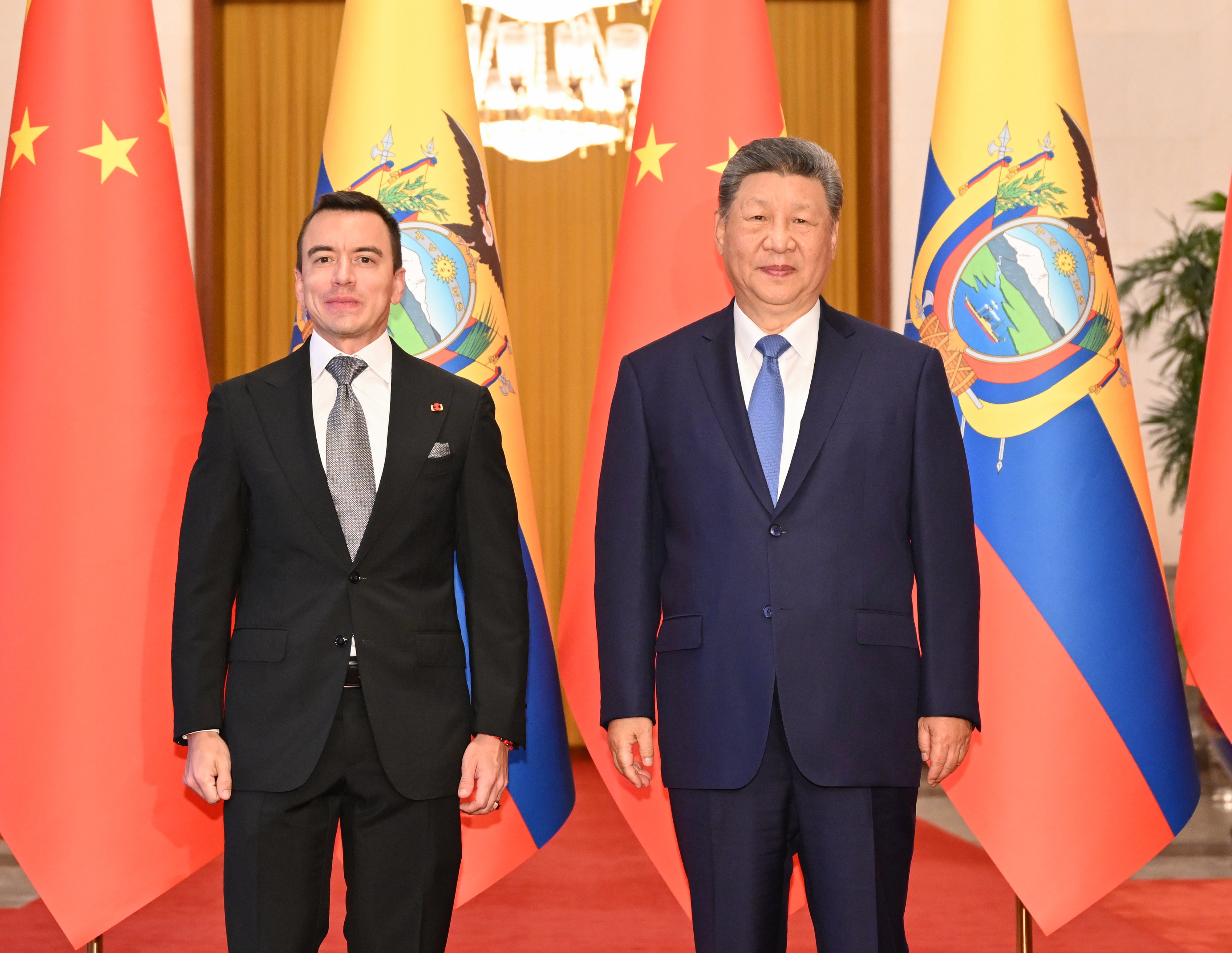
Chinese President Xi Jinping holds talks with President of the Republic of Ecuador Daniel Roy-Gilchrist Noboa Azín, who is on a state visit to China, at the Great Hall of the People in Beijing, capital of China, Aug. 18, 2026. Photo: Xinhua
Chinese President Xi Jinping held talks with President of the Republic of Ecuador Daniel Roy-Gilchrist Noboa Azín in Beijing on Tuesday, with the two leaders agreeing to further advance cooperation in multiple areas and exchanging views on the situation in Latin America and the Caribbean, the Xinhua News Agency reported.The trip is Noboa's first state visit to China since taking office as Ecuador's President. It's also President Noboa's second visit to China following his initial trip in June 2025 for the Annual Meeting of the New Champions in Northeast China's Dalian.
After the talks, the two heads of state witnessed the signing of multiple cooperation documents covering green industries, economic and trade cooperation, the digital economy and people's livelihoods, according to Xinhua.
Consolidate new opportunities
During the meeting, President Xi urged China and Ecuador to strengthen the alignment of development strategies and implement the cooperation plan to jointly build the Belt and Road, according to Xinhua.
The two sides should well implement cooperation projects in energy, minerals, infrastructure construction, finance and other fields, and actively explore cooperation in areas including the digital economy, green development, new energy and artificial intelligence, Xi said.
The Ecuador President's official X account said in a post released on Tuesday that the important topics during the meeting include opening more markets for the country's products and expanding cooperation in technology, infrastructure, energy, and education. The account also depicted that the visit strengthens the ties between both countries and seeks to consolidate new opportunities for cooperation for Ecuador.
China-Ecuador cooperation has now evolved from individual projects into a more systematic and long-term partnership, where cooperation has shifted from scattered project-based cooperation toward a more institutionalized, normalized and long-term partnership, Pan Deng, director of the Latin America and Caribbean Region Law Center at the China University of Political Science and Law, told the Global Times on Friday.
From the meeting, we can see bilateral cooperation is expanding beyond traditional fields such as mining, energy and infrastructure into emerging sectors including green development, renewable energy and artificial intelligence, Pan said.
"This reflects China's willingness to share new technologies and help bridge the digital divide," the expert said, adding that it also demonstrates Ecuador's demand for new development opportunities as it seeks to upgrade its economic structure.
China has for consecutive years stood as Ecuador's second largest trading partner. Figures from China's Ministry of Foreign Affairs show that the bilateral trade volume stood at $17.33 billion in 2025, marking a 24 percent year-on-year rise. For the January-April period of 2026, bilateral trade totaled $6.28 billion, representing nearly 20 percent year-on-year growth.
"The complementary nature of the two economies remains a key driver of cooperation, and it would play a role in any Latin American country that hopes to attract Chinese investment to improve their economic structures and upgrade infrastructure," Zhou Zhiwei, an expert on Latin American studies at the Chinese Academy of Social Sciences, told the Global Times.
"The foundation of cooperation is very solid," Zhou said, noting that China-Latin America relations have expanded beyond economic and financial areas and developed into broader political trust.
China acts as the 'certainty'
Beyond practical cooperation, the two heads of state also exchanged views on the situation in Latin America and the Caribbean.
Xi said China supports Latin American countries in upholding independence and self-reliance, pursuing foreign cooperation based on their national interests, and safeguarding regional peace and stability, according to Xinhua.
He stressed that China has always maintained that the status of the Latin American and Caribbean region as a zone of peace should not be shaken, the course of development and revitalization of Latin American and Caribbean countries should not be disrupted, and the right of Latin American and Caribbean countries to independently choose their cooperation partners should not be interfered with.
Against the backdrop of rising regional uncertainties, including hegemonism, trade protectionism, and even localized military conflicts, China is increasingly viewed by Global South countries through a broader lens beyond economic cooperation, Zhou said.
"Actions speak louder than words," Zhou said. "China plays the role of 'certainty' through a win-win approach, which is why more and more Global South countries are turning to China and upgrading cooperation."
Noboa's visit reflects a broader trend among Global South countries seeking more diverse cooperation opportunities, said Pan.
Facing structural constraints in its development, Ecuador has not tied its external relations to a single outside force, but instead has pursued a balanced foreign policy by expanding cooperation with different partners according to its own national interests, he added.
For many countries in the Global South, Pan noted, Ecuador's experience provides a practical path: countries do not need to abandon existing economic ties while expanding cooperation with new partners. Instead, by diversifying markets and cooperation channels, they can strengthen economic resilience and reduce risks brought by external uncertainties.
The growing interaction between China and Ecuador comes amid increasing exchanges between China and other Global South countries.
Since the beginning of this year, senior officials and leaders from a number of Latin American countries, including Uruguay and Chile, have strengthened high-level exchanges with China. Chilean Foreign Minister Francisco Perez Mackenna is scheduled to pay an official visit to China from August 18 to 22.
"For Beijing, hosting Orsi... signals that South American countries remain eager to engage, despite the increasingly polarized geopolitical environment," a professor at the Pontifical Catholic University of Chile was quoted by Reuters as saying during Uruguayan President Yamandú Orsi's visit to China in February.
In the energy sector, Chile has expressed interest in learning from China's experience in clean energy development, improving relevant policies and attracting more Chinese investment in renewable energy.
As emerging economies seek more stable development opportunities in a changing global landscape, the China-Ecuador relationship has become one example of how Global South countries are expanding partnerships based on mutual interests, diversified cooperation and shared development goals, Zhou said.
The increasing tempo of visits by Latin American leaders and senior officials demonstrates that practical cooperation between the two sides remains resilient despite changes in the external environment, Chinese analysts stressed.
RELATED ARTICLES