Where are the policy dividends and market opportunities in Macao's Third Five-Year Plan?: Hai Feng
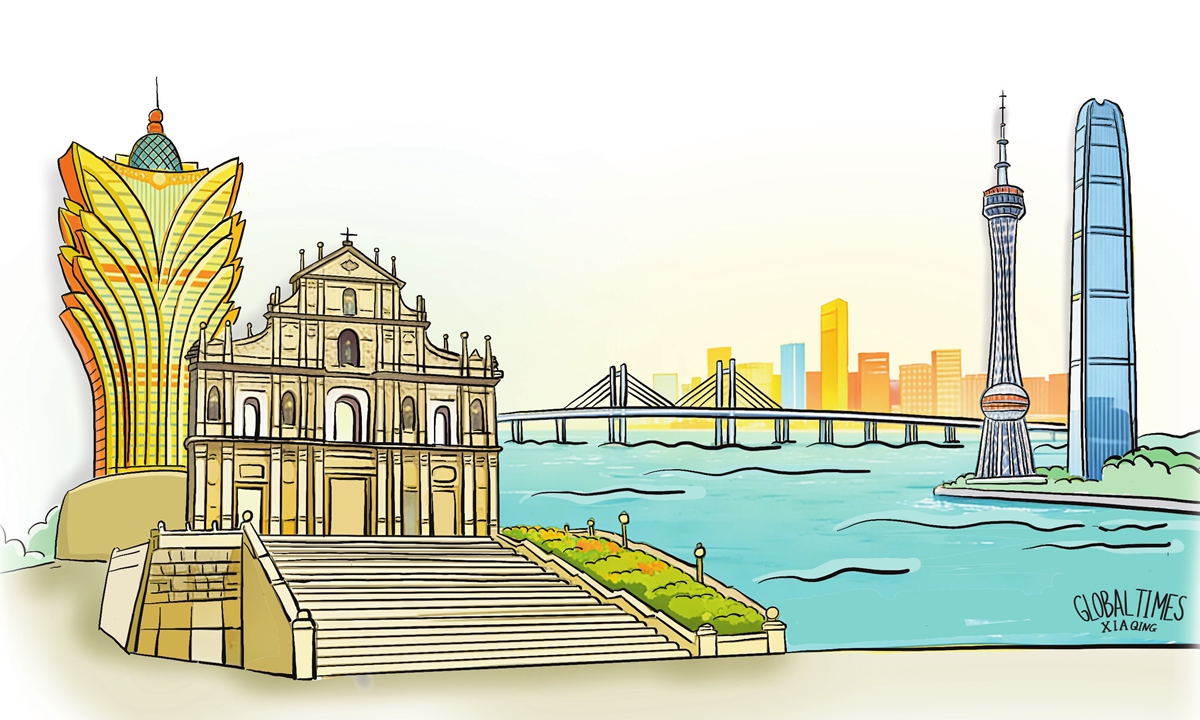
Macao's Third Five-Year Plan Illustration: Xia Qing/GT
On Tuesday, Macao officially unveiled its Third Five-Year Plan. The significance of this third blueprint for the city's future development lies in marking a clear turning point: Long reliant on gaming as its pillar industry, Macao is restructuring its growth engine under the combined force of national strategies, Hengqin's physical space and massive policy investment.In the past, discussions on Macao's appropriate economic diversification mostly centered on "whether to transform." Now, the Third Five-Year Plan answers "what to rely on, who will invest, where to land and how to achieve results." Deploying approximately 130 billion patacas ($16.1 billion) in major project investments, government guidance funds, four major projects, Macao-Hengqin integrated development, institutional environment upgrades and accelerated urban renewal, these combined initiatives signal a systemic restructuring rather than isolated benefits.
For the market, Macao is shifting from a purely tourist destination into a novel economic node defined by the combination of international platform, Hengqin as a hinterland and Greater Bay Area synergy.
Why now?
The challenge of Macao's over-reliance on a single industry is not new. While the gaming industry brought prosperity, fiscal revenue and global visibility, it left Macao exposed to a single-track industrial structure, weak risk resilience and constrained physical space. In boom times, risks were masked; when shocks hit, vulnerabilities were instantly exposed. Therefore, appropriate economic diversification has never been a mere "icing on the cake" - it is an essential requirement for Macao's long-term prosperity and stability.
The core value of the Third Five-Year Plan is that it marks a transition from directional discussions into a stage of systemic execution. The plan provides concrete backing in funding, projects, platforms, land, talent, institutions and spatial capacity. In particular, the deployment of roughly 130 billion patacas into major projects proves that Macao is not patching up its old model, but laying foundations, building frameworks and constructing engines for future industries.
Several macro factors converge at this moment: China's 15th Five-Year Plan sets new expectations and opportunities for Macao, while the Guangdong-Macao In-Depth Cooperation Zone in Hengqin resolves Macao's land constraints. Greater Bay Area synergy also connects Macao to a far broader market. Furthermore, shifting international trade environments highlight Macao's unique advantage of being "backed by the motherland and connected to the world." Since the window of opportunity is now open, Macao can no longer rest on its laurels; it must actively pave new ground.
130 billion patacas investment: more than just projects
During the Third Five-Year Plan period, Macao will invest approximately 130 billion patacas into major projects for economic diversification and establish government guidance funds. The significance of this capital lies in the shifting role of government.
In the past, businesses worried less about missing opportunities than market certainty, project infrastructure, talent pipelines and whether industry clusters could form. Government guidance funds address this by leveraging "government capital first, followed by private capital and industrial resources" to lower early-stage trial costs for the market and build nursery conditions for emerging industries.
For businesses, this signals three main shifts. First, Macao will take a more proactive approach to attracting investment. International advanced technologies, innovative enterprises and high-end talent will all receive more targeted institutional support in the future.
Second, Macao will place greater emphasis on "industrial chains" rather than individual enterprises. True policy benefits will not simply consist of subsidies for a single company. They will foster an ecosystem - through industrial parks, funds, universities, platforms and cross-border mechanisms - where enterprises choose to stay, talent is attracted and technology is successfully commercialized.
Third, Macao will place greater emphasis on market expectations. The plan calls for fostering a "fair, transparent and predictable" market order and business environment, which is more important than one-time incentives. Whether enterprises dare to make long-term investments and whether capital is willing to position itself in advance depends not on temporary subsidies, but on whether the rules are stable, policies are consistent and the market can see a clear future.
Four major projects present sectors truly worth watching
The highest-value components of the Third Five-Year Plan are its four major projects. Rather than generic construction endeavors, they serve as concrete entry points for future industry opportunities.
The first sector worth watching is the "talent-research-industry" pipeline behind Education Town. The Macao-Hengqin International Education (University) Town addresses Macao's higher education space shortages and limited research commercialization capacity. Extending Macao universities' operations into Hengqin is not just about building extra facilities; it unlocks space for international education, research collaboration, talent development and technological transfer. Surrounding the University Town, new demand will emerge for educational services and research platforms; laboratory development and international academic exchanges; youth apartments, tech incubators and vocational training. Whoever serves these universities, links research and captures commercial output will share in this cluster dividend.
The second sector is the model of "Macao R&D and Hengqin commercialization" via the tech park. The Macao Technology Research Industrial Park focuses on digital technology, biomedicine, integrated circuits and aerospace technology, explicitly targeting sub-sectors like artificial intelligence (AI), innovative pharmaceuticals, RISC-V open-source architecture and aerospace data services. This sends a clear message: Macao's technology sector is moving beyond academic research into a new era of industrialization, commercialization and internationalization.
For technology companies, Macao's value lies in its international platform, research resources and institutional advantages; Hengqin's value, meanwhile, lies in its industrial space, manufacturing capabilities and market reach. The combination of the two represents the practical path toward "Macao R&D and Hengqin commercialization"
For companies in fields such as AI, biopharmaceuticals, chip design and digital services, the earlier they enter this ecosystem, the greater their opportunity to secure a leading position in terms of industrial parks, investment funds, talent, application scenarios and cross-border cooperation.
The third one is new consumption upgrades behind the Tourism and Culture Zone. The Macao International Integrated Tourism and Culture Zone is not simply about adding a few tourist attractions. It aims to transform Macao's unique urban character - a fusion of Chinese and Western cultures - into higher-value-added cultural consumption.
In the future, Macao's competitiveness in tourism and culture cannot rely solely on gaming, hotels and shopping; it must also extend to richer forms of content consumption, such as museums, performing arts, conventions and exhibitions, fine arts, cultural experiences, international exchanges, and urban exploration. Projects such as the Macao National Museum of Culture, the International Performing Arts Center and the Macao Contemporary Art Center signify that Macao is striving not merely for "tourist numbers," but also for "longer visitor stays, higher‑tier consumption and greater international influence."
The fourth sector is cross-border logistics opportunities behind the Hengqin Upstream Cargo Terminal. On the surface, the Macao International Airport Hengqin Upstream Cargo Terminal appears to be a logistics project. In essence, however, it serves as a crucial fulcrum for Macao to enhance its air cargo competitiveness and connect to international trade networks.
By relocating functions such as airport security screening and palletizing to Hengqin, cargo handling efficiency can be improved, capacity expanded and synergies created with the expansion of Macao International Airport. For cross-border e-commerce, air logistics, cold-chain transportation, high-value-added product trade and supply chain service enterprises, this means that in the future, Macao will do more than receive visitors; it will carry out imports, exports and global‑oriented circulation with greater efficiency.
Macao's institutional advantages as a free port and a separate customs territory will thus open up greater opportunities for industrial development.
Hengqin: the greatest source of growth in the Third Five-Year Plan
To truly understand the Third Five-Year Plan, one must look beyond Macao itself and focus on Hengqin.
Macao's greatest natural constraint is land and space; its greatest strategic opportunity is Hengqin, which is not merely an "extension" of Macao. It is becoming a key hinterland for Macao's diversified industrial development. The integrated development of Macao-Hengqin is not merely a geographical merger, but a recombination of institutions, industries, talent, capital and markets.
Macao can leverage its strengths in internationalization, as a Portuguese-speaking hub, professional services, education and research, and tourism and conventions; Hengqin can provide industrial space, policy experimentation, project implementation capacity and the ability to connect to the vast mainland market. The most competitive enterprises of the future will not be those operating solely in Macao or Hengqin, but those capable of truly integrating the strengths of both regions.
Education will expand through Macao-Hengqin collaboration; technology will be commercialized through Macao-Hengqin synergy; finance will innovate through cross-border mechanisms; cultural and tourism industries will grow by leveraging resources from both regions; and logistics efficiency will be enhanced through the connection between Macao International Airport and the Hengqin cargo terminal. Those who can grasp the industrial logic of this "two-city, one-entity" model will be the first to capture the core benefits Macao has to offer over the next five years.
Macao's true opportunity lies in the transition from a 'single city' to a 'comprehensive platform'
The profound significance of the Third Five-Year Plan lies in transforming Macao's development logic.
In the past, Macao relied primarily on a single industry to sustain its prosperity; in the future, it will increasingly rely on the coordinated development of diverse industries such as education and technology, culture, tourism, conventions, healthcare, specialized finance and cross-border logistics.
In the past, Macao was constrained by its urban space; in the future, it will leverage Hengqin to expand its industrial reach. In the past, Macao was primarily a distinctive city within the region; in the future, it aims to become a multifaceted platform that serves the nation's high-level opening-up, connects Portuguese- and Spanish-speaking countries, and integrates into the development of the Greater Bay Area.
Therefore, the greatest policy benefit brought by this plan is not a specific subsidy, a single industrial park or a particular plot of land, but rather a clearer vision for development:
Macao is evolving from a "gambling-dominated city" to an "international platform for synergistic development across diverse industries"; from a "small city with limited space" to a "large-scale industrial system linking Macao and Hengqin"; and from "waiting for opportunities" to "proactively creating opportunities."
Opportunities are never distributed evenly. Those with insight will see the industrial restructuring behind 130 billion patacas; those with a broader vision will witness Macao's transformation from a "city favored by opportunity" to a "city that proactively builds platforms for opportunity."
Though small, Macao holds a promising future with the motherland behind it.
RELATED ARTICLES