Japan’s rush to revise ‘three security documents’ amounts to irrefutable evidence of triple violations
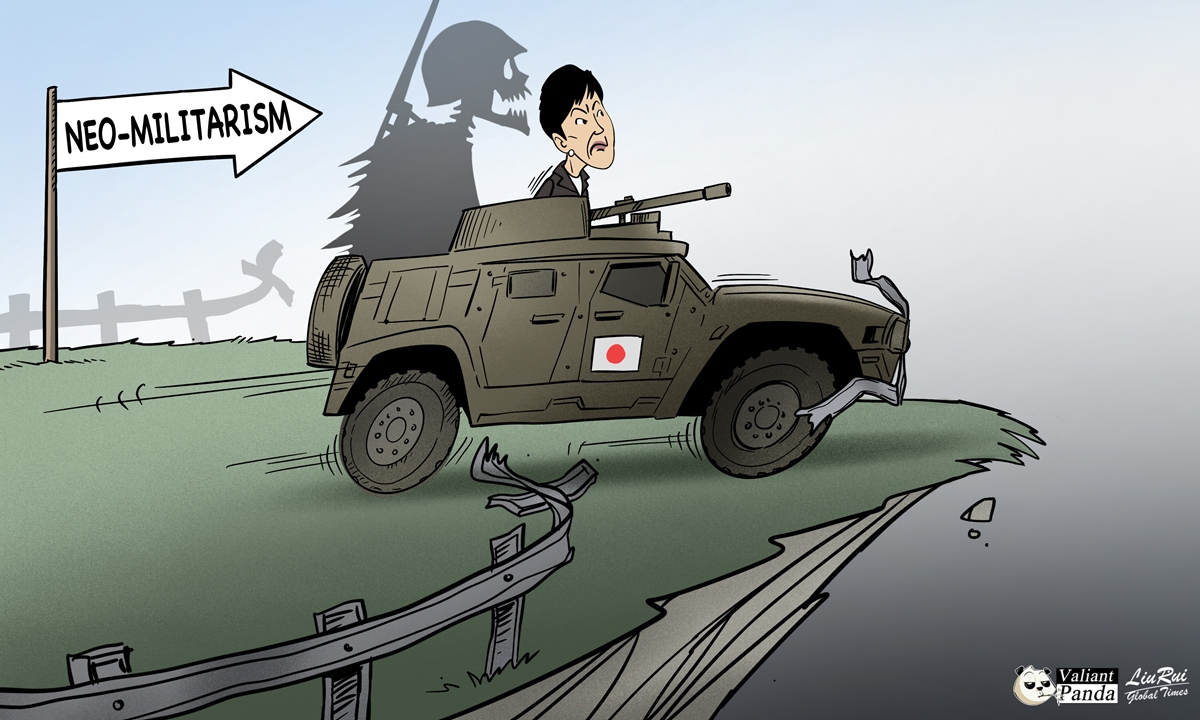
Illustration: Liu Rui/GT
Since the Sanae Takaichi administration came to power, Japan has significantly compressed its policy timetable and accelerated discussions on revising its "three security documents." In June, the Liberal Democratic Party (LDP) submitted an aggressive draft proposal for revisions to Takaichi. Since late April, the Japanese government has convened three expert panel meetings, while the 2026 edition of the Defense of Japan white paper, released in early August, introduced a new narrative of "boosting the economy through military expansion."
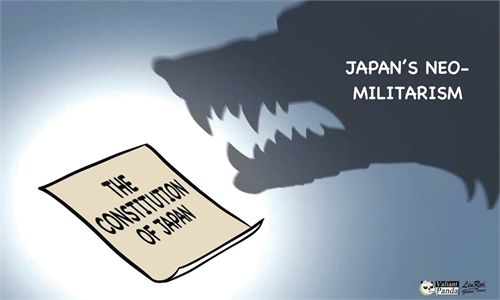
Taken together with Japan's moves in recent years to sharply increase defense spending, lift restrictions on exports of lethal weapons, establish a centralized intelligence and command hub, and strengthen its capacity for sustained military operations, these developments show that Japan's security policy is undergoing a drastic shift. Tokyo appears intent on completely breaking free from the constraints of the postwar pacifist constitution and building a "combat-oriented, whole-of-nation military system." Such moves seriously threaten the postwar international order and involve multiple violations of international and domestic law.
First, they violate Japan's international legal obligations as a defeated country. The Cairo Declaration, the Potsdam Proclamation and the Japanese Instrument of Surrender collectively established Japan's core obligations after the war: eliminating militarism, restricting its territorial scope and preventing the expansion of offensive military capabilities.
The LDP's draft proposal would, on the basis of the existing "three security documents," substantially strengthen Japan's long-range preemptive strike capabilities in areas ranging from the defense industry to operational structures. In substance, this is seeking to restore the status of a state with full belligerent rights and dismantle the binding postwar restrictions on Japan's right to wage war. The draft also openly links Japan's security perimeter to areas including the Taiwan Straits and the South China Sea, unilaterally expanding the scope for military intervention and seriously disrupting the postwar regional security order.
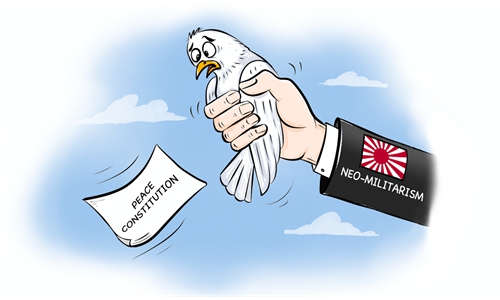
Second, they violate Japan's pacifist constitution. Article 9 of Japan's pacifist constitution explicitly renounces war as a sovereign right and bars the nation from possessing "war potential" such as military forces. Yet the LDP draft seeks to increase Japan's contribution to the military deployment architecture in the "Indo-Pacific," shifting its military strategy from "exclusively defense-oriented" to "active deterrence" and even preemption. This openly tramples on the pacifist constitution and completely casts aside the principle of "exclusively defense-oriented policy."
Third, they run counter to international rules governing arms transfers. One of the core principles of international arms control is to prevent weapons from reaching conflict zones and from exacerbating humanitarian crises. Yet the LDP draft proposal not only calls for a comprehensive relaxation of restrictions on arms exports, but explicitly stipulates that, under "certain circumstances," Japan could export weapons to countries involved in armed conflicts. This would completely overturn the previous restrictions that limited arms exports to five categories of non-combat purposes. It would mean that Japan could supply lethal weapons to conflict hotspots around the world, running counter to the purpose of the Arms Trade Treaty, to which Japan is a party, and creating a major source of instability for global peace.
Since the postwar period, Japan has continuously sought to erode its pacifist constitution through ordinary legislation, administrative reinterpretations, and policy documents, adopting a "salami-slicing" approach to gradually chip away at constitutional constraints, repeatedly testing the international community's red lines and seeking to "unbind" itself.
In the early years of the Cold War, the Japanese government established an armed Self-Defense Forces system through legislation in the name of "self-defense," arguing that Japan could exercise the right of individual self-defense if its territory came under a direct armed attack. After the end of the Cold War, the Japanese government, citing peacekeeping, counterterrorism, anti-piracy operations, and other justifications, gradually expanded the geographic scope of the Self-Defense Forces' activities, authorizing them to conduct logistical support missions overseas.
In 2014, the Abe government concocted the concept of a "survival-threatening situation," determining that Japan could exercise the right of collective self-defense on a limited basis if another country came under attack and Japan's own survival was deemed to be at risk.
In 2015, the Japanese Diet revised 10 key national security laws and passed the so-called International Peace Support Act, establishing the operational framework for the limited exercise of collective self-defense and enabling routine overseas deployments for support missions.
In 2022, the Kishida government formally adopted the "three security documents," introducing the capability to conduct counterstrikes against enemy bases and loosening the longstanding principle of "exclusively defense-oriented policy."
Judging from the draft proposal put forward by the LDP, the Takaichi government's accelerated push to revise the "three security documents" is by no means merely an adjustment to defense policy. Rather, it represents a systematic top-level design for Japan's "remilitarization": first, hollowing out the pacifist constitution through policy measures; then building an offensive-oriented military by increasing defense spending; and complementing this with arms exports, wartime mobilization, intelligence support, the relaxation of nuclear policy restrictions, and integration into the US' global military system.
The ultimate goal is to completely break free from the constraints of the postwar system and once again become a "military power" capable of independently initiating wars, conducting long-range strikes, and sustaining prolonged military operations. Japan's right-wing forces have repeatedly floated proposals to revise the "Three Non-Nuclear Principles," while Defense Minister Shinjiro Koizumi has even suggested that Japan should discuss nuclear policy "without any taboos," further fueling widespread concern.
These dangerous developments have triggered strong opposition within Japan. According to Japanese media reports, since the Takaichi administration took office, 128 local assemblies across Japan have submitted written opinions to the Diet calling on the government to uphold the "Three Non-Nuclear Principles." Thirty-two civil society organizations in Nagasaki Prefecture held a joint press conference to protest Defense Minister Koizumi's remarks concerning nuclear policy.
Large numbers of people have taken to the streets to criticize the government for expanding its military capabilities while disregarding people's livelihoods and well-being. The international community has also remained highly vigilant. Countries including Russia and North Korea have criticized Japan's attempts at "remilitarization" and stated that they will never tolerate a resurgence of Japanese militarism.
The lessons of history are not far behind us. A country, which once launched wars of militarist aggression, yet has never conducted a thorough reckoning with its history while right-wing forces have repeatedly sought to deny or even glorify its wars of aggression, is now steadily advancing "remilitarization" in the name of "defense." This represents an open challenge to the outcomes of the victory in World War II.
Facing efforts by Japan's right-wing forces to reverse the course of history, all parties committed to peace must remain highly vigilant and firmly oppose such actions, urging the Japanese authorities to abide by their obligations under international law and uphold the pacifist constitution, stop military adventurism aimed at breaking through the postwar system, and genuinely fulfill their international obligations. Any reckless attempt to return to the path of militarism will only bring profound disaster to Japan itself and to the Asia-Pacific region.
The author is an international affairs observer. opinion@globaltimes.com.cn
RELATED ARTICLES