Chinese warships exercise freedom of navigation – what business is it of Japan’s?
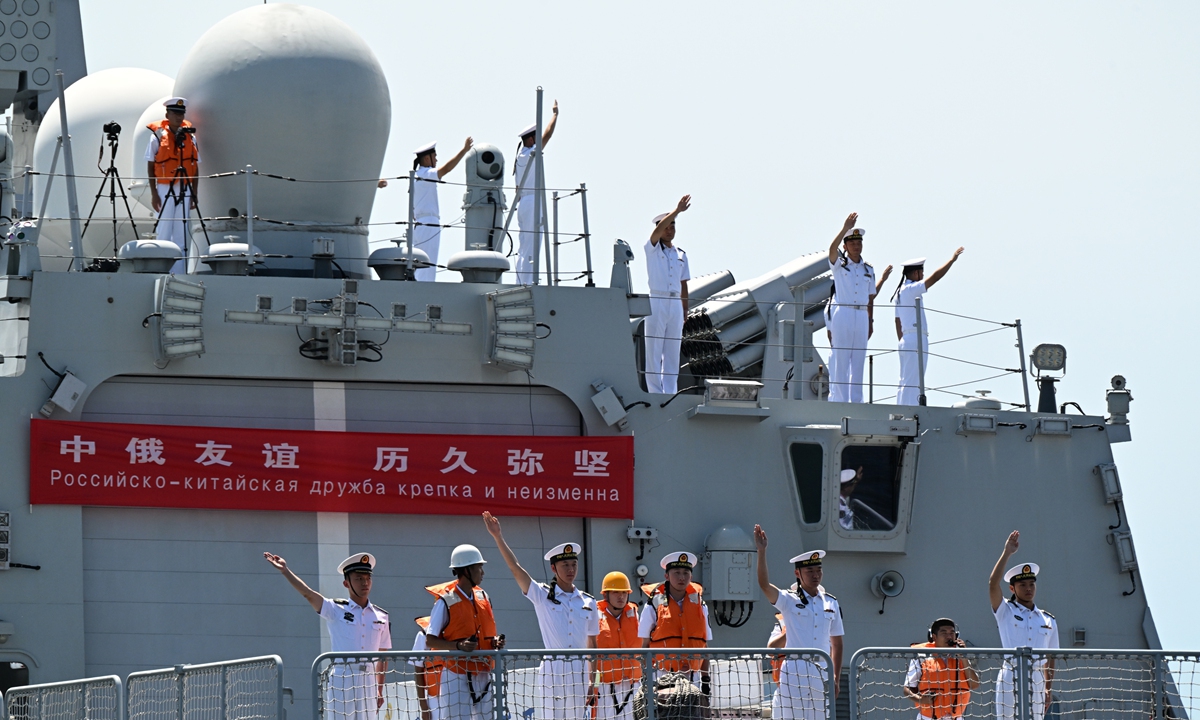
Crew members of the Chinese People's Liberation Army Navy guided-missile destroyer Kaifeng, after taking part in joint patrols with Russian Navy ships in the Pacific Ocean, stand on deck upon arrival at the port of Vladivostok, Russia, on July 28, 2026. The Russian and Chinese navies completed their sixth joint patrol in the Pacific Ocean, a mission that lasted two weeks. Photo: VCG
On Monday, Japan's Ministry of Defense claimed to have confirmed that three Chinese naval vessels entered the Pacific Ocean from Okinawa after completing a joint patrol with Russia, before passing through the Soya Strait, also known as the La Perouse Strait, into the Sea of Japan - effectively "sailing nearly all the way around the Japanese archipelago." The press release made a point of noting that one of the Chinese guided-missile destroyers had conducted firing exercises in "Japan's exclusive economic zone" near Okinotori. The tone suggested that a routine presence of Chinese warships in nearby international waters was somehow a monumental affair.
Hyping up a "military threat" is an old tune that the Sanae Takaichi administration has played to death. In its latest Defense White Paper, Japan's Ministry of Defense has framed China as an "unprecedented and greatest strategic challenge." However, repeating tough rhetoric frightens no one; it merely lays bare Tokyo's own insecurities and double standards.
Chinese warships are exercising freedom of navigation - what business is it of Japan's? The high seas are not anyone's private backyard, nor are they Japan's moat. The Soya Strait through which the Chinese warships navigated is an international one subject to the right of transit passage under international law. Besides, the remainder of their voyage took place predominantly on the high seas, where freedom of navigation is fully enjoyed. When the Chinese Navy conducts lawful, routine patrols and training in international waters, it requires neither prior consultation with nor authorization from anyone.
Japan is stoking fears of a "China threat." Setting aside the fact that this is a blatant lie, is Japan even in a position to lecture others on "threat"? As a defeated power in World War II, Japan's territorial scope and post-war legal obligations are clearly defined by foundational international legal documents, including the Cairo Declaration and the Potsdam Proclamation. Not only should Japan's military capabilities be strictly circumscribed by its pacifist constitution, but post-war arrangements also expressly forbid it from possessing offensive forces.
In recent years, however, some Japanese right-wing forces have played the victim while steadily testing the waters on rearmament and constitutional revision - drastically hiking defense budgets, pursuing collective self-defense, lifting weapon export bans, and forcefully pushing the Self-Defense Forces toward becoming a "normal military." The real danger demanding vigilance is not the normal navigation of Chinese warships on the high seas, but the momentum behind a resurgence of Japanese militarism and the persistent refusal of Japan's right-wing government to thoroughly reflect on the country's history of aggression.
The Chinese Navy's "circuit patrols around Japan" show how Chinese military capability is the anchor for regional peace and stability. China upholds the freedom of navigation established by international law and defends the sanctity of the post-war international order. The operations of Chinese warships on the high seas require no one's "permission" and tolerate no interference. So what if they "sail around Japan" once - or twice?
RELATED ARTICLES