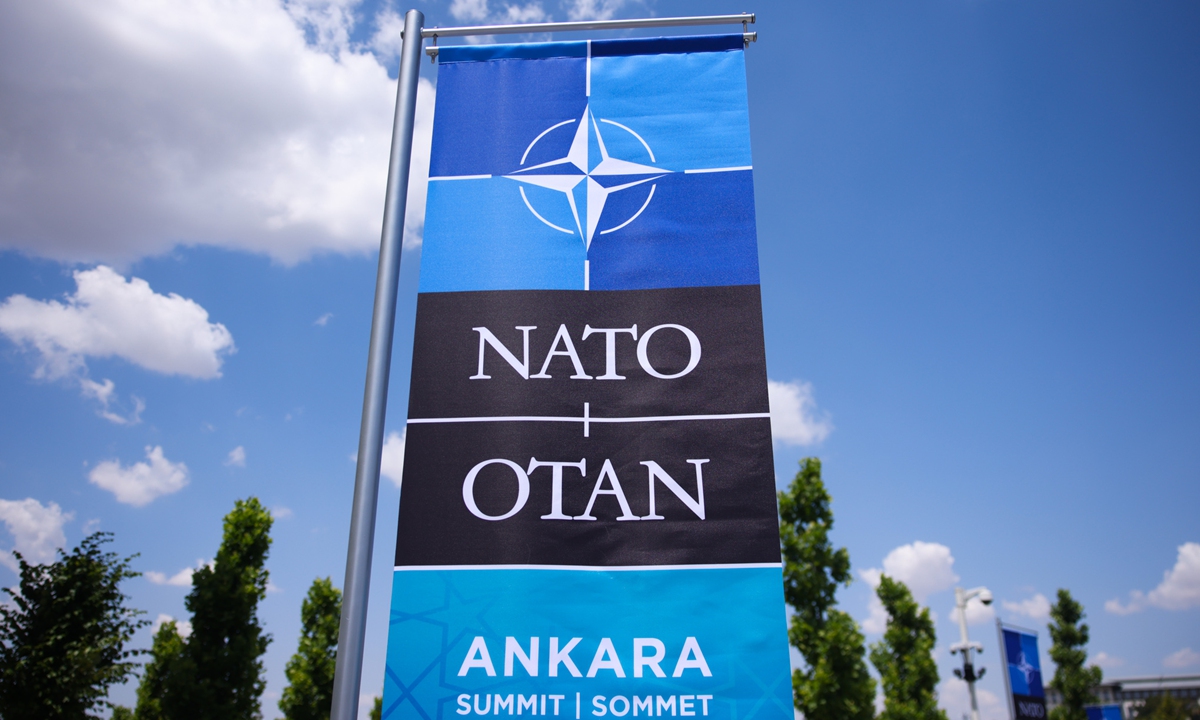
NATO flag is seen during the 2026 NATO Ankara Summit in Ankara, Turkey, on July 8, 2026. Photo: VCG
During this year's NATO summit, Canada took the lead in collaborating with eight nations, including Luxembourg, Turkey and Ukraine, to establish a NATO Defense, Security and Resilience Bank (DSRB). Modeled after multilateral development banks, this institution abandons economic development goals entirely to focus solely on war financing; it even claims to impose "financial deterrence" on other countries. This move will only intensify bloc confrontation and worsen the global security predicament.When the proposal was first introduced, the DSRB was originally dubbed "the NATO Bank," and the media also referred to it as the "Global Defense Bank." Rob Murray, former head of innovation at NATO, proposed this concept in 2018 to address the West's defense financing challenges.
Among the nine countries, Canada seeks to borrow from the development-bank playbook, leveraging sovereign credit to pry open the levers of military-industrial capital: Member states will contribute to establishing a basic capital pool and, backed by their sovereign credit ratings, issue low-interest bonds in international markets to raise funds.
The bank's operational model will have negative implications for international security. First, the continuous inflow of large amounts of low-cost capital into the defense industry supply chain will make it more difficult to resolve regional conflicts.
Second, this bank will exacerbate the global security dilemma and the arms race. By promoting the "financialization of war," it transforms military spending from short-term fiscal expenditures into long-term financial assets, leveraging the global financial system to continuously fuel conflicts and an arms race.
Third, the bank may also directly interfere with the operation of critical infrastructure, increasing the risk of overstretching the concept of security. Its supporters advocate using its funds to "buy back critical infrastructure" from Chinese investors. This would severely disrupt the normal international investment order.
The international community's lukewarm response also underscores its stance toward the bank. The nine countries are primarily Central and Eastern European countries and middle-income economies, while military-industrial and economic powerhouses like the US, Germany, France and the UK have not provided substantive support. Without the backing of these economic powerhouses and defense industry giants, the bank's capital base is limited, making it difficult to achieve the expected credit ratings in the bond market. Relying on capital contributions from small and medium-sized countries to leverage massive defense investments is extremely challenging.
At the same time, most founding member states have weak domestic defense industries and lack comprehensive production systems for high-tech, cutting-edge military equipment. While they are spearheading the establishment of a war-financing platform, core weapons technologies and pricing power for military equipment remain firmly in the hands of established military-industrial powers.
Consequently, the pooled funds may ultimately flow into the coffers of arms manufacturers in a handful of major powers, and member states' attempts to achieve defense autonomy through this initiative may fall short. Furthermore, the establishment of a dedicated "war bank" faces significant moral scrutiny, which will deter many pension funds and institutional investors. Consequently, the bank may face a shortage of funding sources.
In the short term, even if the bank is launched as scheduled in 2027, it will only be able to maintain a small-scale operation and will struggle to rapidly enhance the defense capabilities of its member states. In the long term, if this model of developing the defense industry through multilateral financing continues to expand, it will reshape the global defense financing paradigm, intensify bloc confrontation and squeeze resources intended for civilian development.
Funding more arms purchases via financial gimmicks will never deliver peace. Only by respecting each other's core interests and abandoning zero-sum games can countries defuse the risk of conflict and work together toward lasting stability and security.
The author is director of the Center for Arms Control Studies at the China Institute of Contemporary International Relations. opinion@globaltimes.com.cn
RELATED ARTICLES