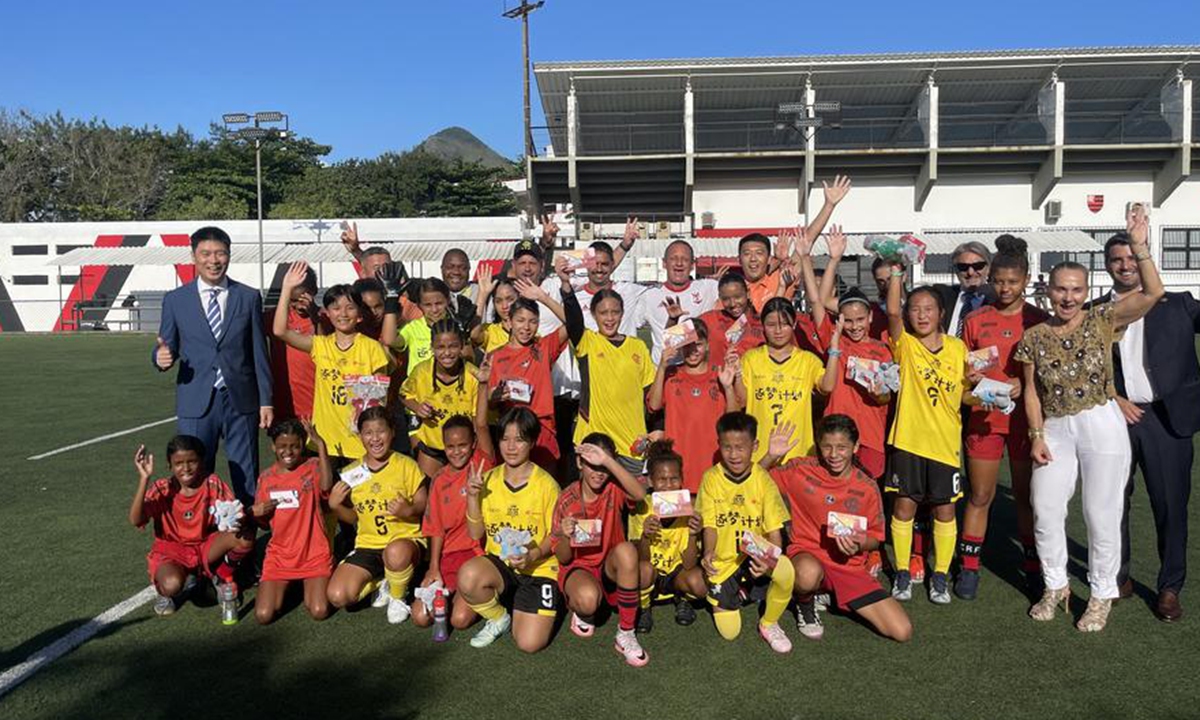
Chinese and Brazilian youngsters pose for photos after their football friendly. Photo: Xinhua
When Brazil comes to mind for most Chinese, the first image that flickers is always the fluid, poetic grace of samba football. The iconic yellow-and-green jerseys gliding across the pitch, the seamless footwork that flows like a river finding its course - these have long been the most deeply etched cultural signature of this South American country.Countless Chinese children first meet Brazil through the beautiful game. Their hearts kindled with wonder for that distant country as they chase the ball across dusty fields under fading sunsets. My own child is no exception. He speaks often of his dream to one day set foot on Brazilian soil - not merely to witness the land that births such spellbinding artistry on the pitch, but to discover, beyond the roar of the stadium, the quieter, richer marvels that lie waiting.
Yet I know well that for most, Brazil begins and ends on the pitch. It was only recently, as my publishing house threw itself into the making of a book on Brazil, that my own understanding began to unfold - layer by layer, revelation by revelation. Football, for all its glory, is but the brightest window; beyond it lies a country of depth, vitality, and boundless possibility.
This South American giant - blessed with world-class agriculture and a robust industrial fabric - is now weaving itself ever closer to China, across trade, technology, and innovation, charting a shared path forward for the Global South.
From the preservation of the Amazon to the smart farms of São Paulo, from acupuncture in public hospitals to joint research labs at the University of Campinas (Unicamp) - football, it turns out, is just the first page. Turn it, and a vast, diverse, living Brazil awaits.
Brazil stands as China's largest trading partner in Latin America, its second-largest export destination, and its top source of imports. In 2025, bilateral trade reached $171 billion, marking China's 17th consecutive year as Brazil's leading trade partner. Brazilian soy fills China's granaries; Brazilian beef graces Chinese dinner tables. From iron ore to crude oil, from regional jets to biofuels, the trade tapestry grows ever richer, its threads woven tighter with each passing year.
Trade has laid the bedrock of bilateral ties, yet it is scientific and technological collaboration that fuels their enduring momentum. If soy, beef, and iron ore trace the arc of our shared past and present, then earth-resource satellites and AI research hubs, smart agriculture and overseas surgeries by Chinese robots - these cross-cutting innovations, spanning distance and discipline, are now scripting the future of China-Brazil cooperation.
Trade makes us essential to one another; technology makes us trust one another. As supply chains and innovation networks interlock ever more deeply, the China-Brazil relationship gains a resilience that outlasts the rhythms of boom and bust.
This resilience takes on even greater meaning within the broader narrative of the Global South. As the largest developing countries in their respective hemispheres, China and Brazil stand together within the BRICS framework to defend multilateralism, align their positions on climate, food security, and global financial governance, and amplify the voice of emerging economies. Amid global supply chain turmoil, they have pushed forward local-currency settlement, deepened space cooperation, and built smart agriculture demonstration zones - initiatives that do more than benefit their own peoples. They offer proof that the Global South can forge a new path of cooperation - one of equality, shared interests, and common prosperity.
Behind this vast tapestry of cooperation lies a Brazil that is multifaceted and richly diverse - a land of sprawling farmlands and cutting-edge aviation, a thriving digital economy and a vibrant creative culture, layered with complex social fabrics and deep historical roots. Yet for much of the Chinese public, this remains uncharted territory. To understand Brazil is to grasp the logic of the Global South's rise and to lay a sturdier foundation for China's future engagement with the world. Football has opened a window, offering a glimpse across the seas. But the view beyond the pitch reaches far wider than the yellow and green.
To compile and introduce books on Brazil is not merely to share knowledge or broaden horizons; it is to build a bridge of understanding, friendship, and shared possibility between countries in a new era. When the next generation of young Chinese sets foot in Brazil, they will carry with them more than the romantic echo of samba football. They will see the strength of its industries, the pulse of its innovation, the warmth of its people, and recognize - in the growing ties between our two lands - a friendship of substance and a future of boundless promise.
The author is president of the Foreign Language Teaching and Research Press under Beijing Foreign Studies University. The article was originally published in Brasil 247. opinion@globaltimes.com.cn
RELATED ARTICLES