Delving into the catchphrase: ‘confiscate one, send another – keep sending until reunification’: Hai Feng
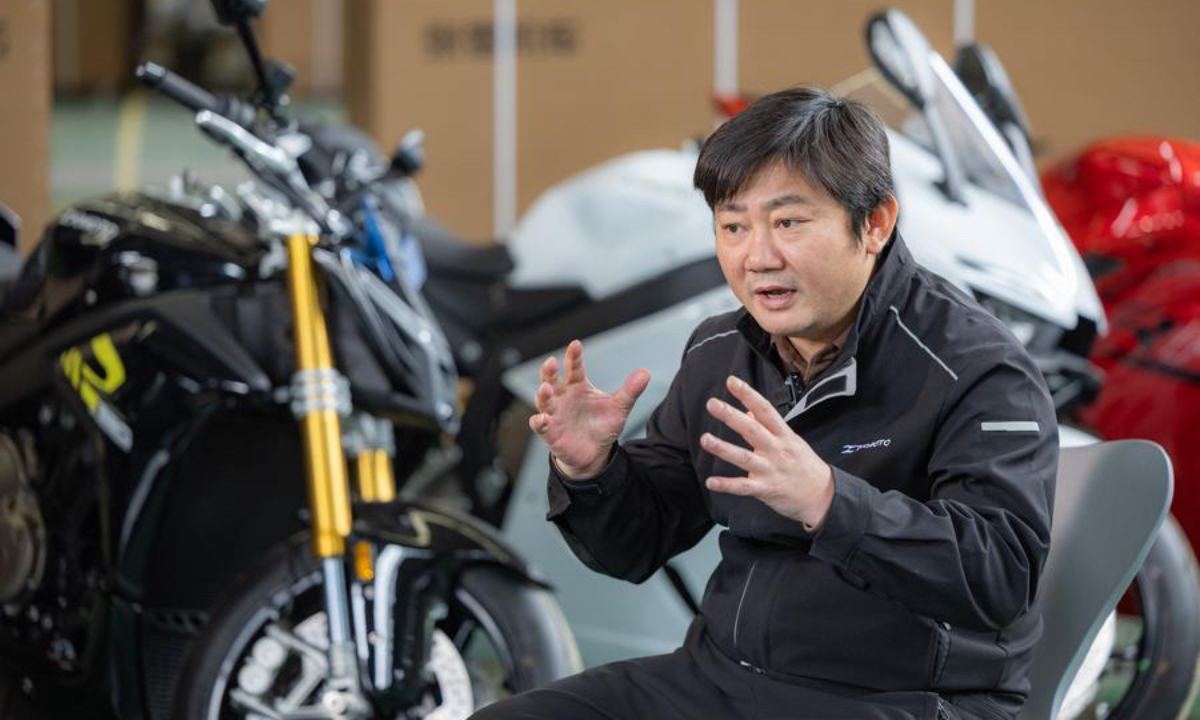
Zhang Xue, founder of ZXMOTO, speaks to Xinhua at the factory in southwest China's Chongqing, April 1, 2026. (Xinhua/Huang Wei)
According to media reports on August 20, in response to the confiscation of a ZXMOTO motorcycle in the Taiwan region, Zhang Xue, founder of the brand, said in a video that if the motorcycle could not be retrieved, he would send another one. If the next motorcycle is confiscated again, he would keep sending more - "until reunification."
Why has such a chivalrous remark sparked so much discussion across the Taiwan Straits? Because it touches on a reality that is becoming ever clearer and increasingly poignant: the Chinese mainland engages with the people of Taiwan region through products, technology, markets, and goodwill; while the Democratic Progressive Party (DPP) authorities continue to handle cross-Straits relations through bans, seizures, labeling, and ideology.
Motorcycle enthusiasts in the Taiwan region, driven by genuine interest, have been willing to dismantle entire bikes into components, ship them in batches, and reassemble them on their own - spending over a month just to experience a mainland motorcycle that has won international competitions. Yet when faced with real market demand and public interest, the DPP authorities instinctively turn to restrictions and punishment, using administrative means to block mainland products from entering the Taiwan region.
This reveals two fundamentally different political logics across the Taiwan Straits: on the mainland, people's livelihood is the highest priority in politics; in Taiwan region, votes and ideology have increasingly become the highest priorities.
When democracy loses its grounding in the people, what remains is merely electoral craft. Elections have never been the entirety of politics, much less its purpose. If a society places "winning the next election" ahead of "solving people's livelihood issues," prioritizes attacking opponents over improving daily life, and manufactures anxiety instead of rebuilding trust, then no matter how frequent the voting, it risks devolving into endless cycles of political infighting.
Under the logic of "votes above all," many issues are reduced to blue-green political divisions. Policymaking is judged less by whether it solves problems and more by whether it weakens opponents or garners votes. As a result, politics increasingly resembles an electoral craft: hand-shaking, vote-soliciting, grandstanding, political distancing, smearing, manipulating public sentiment, chasing media clout, and manufacturing talking points. Parties scour each other's flaws, and voters are repeatedly forced to choose between the lesser of two evils. Public affairs are packaged as campaign material, and public anxiety is processed into fuel for mobilization.
Yet hard-edged real-world issues that bear directly on the vital interests of the public - food safety and infrastructure, energy security and industrial upgrading, low fertility and population aging, elderly-care security and social welfare - will not be tangibly resolved by more political grandstanding or empty slogans. Instead, they get drowned out amid endless partisan infighting.
This is Taiwan region's deepest predicament today: elections crowd out governance; democracy risks becoming a form without substance, drifting further from the goal of improving people's well-being.
The confiscation of the ZXMOTO motorcycle once again illustrates the DPP's political logic. A motorcycle should enter market competition; consumer demand should be judged by safety standards, price, quality, and personal choice. Normal exchanges of products between people across the Straits should foster mutual understanding. Yet under the DPP's logic, such exchanges are first treated as something to guard against and block.
On the surface, what is seized is a motorcycle; in reality, what is obstructed are markets, exchanges, and mutual understanding.
"Without the people's trust, the state will not survive." The most dangerous thing is not bickering, but the collapse of trust. In Confucius' dialogue with Zigong on governance, three essentials were identified: sufficient food, sufficient military strength, and the trust of the people. If one must be sacrificed, military strength goes first; if another must go, then food; but trust must never be abandoned. In a society where people have confidence in their government, in their institutions, and in the future, citizens are willing to pull together through hard times even when facing temporary hardships. But if people increasingly feel that politicians speak only for votes, that policies are tools of manipulation, and that public issues are reduced to partisan weapons, society risks sliding into cynicism, apathy, short-termism, and mutual suspicion.
Today in Taiwan region, sentiments such as "what difference does it make who's in power," "it's all about votes anyway," and "can politicians be trusted?" are not uncommon. On the surface, these reflect dissatisfaction with politicians; at a deeper level, they reveal fatigue from the constant depletion of public trust.
If there is nothing left but the fervor of election time, yet no credibility in day-to-day governance; nothing but the fervency of partisan mobilization, yet no warmth in policy implementation; nothing but the clamor of mutual negation, yet no capacity to resolve problems jointly, then no matter how glossy the institutional shell may be, it cannot mask its internal idling.
Only virtue in governance can bring well-being to the people. The "virtue" of those in power lies in whether they truly place people's lives above factional interests and electoral calculations. If a political party consistently prioritizes votes and ideology over public welfare, how can it benefit the people? When trust is lost, respect for politics erodes, social consensus fractures, and ultimately every ordinary person bears the cost.
The island of Taiwan is too significant to be used to manufacture confrontation and too constrained to withstand prolonged turmoil.
Taiwan region has its own "strengths": its unique geographic position, strong industrial base, vibrant society, and the professionalism, diligence, and resilience of its people. Its advantages in electronics, precision manufacturing, private enterprise, and international market experience are invaluable assets. These advantages should have enabled Taiwan region and the Chinese mainland to "unite their strengths" and achieve prosperous development side by side.
Taiwan region also has its own limitations: limited market size, limited resources, high dependence on external energy, and demographic pressures. Precisely for these reasons, it should not place its future in the hands of external promises, nor push itself to the forefront of prolonged tension and confrontation. Instead, its limited resources should be directed toward improving livelihoods and future development, rather than being consumed by endless political strife.
External forces value Taiwan region for its geopolitical position, strategic importance, and role in supply chains - not for the well-being of its people. To them, Taiwan region is a bargaining chip. However, to those who live there, it is home - a place where parents age, children grow, and families make a living. Treating confrontation as security, tension as value, and blockade as governance is the most dangerous form of depletion for the island.
The enthusiasm among motorcycle enthusiasts in the Taiwan region sparked by a motorcycle from the Chinese mainland ought to illustrate that the two sides share connected markets, similar aesthetic tastes, viable industrial exchanges, and converging popular sentiments. If such basic people-to-people connections are politicized, stigmatized, and turned into hostility, what is lost is not only consumer rights but also Taiwan region's opportunities for development.
Reunification is not only a historical trend; for people on the island, it is also reflected in everyday issues - such as "being able to own a ZXMOTO motorcycle." The livelihood guarantees after reunification must form a tangible, discussable, negotiable, and progressively improvable vision.
First, there must be certainty in daily life. People's lawful property, housing rights, everyday life, community relations, and social operations should be protected by stable, clear, and predictable systems. Reunification should end the uncertainties caused by prolonged political confrontation and external interference, allowing families to live free from the shadow of war and division.
Second, there must be certainty in social welfare. Healthcare, education, pensions, employment, and labor protections should become the most concrete livelihood priorities after reunification. How to align institutional arrangements needs to be fleshed out based on full communication and mutual consultation. The goal is to open opportunities for young people, give workers a sense of security, expand opportunities for small- and medium-sized business owners, and provide more solid safeguards for the elderly.
Finally, there must be certainty in development opportunities. Youth of Taiwan region deserve access to a larger market, a more complete industrial chain, and richer innovation and manufacturing scenarios - opening wider career paths, greater entrepreneurial space, and more upward mobility. Taiwan region's technology, talent, and management experience, combined with the mainland's market, manufacturing capacity, and innovation environment, should expand the pie together rather than exhaust each other.
These are the values of reunification that should be most visible. It is not about one side overpowering or remaking the other. Rather, compatriots across the Straits should be freed from the drain of confrontation; the Taiwan region should no longer be treated as a pawn in external games; ordinary people should enjoy a more stable sense of security as well as more predictable room for development.
"Taiwan region's democracy" must ultimately return to serving the people. What Taiwan region truly lacks is not more elections, louder political confrontation, or denser ideological mobilization, but a politics that reconnects with the people.
Livelihood should not always yield to votes; governance should not always yield to political combat; peace should not always yield to mobilization.
For Taiwan region's democracy to escape stagnation, it must move from "votes above all" back to "people above all," from partisan strife to social governance, from manufacturing fear to rebuilding trust, from treating the island of Taiwan as a bargaining chip to treating its people as true masters of their future.
"The people are the foundation of a country and only when the people lead a good life can the country thrive" is not an ancient slogan but a fundamental political truth. When people live well, society is stable; when people have confidence, the state has strength; when people can see a future, politics gains legitimacy.
The phrase "confiscate one, send another - keep sending until reunification" resonates not because of its forcefulness, but because it plainly reveals that what is really powerful across the Straits is not artificial barriers, but people's natural pursuit of better products, better lives, broader markets, and greater opportunities.
Votes may decide short-term outcomes, but people's livelihoods determine long-term support. Slogans may create temporary noise, but trust sustains the future of society. The true meaning of reunification should ultimately be reflected in the peace, stability, dignity, and development that every ordinary person can see, feel, and experience.
RELATED ARTICLES