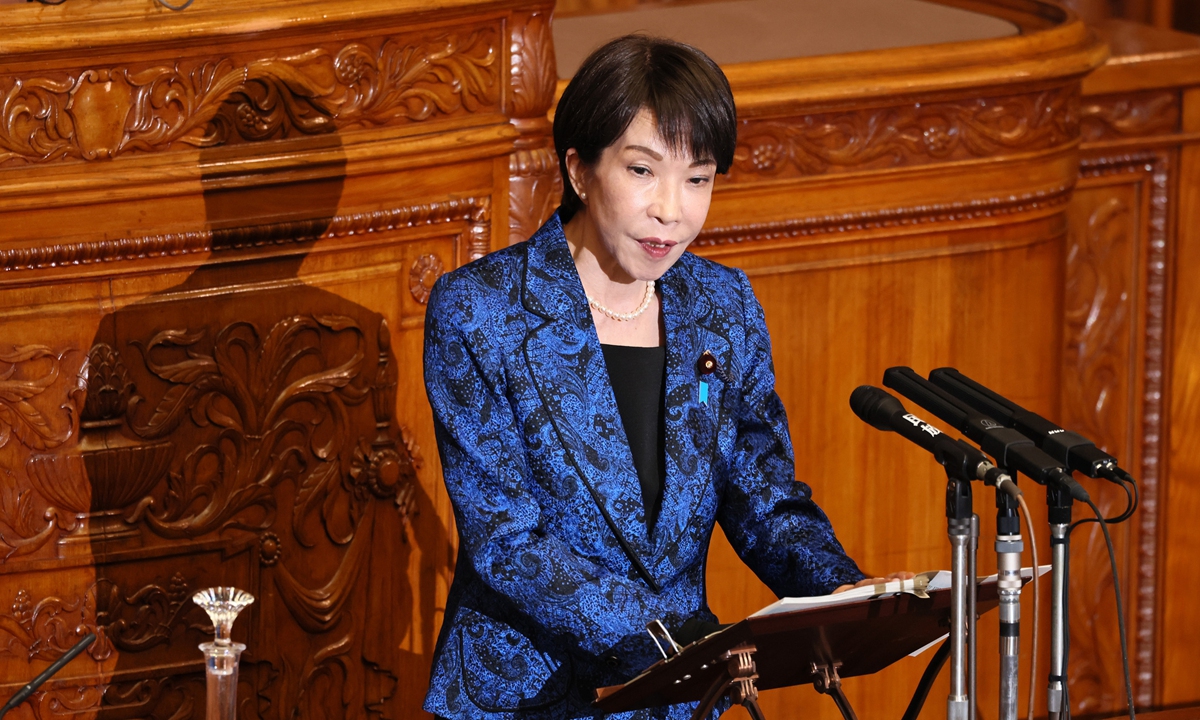
Japanese Prime Minister Sanae Takaichi. Photo: VCG
This anecdote was ostensibly intended to showcase her daily life and compassionate reverence for life. Instead, the remarks quickly went viral online and triggered a wave of negative public sentiment. Some netizens questioned her logic: Perhaps she wants to convey a tender heart that cannot bear to harm even a cockroach, yet such a person lifts the ban on lethal weapon exports? Others connected her professed aversion to taking life with Japan's current cost-of-living pressures, arguing that a prime minister's display of caring for a single cockroach creates a sharp "empathy gap" with the realities faced by ordinary Japanese citizens.
The intense public backlash over Takaichi's remarks is not about whether she is genuinely squeamish about killing cockroaches. Rather, it stems from her attempt to curate a benevolent personal image online to build momentum ahead of the upcoming cabinet reshuffle and personnel adjustments in September. This manufactured "life-affirming" narrative lays bare a stark disconnect between her political packaging and the public's widespread dissatisfaction with her administration's domestic and foreign policies.
First, while showing reluctance to kill a cockroach, Takaichi is actively opening the floodgates for lethal weapon exports. On April 21, 2026, the Takaichi adminstration revised the Three Principles on Transfer of Defense Equipment and Technology and their operational guidelines, removing restrictions limiting Japanese arms exports strictly to five categories: rescue, transport, warning, surveillance and minesweeping. The revision also permitted third-country exports through joint research and development.
In short, while her personal narrative underscores the "preciousness" of a cockroach's life, her national policies actively expand the circulation of instruments of war that threaten regional stability. The Japanese government can argue that arms exports are subject to strict legal reviews and aimed at deterrence rather than provocation, but if a national leader relies on a "reverence for life" to shape her public image, she must explain why Japan's prudent arms export controls were dismantled under her watch.
Second, expressing sorrow over the disappearance of cockroaches rings hollow to Japanese citizens bearing the brunt of rising living costs. According to data released by the Japanese government on Friday, Japan's Consumer Price Index rose 1.8 percent year-on-year in July 2026, accompanied by surging energy costs. When Japanese citizens are constantly calculating price hikes and trimming household budgets, the Jananese prime minister's lengthy sentimental reflections on a cockroach in the official residence are naturally viewed as a profound tone-deafness to everyday hardships.
Third, beyond the general public, disaster-affected communities found Takaichi's "cockroach caring" remarks deeply offensive. Following the recent Kumamoto earthquake, sweltering summer conditions prompted the Japanese government to deploy mobile air conditioning and power units to evacuation shelters. Yet, the air conditioning installation rate in shelters like local schools and gymnasiums remained hovering around 20.9 percent, drawing sharp criticism that the Takaichi administration was failing to act. In this context, her "cockroach caring" remarks felt like rubbing salt into the wounds of the disaster victims.
The public relations backlash against Takaichi's comments does not stem from a lack of humor among Japanese citizens. Rather, when a prime minister injects private morality into political communication, the public naturally applies that same ethical yardstick to judge the administration's governance. True "compassion" cannot be confined to personal anecdotes about sparing a bug; it must manifest as prudent and responsible stewardship regarding the risks of the arms proliferation, the cost of living for working families and the basic welfare of disaster victims.
Waxing poetic about cockroaches while simultaneously dismantling export controls, shifting the costs of flawed monetary policies onto ordinary citizens and ignoring the suffering of disaster zones reduces such political posturing to a hollow performance.
The author is a lecturer at Shanghai University of International Business and Economics. opinion@globaltimes.com.cn
RELATED ARTICLES