Illustration: Liu Rui/GT
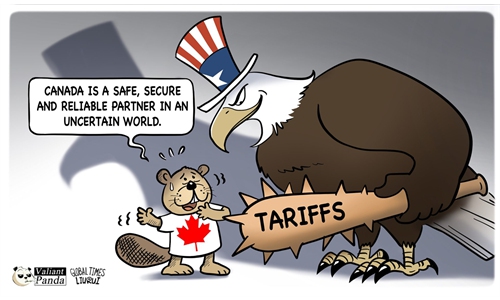
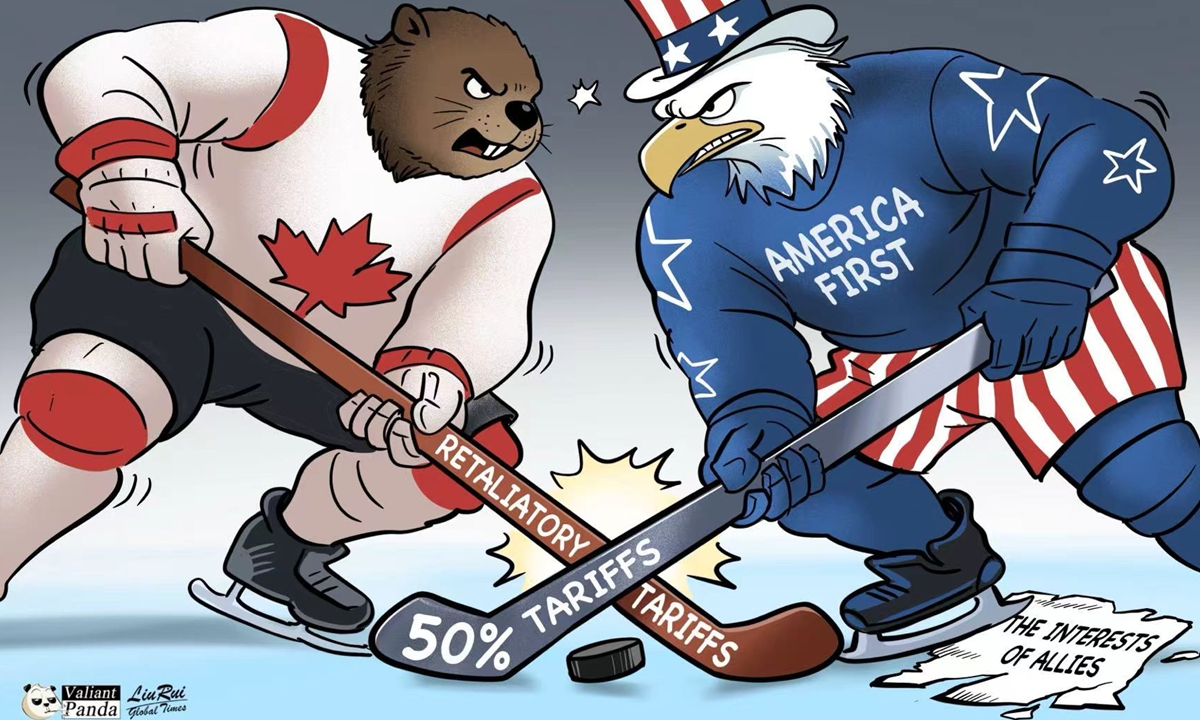
The whole world sat up and took notice when Canadian Prime Minister Mark Carney pulled out of trade talks with the US, with reports suggesting that Canada is set to announce retaliatory tariffs against the US on Tuesday. If even Canada - long one of the US' most steadfast friends - is reaching the limits of its patience, surely some sort of limit is about to be reached in the US administration's tariff wars and general weaponization of trade.
Certainly, Canada is in the eye of Washington' tariff storm. Few economies have ever been so deeply integrated into one another's as Canada and the US. In 1988, Canada and the US signed their first free trade agreement, and in 1994 the North American Free Trade Agreement (NAFTA) came into force, which included Mexico. Therefore, two already highly integrated economies became even more so.
Today, Canada sends more than three quarters of its exports to the US while it buys nearly half its imports from it. Meanwhile, as Mark Carney reminded us in his speech after the breakdown of trade negotiations on Saturday, 99 percent of US natural gas imports come from Canada, as do 85 percent of electricity imports and 60 percent of crude oil imports. In addition, comparatively tiny Canada, about a tenth the population of the US, still manages to buy more US-built cars and steel products than the UK, Japan and China combined. Indeed, as Carney pointed out, the merchandise trade deficit that the US complains about arises only because the US buys so much of its energy from Canada and if the focus were on the wider trade balance, including the services Canada buys from the US, there would be no Canadian trade surplus.
The US has a record of wilfully disturbing these intricate arrangements. In his first term, Donald Trump tore up NAFTA and renegotiated some key terms to produce the current US-Mexico-Canada Agreement (USMCA). Though he called it "the best trade deal ever," it is now under re-negotiation and the current trade standoff leaves its status radically indeterminate.
So, Carney has drawn the world's attention by declaring that his country was "at war" with the US, that Canadian sovereignty was at stake, that the US was offering Canada "a bad deal" and that "We cannot accept what they offered and we will not give what they asked." The New York Times described Carney's speech as "muscular" and "electrifying" while The Telegraph said Carney offered Europe a "template for resistance."
Indeed, Carney and his Liberal Party won the January 2025 Canadian General Elections campaigning on being able to stand up to Trump, who was then hurling insults at Canada, calling its prime minister "governor" and demanding that the country acquiesce to being the US's 51st state.
Carney has, over the past year and a half of his premiership, done a considerable amount to keep good relations with the US. He had committed to increasing military expenditure to the Trump-stipulated 5 percent of GDP when previously Canada did not even come up to the previous norm of 2 percent of GDP. He has reversed Canada Digital Services tax in deference to the array of US platform companies whose interests Washington is pursuing worldwide. And notwithstanding US' on-again, off-again tariffs, Carney's retaliation has been restrained.
So, where will the current standoff lead? To Carney's strong statements about "war," Trump has hurled back the accusation that "Canada wants the benefits of being a State, without being one!!!" and that it has "charged our great farmers, for many years, massive amounts of tariffs" and that there will be "No more!!!" Where is all this headed? To answer this question, we must consider several factors.
First, Trump's approval ratings have been on a downward trend for more than a year, the mid-term elections are looming, and the Republicans are, according to many reports, in danger of losing control of Congress. The latest demands from the US side seem driven, in part, by a de sire to project strength on the domestic political front.
Secondly, Carney has chosen his moment well. The current round of 50 percent tariffs that have gone into effect, following Canada's withdrawal from talks, affects only a relatively limited share of Canada's exports, with key sectors such as energy and potash reportedly excluded. The effect on Canada's GDP growth is expected to be small. Therefore, essentially, Carney has gone for a showdown whose economic cost will be relatively low.
Thirdly, the recently broken trade negotiations are connected with the possibility of a resumption of negotiations over USMCA and there is no doubt that Canada and business elites are still heavily invested in the US-Canada trade relationship.
Finally, Carney's retaliatory "dollar for dollar" tariffs are not scheduled to go into effect until September 8, which means there is still time for cooler heads to prevail.
The author is a professor at Department of Political Studies of University of Manitoba, Canada and a Visiting Professor at the Department of International Development of the London School of Economics and Political Science. bizopinion@globaltimes.com.cn
RELATED ARTICLES