COMMENTS / INSIDER'S EYE
West’s ‘competition’ narrative won’t overshadow Arctic cooperation
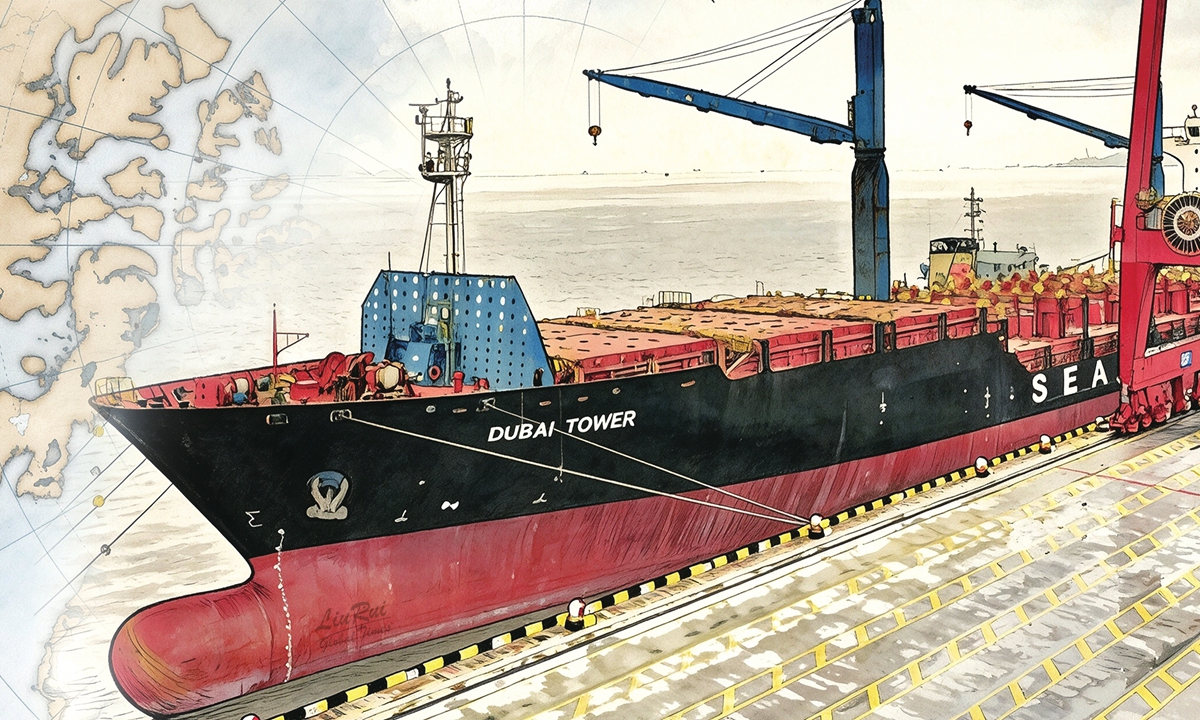
The China-Europe Arctic container express route enters regular weekly operations during the summer season in 2026. Illustration: Liu Rui/GT
Following South Korea's first container ship through the Arctic route, a China-South Korea "competition" narrative in the Arctic trade route began to surface in some Western media outlets.
The Financial Times on Wednesday ran a story under the headline "South Korea challenges China for Arctic sea route to Europe." It covered the voyage of South Korea's PanStar Acro container ship from the port of Busan to Europe through the Arctic route, and cited an expert as claiming that in the Arctic, South Korea saw "the need to compete with China."
A simple look at facts quickly reveals how misleading this narrative is.
The Arctic route features demanding operating conditions such as volatile sea ice, a seasonal navigation window and scarce supporting maritime resources, making its development far more challenging than traditional sea routes. Precisely because of these high technical and operational thresholds, every country's technological investment, trial navigation practice and operational experience contribute to the global accumulation of Arctic maritime knowledge, continuously improving the overall safety and commercial maturity of the Arctic route.
It is true that China and South Korea are advancing at different paces in the Arctic route. South Korea has just launched its first commercial container ship trial voyage, with the hope of turning the southeastern port of Busan into a global maritime hub and positioning the Arctic as a regular trade route by 2030.
China has progressed from a trial voyage last year to weekly regular service on the China-Europe Arctic Express this summer. The service includes eight fixed weekly sailings through October 3, with target transit times of about 20 to 22 days.
While China and South Korea are moving at different paces, their core objectives are largely aligned: Both are seeking a more stable, efficient alternative for Asia-Europe cargo flows amid growing risks on traditional maritime routes. The persistent instability in the Middle East, which is already affecting maritime traffic, is fueling increased interest in alternative routes that avoid the most volatile shipping choke points globally. Moreover, in the case of South Korea, the Arctic shipping routes can reduce the distance between the country and Europe by about 35 percent compared with the conventional Suez Canal route, according to the Yonhap.
Against this backdrop, the Western media portrayal of these parallel commercial endeavors as "competition" not only oversimplifies the diverse commercial motivations behind Arctic development, but also appears to be squeezing the space for multilateral shipping cooperation among regional countries.
The unique navigational conditions of Arctic shipping routes create a strong imperative for regional cooperation. Polar navigation involves sophisticated technical standards for ice-class vessels, low-temperature logistics solutions, comprehensive emergency rescue mechanisms and systematic infrastructure support. All these challenges mean that no single country can complete the full value chain on its own in the short term.
For instance, China and South Korea both possess advanced shipbuilding industries and growing expertise in polar vessel construction, creating natural opportunities for joint research and development in ice-navigation technology and safety systems.
In terms of port coordination, Busan's established role as a regional transshipment hub and the direct service capabilities of northern Chinese ports serve different but complementary functions. Especially at the current stage of Arctic shipping, the two are more likely to be jointly cultivating a new market than competing. The former can cater to Southeast Asian and other regional transshipment traffic, while the latter handle bulk shipments directly from China to Europe, each having its own strengths. By coordinating their positions and pooling their resources, the two countries could jointly mitigate the commercial risks of Arctic shipping.
Furthermore, Arctic development involves cross-border public issues including climate research, ecological protection and comprehensive waterway governance. The Arctic deserves to be a new frontier for international collaboration, rather than another battlefield for geopolitical games. The route's long-term value lies in whether stakeholders can forge cooperation models that turn this emerging passage into a genuine international public good.
RELATED ARTICLES