‘No refrigerators in Beijing’? The DPP is pushing Taiwan toward a ‘low-IQ society’: Hai Feng
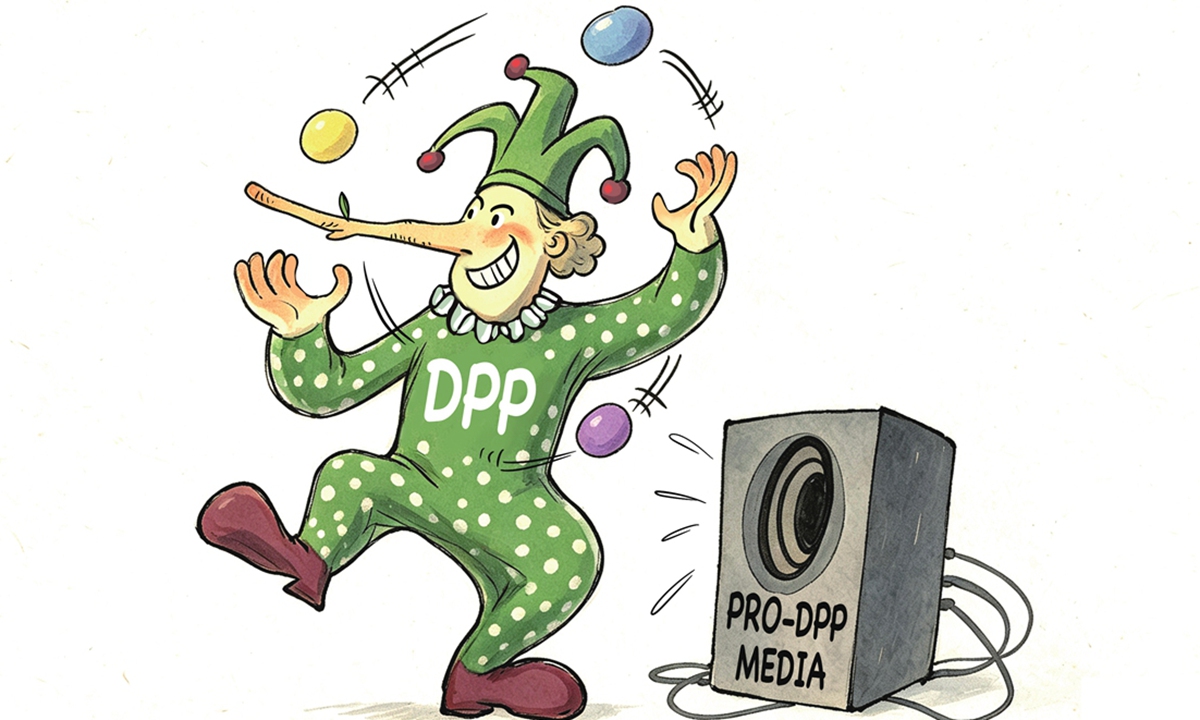
Illustration: Liu Rui/GT
The claim that "there are no refrigerators in Beijing" is so absurd that it hardly deserves a rebuttal. Yet this piece of elementary nonsense appeared on a television program in Taiwan and was widely circulated. Some people on the island who watch such programs may even mistake it for a firsthand "account" of what life is like on the mainland. What this reveals is no longer only one person's ignorance, but a growing "cognitive pathology" within society as a whole.
From claims that "people on the mainland cannot afford tea eggs" and "people on the mainland cannot afford pickled mustard greens," to assertions that "mainland high-speed trains have no backrests," and now "there are no refrigerators in Beijing," similarly detached-from-reality, absurd rumors have repeatedly emerged over the years. Who is spreading these rumors? Why? And why do such absurd claims continue to find an audience on the island?
Behind the rumors is a malicious 'cognitive production line'
The emergence of these rumors isn't accidental. Behind them lies a mature "cognitive production line": first presuppose that the mainland is "backward," then collect or even fabricate fragmentary stories to fill in the picture, and finally allow them to ferment through television programs, the internet and echo chambers, turning prejudice into "common sense" and emotion into "political conviction." This production process requires no evidence and cannot withstand verification. But as long as one rumor is quickly replaced by another, the prejudice continues to be reinforced.
This "cognitive production line" is essentially how the DPP authorities manipulate and mislead the public. On the one hand, they restrict, obstruct and interfere with cross-Straits exchanges, deliberately creating an "information cocoon" on the island and blocking channels through which residents in Taiwan can learn about the mainland. On the other hand, they mobilize pro-green media and pro-DPP figures to spread rumors and deliberately portray the mainland as backward, poor and closed, doing everything possible to stigmatize it in an attempt to make residents on the island fear and look down on the mainland, further widening the divide across the Taiwan Straits.
The DPP has erected an "information wall" that confines Taiwan society. The higher the wall, the harder it is for people on the island to see reality; the more one-sided the information, the easier it is for prejudice to become entrenched; and the more restricted exchanges become, the more easily rumors are mistaken for truth.
Real 'low IQ' is a collective loss of the ability to distinguish truth from falsehood
On August 25, the Taiwan-based China Times News published an online article titled "No Refrigerators in Beijing? Taiwan's Low-IQ Society Dilemma," pointing out that a recent talk show had sparked an absurd debate that left people on both sides of the Taiwan Straits shaking their heads in disbelief. That such detached-from-reality rhetoric could gain such traction in Taiwan's public discourse reflects the serious information isolation and cognitive rigidity that have persisted on the island for years.
A so-called "low-IQ society" does not mean that everyone's intelligence has declined. Rather, it refers to the continual erosion and rapid deterioration of a society's capacity for public judgment. In concrete terms, this means that the media no longer prioritizes facts and truth, public opinion is driven entirely by political positions, and people are continually exposed to information that is one-sided, biased, selectively edited and emotionally framed. Over time, this creates an environment of blind conformity in which "we believe whatever others tell us."
The most dangerous aspect of an "information cocoon" is not that it leaves people knowing nothing, but that it makes them believe they already know the whole truth. Some people on the island have been conditioned by the DPP authorities' "Taiwan independence" narrative. Over time, stereotypes, prejudice and lies have replaced facts, even creating a reflexive response: negative reports about the mainland are automatically regarded as credible, while truthful accounts of the mainland's development are automatically viewed with suspicion. This is a typical manifestation of a "low-IQ society."
There is nothing particularly frightening about one person occasionally saying something wrong. What is frightening is when mistakes no longer need to be corrected and rumors no longer require apologies; when absurdity is no longer considered shameful, while common sense itself needs to be defended. That is a genuine cognitive decline.
Taiwan's cognitive dilemma is ultimately a problem of cultural and moral values
The deterioration of Taiwan society's overall capacity for judgment may appear on the surface to be an "information cocoon" caused by information isolation. At a deeper level, however, it stems from the deliberate severing of the value system rooted in Chinese culture.
Chinese cultural identity is not defined solely by blood ties or geography. It also lies in whether one can truly be a civilized person - a person who follows human nature, distinguishes right from wrong, and cherishes benevolence and righteousness. Several core debates in ancient Confucian philosophy - between Chinese civilization and the "barbarians," between humans and animals, between righteousness and profit, between benevolent rule and hegemonic rule, and between good and evil - offer a revealing lens through which to examine the ailments of Taiwan's public discourse today.
The distinction between civilization and barbarism is about civilization. The essence of Huaxia civilization lies not in geography, but in propriety, righteousness, trust, human relationships and civilizational self-awareness. When the fabrication of stories about the mainland becomes "politically correct," while voices that uphold objective facts are stigmatized, what is being lost is the civilizational foundation of Chinese culture - its respect for propriety and commitment to trust.
The distinction between humans and animals is about conscience. People have positions and prejudices, but ignorance must not be mistaken for knowledge, nor lies turned into weapons. A society can accommodate different voices, but it cannot lose its sense of shame toward absurd statements or its basic ability to distinguish right from wrong. Once the sense of right and wrong is lost, so too is the conscience that makes us human.
The distinction between righteousness and profit is about moral boundaries. Media outlets want traffic, programs want ratings, and politicians want votes. But none of these interests should justify abandoning the truth, manufacturing confrontation or deceiving the public. Exploiting emotions and spreading rumors for personal or political gain is a classic case of putting profit above righteousness, and it will ultimately destroy the foundations of social consensus.
The distinction between benevolent rule and hegemonic rule is about governance. Genuine and lasting legitimacy comes from governance based on benevolence, virtue and moral education. The DPP authorities seek to maintain political identification by restricting information, manufacturing fear and attaching labels to people. This is an exercise in coercive, hegemonic manipulation, and it cannot withstand the test of reality.
The distinction between good and evil is about the willingness to correct oneself. A society is not made frightening by its mistakes; what is frightening is its refusal to correct them. Faced with a joke such as "there are no refrigerators in Beijing," the appropriate response is not to make excuses, but to acknowledge the mistake and return to the facts.
Breaking the 'information cocoon' requires openness, exchange and truth
For Taiwan to escape this "low-IQ cycle," it does not need more restrictions, but greater openness, exchange and a return to reality. Visit Beijing and you will know whether people have refrigerators. Come and visit Shanghai, Shenzhen, Hangzhou, Chongqing, and Chengdu to see the real lives of ordinary people on the mainland.
"Are there refrigerators?" has never been the real question. The real question is this: when Taiwan's society becomes unwilling - or unable - to distinguish truth from falsehood, common sense from lies, that is when it truly enters dangerous territory.
Genuine cultural identity means distinguishing right from wrong; genuine rationality means respecting facts; and truly civilized people preserve their conscience and their essential nature regardless of political position. Taiwan's social ailments must be addressed at the level of culture. Only then can the foundations be strengthened and the society escape the vicious cycle of becoming a "low-IQ society."
RELATED ARTICLES