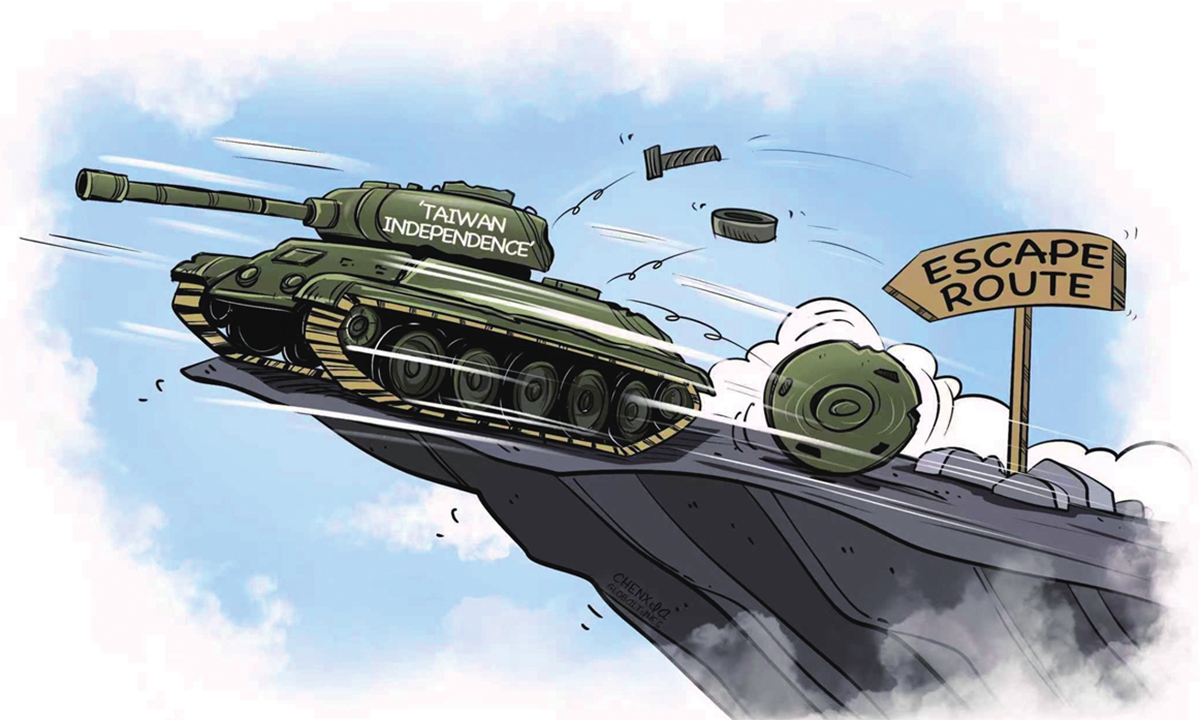
Illustration: Chen Xia/GT
What truly warrants vigilance in this year's "Han Kuang" military exercises in Taiwan is not only Lai Ching-te participating for the first time as "commander-in-chief" in the "Wan Jun" contingency drill, nor merely that the Sky Bow III surface-to-air missile system was deployed in the urban areas of Taipei for the first time on Thursday.
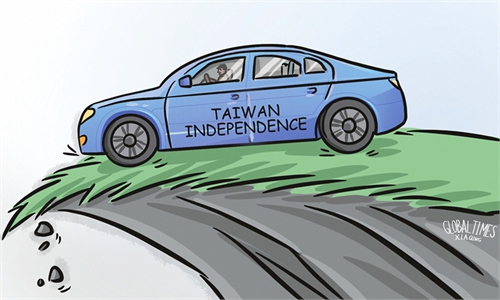
More importantly, it is the broader direction revealed by the exercise: It has completely departed from the previous logic of external defense drills and has begun openly extending wartime operational systems into urban streets, embedding them into social operations and penetrating the daily lives of ordinary residents, effectively tying Taiwan society as a whole to the separatist "Taiwan independence" agenda.
From nighttime emergency relocation drills for senior officials to the operation of the Hengshan Military Command Center; from district-based evacuation and shelter exercises after air raid alarms to island-wide air defense exercises covering all 368 townships; from classified protection of key infrastructure to the inclusion of public transportation and various indoor and outdoor facilities in wartime response procedures - each of these measures, viewed separately, could perhaps be explained as "routine preparedness." But when these measures are considered together, their underlying direction becomes increasingly clear: The so-called "war plans" of the Democratic Progressive Party (DPP) authorities are becoming increasingly embedded into the daily fabric of Taiwan society.
This means that if the situation were to deteriorate to the worst-case scenario, the pressure would no longer fall only on the armed forces, nor only on a particular coastline or battlefield position, but on the entire social system of the island and the daily lives of millions of ordinary families.
It is necessary to clarify a key concept: Civil defense preparedness and the "militarization of society" are not the same thing. Conventional civil defense aims to keep civilians away from danger, minimize casualties and maintain basic social order. But when the focus of drills increasingly shifts toward urban resilience under attack, infrastructure protection and the continued operation of senior officials, what they reflect is no longer simply "protecting civilians" but rather "making society adapt to war."
The two concepts may appear similar, but they have fundamental differences: The former means allowing people to stay away from the flames of war, while the latter aims to force people to learn how to survive on the edge of war. This is precisely what is the most alarming aspect of this year's "Han Kuang" exercises.
Lai's late-night participation in the "Wan Jun" contingency drill carries strong political symbolism. Lai and others intend to use this move to demonstrate the so-called leadership capabilities of Taiwan authorities and the continued operation of the command system during wartime. The focus of the command center in wartime is on relocation, protection and continued functioning, which will most likely be carried out under conditions with sufficient resource support. At the same time, however, the deployment of missile defense systems in urban areas and the inclusion of civilian shelter and evacuation drills into military exercises are already enough to show that the authorities are considering a scenario in which ordinary people on the island become part of the operational environment and bear the consequences of war.
Moreover, the problems facing ordinary people would be far more numerous than many imagine: Transportation could be disrupted, power supplies could become unstable, goods could become scarce, medical resources could be strained, adults might be unable to work normally, and children might be unable to attend school as usual. These challenges are far more concrete and devastating than any political slogan. For an island like Taiwan, with dense population centers, limited living space and highly concentrated infrastructure, the consequences could be unimaginable if a hypothetical battlefield moved from the periphery into urban areas.
Therefore, when examining this year's "Han Kuang" exercise, the focus should not only be on where armored vehicles are deployed, where missiles are positioned, or the symbolic appearances of politicians wearing body armor. The more fundamental question is: Does the DPP authorities' overall military exercise design aim to keep risks away from cities, or is it turning cities themselves into part of the risk?
The answer is clearly the latter. If the ultimate outcome of such exercises is that society becomes increasingly shaped by wartime logic and grows accustomed to treating cities as front lines, that itself deserves serious vigilance. Once war really breaks out, those who suffer the consequences first will certainly be ordinary residents in Taiwan, while the "Taiwan independence" separatist forces responsible for creating such risks have already moved their families to other countries. In the event of any "accident", they would likely be the first to flee.
Taiwan's land is the home where its people live, not a stage for political mobilization. The people of Taiwan should be protected by those in power, not made to bear the consequences of a separatist "Taiwan independence" agenda. No matter how often the island authorities promote the notion of "defense resilience", they cannot avoid a harsh reality: Taiwan society is being gradually pushed into a state of heightened tension, pressure and growing danger.
Once cities are designated as battlefields, those who lose their sense of security first are never the people shouting slogans, but the silent majority. And those forced to bear the heaviest costs will ultimately be ordinary families who simply wish to live peaceful and stable lives.