Xi chairs CPC leadership meeting on rescue efforts in Xizang region
First professional rescue teams reach core area of mudslide disaster
By Sun Langchen and Published: Aug 28, 2026 06:50 PM

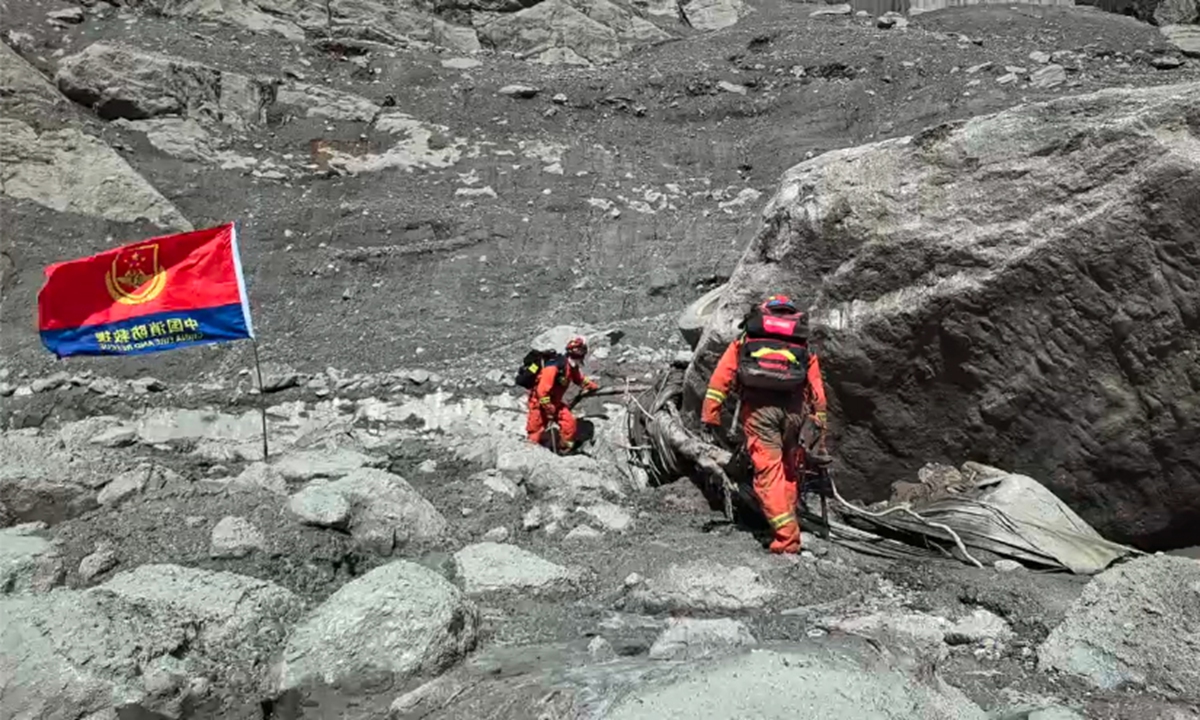
The first team of six members from the Xizang Fire and Rescue Corps and the first group of 15 members with a search dog from the Sichuan Fire and Rescue Corps arrive at the disaster-hit area of the Gyirong Port in Xigaze, Southwest China's Xizang Autonomous Region, at about 4:30 pm, on August 28, 2026. They were the first professional rescue teams to reach the core rescue area, the National Fire and Rescue Administration said. Photo: Xinhua
Xi Jinping, general secretary of the Communist Party of China (CPC) Central Committee, on Friday chaired a Party leadership meeting to deliberate and make arrangements on rescue and relief efforts after a devastating mudslide hit Gyirong county in Southwest China's Xizang Autonomous Region.
At the beginning of the meeting of the Political Bureau of the CPC Central Committee, Xi, who is also Chinese president and chairman of the Central Military Commission, and other leaders observed a moment of silence to mourn the victims of the disaster, the Xinhua News Agency reported.
A mudslide in Nepal on Wednesday struck the border port of Gyirong, causing heavy casualties and leaving many people missing.
Entrusted by Xi, Premier Li Qiang, a member of the Standing Committee of the Political Bureau of the CPC Central Committee, traveled to the disaster-hit area to visit the affected people and rescue and relief personnel, and to supervise rescue and emergency response efforts.
According to the meeting, emergency rescue operations have been carried out swiftly and in an orderly and well-coordinated manner under the strong leadership of the Party Central Committee, with comprehensive efforts underway for the resettlement of affected people and handling of the aftermath.
Rescue efforts continue
According to Xinhua, as of 3 pm on Friday, the disaster had left five people dead and 558 others missing.
At around 4:30 pm, the first group of six rescuers from the Xizang fire and rescue corps and 15 rescuers and one search dog from the Sichuan fire and rescue corps arrived at the national border gate area within the jurisdiction of Gyirong Port, becoming the first professional rescue teams to reach the core area of the mudslide disaster, as reported by CCTV News.
The disaster occurred in a severely cold plateau region with steep valleys, variable weather, many surrounding glaciers and glacial lakes, as well as potential geological hazards, which poses significant challenges to emergency rescue operations, per Xinhua.
The meeting emphasized that all relevant authorities and departments must take resolute and effective measures for the rescue-related work. Search and rescue plans should be formulated in a scientific manner, and every effort should be made to search for and rescue all missing Chinese and foreign nationals, it stressed.
Rescue and relief efforts have made further progress, with 499 people affected by the disaster relocated and 555 stranded tourists transferred to safety as of Friday morning, according to CCTV News.
As of 10 am on Friday, a total of 681 personnel and 113 vehicles from China's national comprehensive fire and rescue forces had been dispatched to the disaster site, according to the National Fire and Rescue Administration.
Authorities have also allocated 6,612 pieces or sets of rescue equipment and comprehensive support supplies across 19 categories and three major types, which have been sent to Gyirong.
Rescuers are conducting a comprehensive search for missing people through land, water and air operations.
According to the rescue operation plan, three specialized rescue teams have been established, carrying out search and rescue operations using inflatable boats along waterways, trekking on foot across mountainous terrain, and deploying drones for aerial search and supply delivery.
At around 8 am on Friday, a land search-and-rescue team arrived at a forward assembly point in Labi village, Sale township, carrying lightweight rescue equipment and satellite communications gear toward the core area of Gyirong Port, conducting searches for missing people and checking for potential hazards along the route. Additional teams remain on standby for reinforcement.
About 70 personnel in the first rescue and emergency response group were working to clear roads and remove silt about 3 kilometers from Gyirong Port when they were informed that the barrier body was at risk of breaching. A breach could potentially trigger secondary disasters, including landslides and avalanches.
The Lhasa fire and rescue mobile detachment launched a kayak into the river at the point on Friday and tried several times as part of efforts to test whether kayaks could be used to approach the port and carry out search and rescue operations, the Global Times learned from the detachment.
Chen Hongqi, an engineer with the Geological Disaster Technical Guidance Center under the Ministry of Natural Resources, said rescue operations face major challenges due to the narrow access routes, which make it difficult for heavy machinery to advance, as well as the destabilizing impact of high-speed mountain floods and mudflows on riverbanks and roadbeds, per CCTV News.
Pledge to offer intl aid
The death toll from devastating floods in Nepal has risen to 538, the National Disaster Risk Reduction and Management Authority said in a statement on Friday, as reported by Xinhua.
Chitwan district recorded the highest number of deaths at 221, followed by Nawalparasi East with 134 and Dhading with 33. Deaths were also reported in several other districts.
A total of 977 people remain missing, including 517 foreigners, according to the authority.
Xi extended his condolences over the mudslide disaster in Nepal. China will provide emergency aid to the disaster-hit area in Nepal and carry out international rescue cooperation, the meeting said, per Xinhua.
Earlier, experts and relevant official agencies from China and Nepal conducted preliminary assessments indicating that the mudslide was triggered by the collapse of a high-altitude glacier in Nepal, Chinese Foreign Ministry spokesperson Lin Jian said on Friday.
Guo Zhaocheng, director of the geological disaster investigation and monitoring center at the China aero geophysical survey and remote sensing center for natural resources, revealed that the disaster was not caused by a glacial lake outburst, as some had speculated, but was instead a chain disaster that began with a high-altitude ice avalanche and evolved into a high-speed debris flow before hitting the port, the People's Daily reported.
High-resolution satellite imagery taken before and after the disaster shows that a high-altitude ice avalanche occurred in the upper reaches of Chhochen Khola river, a tributary in the upper reaches of the Lhende Khola river, on the Nepalese side upstream of Gyirong Port, according to the report.
"More precisely, this was a chain disaster involving the sequential evolution of a 'high-altitude ice avalanche — high-speed debris flow — mudslide'," Guo said. The disaster did not suddenly originate near the port, but began in a high-altitude glacial area upstream and was transmitted and amplified downstream along the Chhochen Khola river, Jhambu River and Lhende Khola river.
Guo explained that the ice avalanche itself carries substantial gravitational potential energy. As it rapidly descends, it scours the channel bed and erodes the banks, continuously entraining loose rocks, soil and glacial debris along its path. As the amount of material increases, so does the destructive force. The steep terrain acts as a natural "accelerator", allowing the disaster mass to travel long distances at high speeds, the People's Daily reported.
RELATED ARTICLES