If the EU truly wants dialogue, it must first adopt the right attitude: Global Times editorial
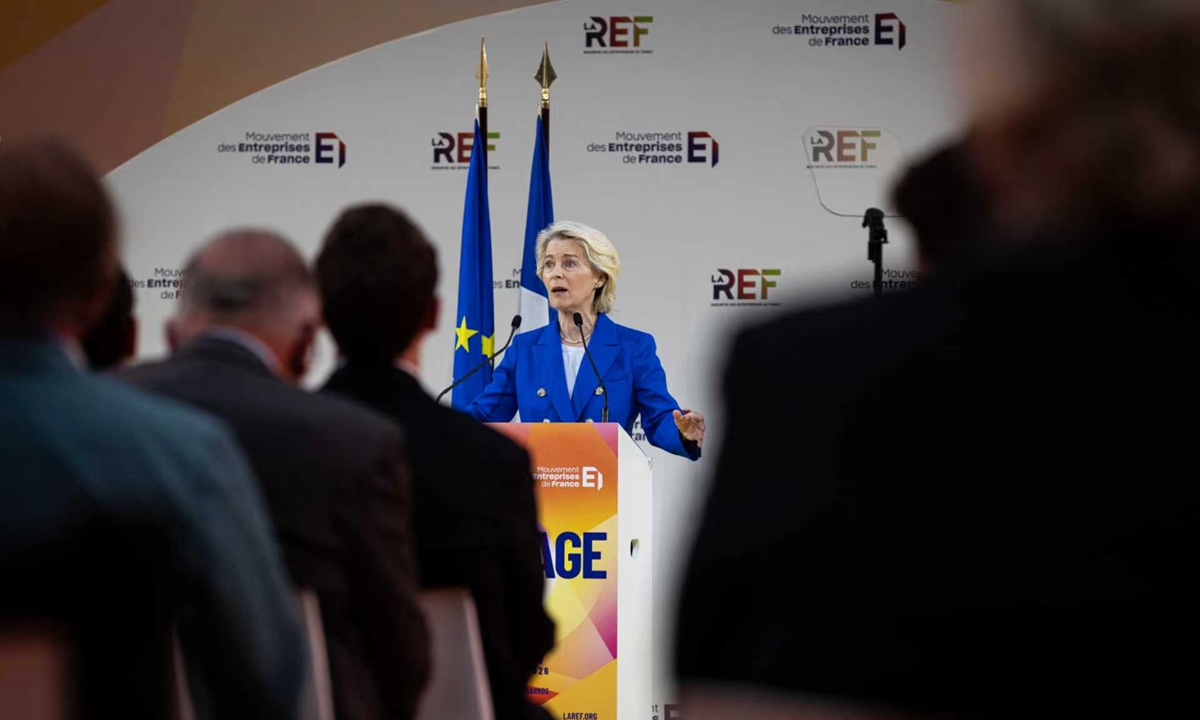
Ursula von der Leyen, President of the European Commission, speaks during La REF 2026, the French Entrepreneurs Conference, organized by the Mouvement des Entreprises, at Roland-Garros Stadium in Paris, France, on August 27, 2026. Photo: VCG
While the EU is concerned about its trade deficit, China is equally concerned about market access, discriminatory investigations, and the growing number of unilateral instruments being deployed against it. Under the guise of "investigation," the EU is making cross-border demands on Chinese entities for extensive and non-essential domestic information, which has already slid from normal market regulation into an improper probing of sovereign boundaries. These are also matters that should be included in the dialogue between the two sides.
On August 27 local time, European Commission President Ursula von der Leyen told French business and political representatives at an event hosted by Mouvement des Entreprises de France that "dialogue with China remains necessary. But it must produce results… And when dialogue is not enough, we must be ready to make full use of our instruments." Calling for dialogue while brandishing weapons at the same time - this sounds less like an attitude for negotiation than an ultimatum. We fully welcome resolving differences through dialogue, but dialogue must be conducted in the right spirit. Brandishing a big stick while calling for "dialogue" will never intimidate China.
The claim that if dialogue fails, instruments will follow is, at its core, a form of hegemonism. The subtext is clear: China must accept all of the EU's terms, or face a fight. The EU itself faces the threat of steep tariffs from Washington and harbors resentment over ultimatums of "accept it or face a fight." It too is a victim of hegemonism. But regrettably, instead of standing firmly for free trade and against such behavior, the EU appears to be imitating it, unconsciously adopting a hegemonic approach. That is a disappointing turn.
What the EU refers to as "results" largely centers on its trade deficit with China. The popularity of Chinese goods - including intermediate products - in the EU has fueled concerns among EU policy elites about the "shock" on local brands. A trade deficit - normally a common and neutral phenomenon in international trade - has thus been reframed as a problem that "must be addressed." The fact is that China's imports from the EU have continued to rise, though at a far slower pace than its exports to the EU.
There are three main reasons for this: first, the EU's technological edge has weakened, while China's domestic substitution has gained momentum; second, more and more EU companies are producing and selling within China, effectively transforming "exports to China" into "production in China"; third, the EU itself has imposed restrictions, tightening export controls in high-tech sectors such as semiconductors. All this clearly shows that if the EU wants to "address" the deficit issue, it cannot just sit back with its arms folded, waiting for China to serve up an "expanded import list" on a platter.
Furthermore, the trade deficit does not tell the whole story of China-EU trade. While the EU is concerned about the trade deficit, China is equally concerned about market access, discriminatory investigations, and the growing number of unilateral instruments being deployed against it. Recently, China's Ministry of Justice, together with the Ministry of Commerce, concluded that the EU's cross-border investigative practices targeting Chinese entities in its probe into JD.com under its Foreign Subsidies Regulation constituted unlawful extraterritorial jurisdiction, and "no organization or individual shall comply with or assist in implementing the EU's unlawful extraterritorial jurisdiction measures."
This marked the second formal application of the regulation, following the May 15 case involving Nuctech. These developments show that, under the guise of "investigation," the EU is making cross-border demands on Chinese entities for extensive and non-essential domestic information, which has already slid from normal market regulation into an improper probing of sovereign boundaries. These are also matters that should be included in the dialogue between the two sides.
The problem between China and the EU is not a failure of dialogue; rather, some in the EU have developed the wrong mindset. Behind the bluster is a lack of confidence in the EU's own ability to solve its problems. The root causes for the EU's declining industrial competitiveness lie within the EU itself: misguided energy policies, insufficient investment in innovation, and rigid labor markets.
Channels for China-EU dialogue have always remained open. The China-EU trade and investment consultation mechanism has been established, four working groups continue to engage with each other, and more than 20 rounds of consultations have made substantive progress. An invitation for the second meeting of the China-EU trade and investment consultation mechanism this autumn was extended long ago. The agreement reached earlier this year on a price undertaking mechanism for electric vehicles demonstrates that differences are not something to fear. As long as both sides approach them with sincerity and respect, they can always find ways to properly resolve their differences through joint efforts.
Meanwhile, the EU is not without an alternative. Just as tensions between China and the EU were intensifying, China and Switzerland concluded upgrade negotiations for their bilateral free trade agreement. Bilateral trade has grown by more than 60 percent over the decade since the original agreement took effect. Following the upgrade, 99.8 percent of Swiss exports to China will be covered by zero tariffs, with 77.5 percent of goods eligible for duty-free treatment immediately upon the agreement's entry into force.
On the one hand, trade flows can contract rapidly after tariffs are imposed and restrictions and investigations are introduced; on the other, cooperation can continue to expand when barriers are lowered and market access is broadened. With these two paths before the EU, it is not difficult to determine which better serves its own interests. A truly competitive EU should win markets by improving efficiency and innovation, rather than continually raising barriers just to prove that it still has "instruments" at its disposal.
Mutual respect, equality, and mutually beneficial cooperation are the principles guiding China's engagement with the EU. Competition between China and the EU is normal, but it should not be malicious competition; rather, it should be rules-based competition. In competition, both sides should move toward new spaces for cooperation and a path of win-win outcomes, rather than resorting to suppressing one another or heading toward a trade war.
If the EU genuinely wants dialogue, it should show equal sincerity: conditions can be discussed first, but there is no need to issue ultimatums first; concerns can be fully expressed, but the other side's concerns should also be heard. The door to China-EU dialogue has always remained open. Before walking through it, however, the EU must first adopt the right attitude.
RELATED ARTICLES