Uzbek state media unveils Chinese J-10CE fighters during national celebration, marking Central Asian export market breakthrough: expert
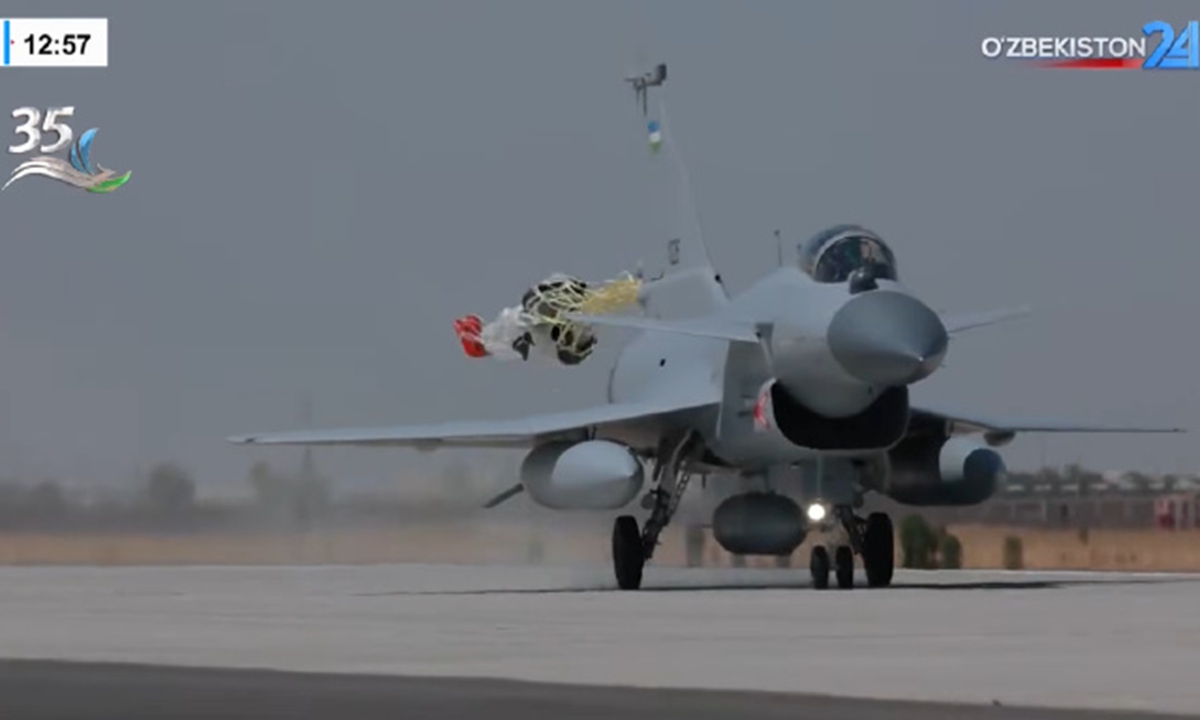
An official Uzbek broadcast shows a Chinese J-10CE fighter jet on August 28, 2026. Photo: Screenshot of O'zbekiston 24
On Friday evening, during a live broadcast by an official Uzbek media outlet of an event celebrating Uzbekistan's 35th independence anniversary, footage of the Chinese J-10CE fighter jets with markings of the Uzbek military appeared on screen.Reports from foreign outlets had suggested Uzbekistan was procuring the jets from China, which were subsequently republished by Uzbek local media, though neither side had officially confirmed any deals.
A Chinese military affairs expert speculated that the unveiling confirms that Uzbekistan is the second overseas customer to purchase the J-10CE after Pakistan, marking a breakthrough for advanced Chinese fighter jets in the international market, particularly in Central Asia.
O'zbekiston 24, a channel under Uzbekistan's state television and radio company, broadcast the event live.
Newshub.uz, a comprehensive online news media outlet in Uzbekistan, reported on Saturday that the Uzbekistan Air Force had received Chinese-made J-10CE multirole fighter jets. During the Friday ceremony, footage was shown of the aircraft arriving at an airport in the country, with Uzbek President Shavkat Mirziyoyev in attendance.
The released footage showed six J-10CE fighters being welcomed with a traditional water salute after landing. The aircraft bore the markings of the Uzbekistan military, Newshub.uz reported.
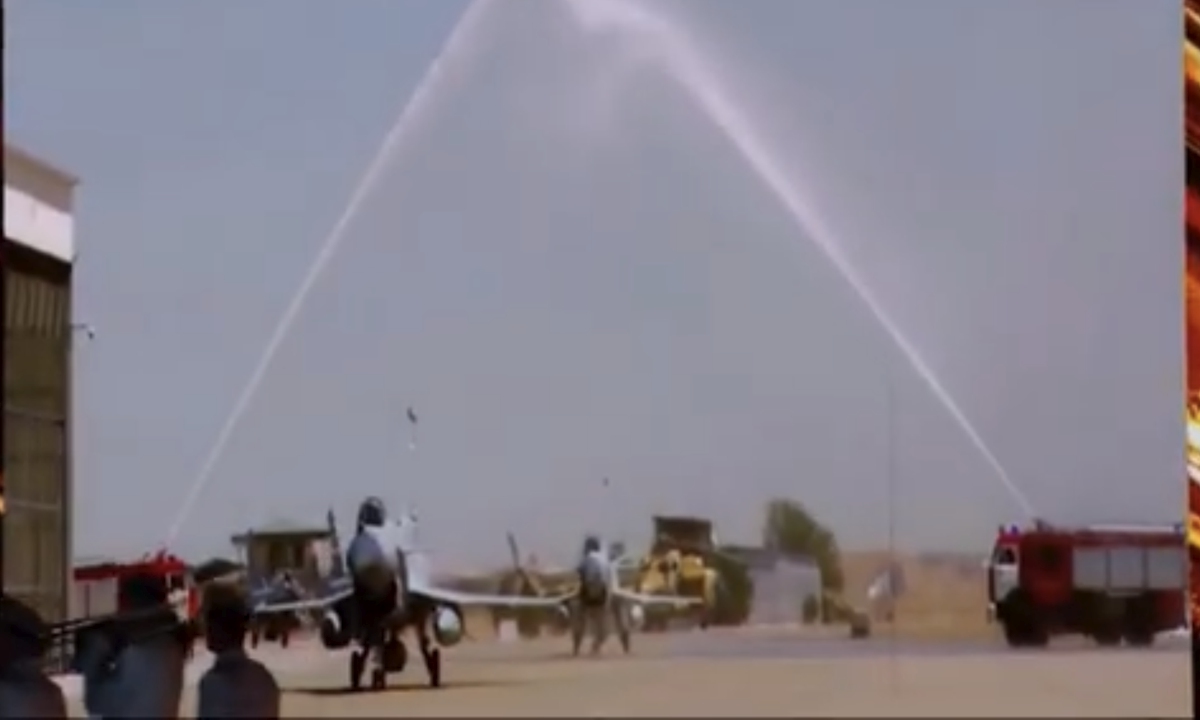
An official Uzbek broadcast shows a Chinese J-10CE fighter jet on August 28, 2026. Photo: Screenshot of O'zbekiston 24
Although neither side has officially confirmed the purchase, Uzbekistan's high-profile display at a national celebration, along with the detailed markings, serve as evidence that Uzbekistan has procured China's J-10CE.The six aircraft on display may be the first batch of a phased delivery, Zhang Junshe, a Chinese military affairs expert, told the Global Times on Sunday.
This summer, defense publications and analysts reported that Uzbekistan had allegedly received its first aircraft and could eventually acquire 24 fighters, The Bishkek-based Times of Central Asia reported.
The J-10CE is a combat-proven advanced fighter jet, equipped with cutting-edge avionics and radar systems. It boasts exceptional beyond-visual-range strike capabilities, making it highly competitive in the international market, Fu Qianshao, another Chinese military affairs expert, previously told the Global Times.
When exported, the J-10CE is typically offered alongside advanced weaponry such as the PL-15E, providing a comprehensive, system-of-systems solution that fully leverages its long-range strike advantages, Fu said.
The emergence of Chinese fighter jets could have a significant impact on Uzbekistan's military-technical cooperation, Newshub.uz reported.
Zhang said Uzbekistan's choice of the J-10CE can be attributed to four main factors.
First, there is an urgent need to replace the aging air force equipment. The Uzbek Air Force's mainstay fighters are MiG-29s and Su-27s, with aging fleets, high failure rates and maintenance difficulties.
Second, the J-10CE offers high cost-effectiveness, being more affordable than Western fighters of comparable capability.
Its performance has also been combat-verified, with impressive showings in India-Pakistan air engagements and multinational exercises, demonstrating beyond-visual-range and close-combat capabilities that have eliminated concerns about its performance.
Fourth, the J-10CE integrates well with existing systems. Uzbekistan already fields Chinese-made air defense systems, including the HQ-9B. Introducing the J-10CE would enable data-link integration with these systems, achieving integrated fighter-air defense operations and reducing future integration costs.
Thus, the J-10CE meets Uzbekistan's three key needs: rapidly restoring and enhancing air combat capability, building a modern aerospace defense system, and reducing lifecycle costs. The J-10CE is relatively easy to maintain, and China's defense industrial support system is well established, helping reduce long-term operational and maintenance costs after fleet replacement, said Zhang.
Beyond Uzbekistan, reports have also emerged regarding other countries either advancing J-10CE procurement or expressing interest in the fighter.
Bangladeshi media Daily Sabah reported on Tuesday that draft agreements covering the J-10CE and attack helicopters had been prepared and submitted to relevant authorities for approval.
France's Meta Defense also reported that Algeria was in discussions over the possible purchase of 40 Chengdu J-10 fighters and four to five Shaanxi KJ-500 airborne early-warning and control aircraft. The report has likewise not been officially confirmed by either Algeria or China.
Indonesia has also shown interest in China's J-10 fighter jets. In October 2025, the Indonesian defense minister said that the country was set to acquire J-10 fighter jets from China, though he had declined to provide details regarding the purchase timeline or the expected delivery of the aircraft, according to Indonesian news agency Antara.
The J-10CE has broad export prospects as Chinese-made fighters continue to gain global recognition, Zhang noted.
RELATED ARTICLES