In China, ‘prime city billboards’ reserved for scientists: Why this sparked overseas discussion
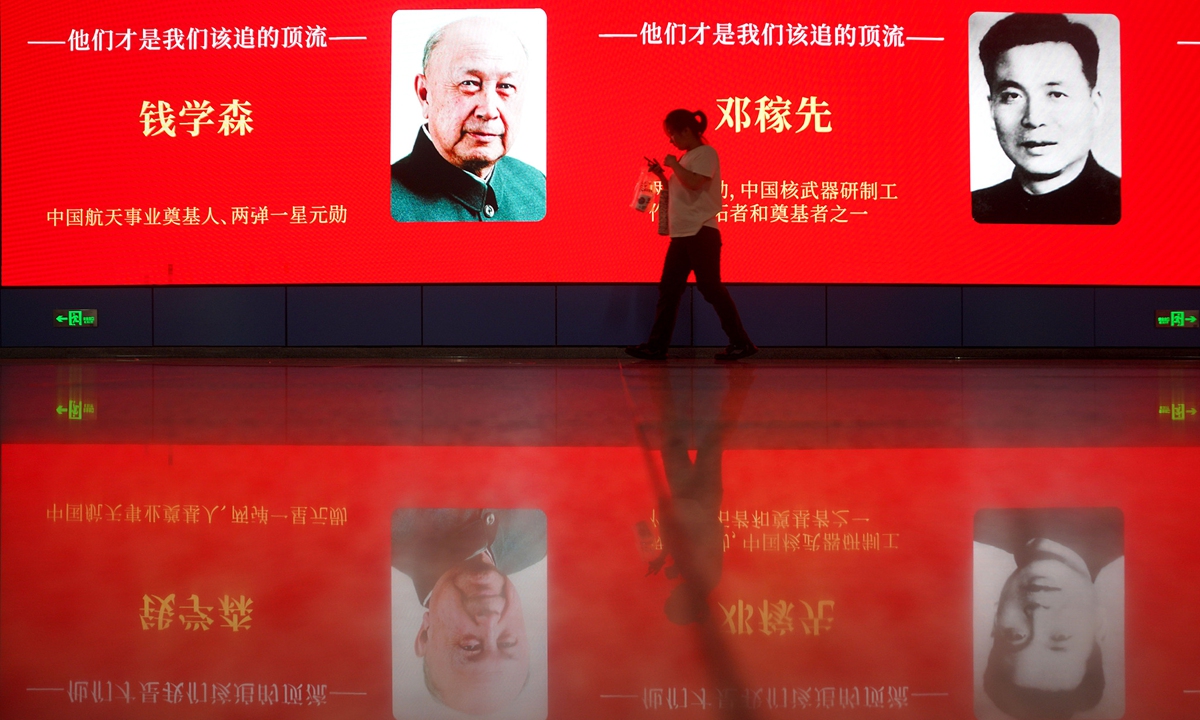
Posters featuring Chinese scientists Qian Xuesen and Deng Jiaxian at the Convention and Exhibition Center metro station, Zhengzhou, Henan Province on August 27, 2026. Photo: VCG
Recently, as more and more foreigners have traveled to China, they've noticed a detail considered "very Chinese": They've discovered that highly visible locations - such as city squares, subway stations and billboards on overpasses - are often reserved for "the backbone of the nation," including figures like the founding father of China's missile and space programs Qian Xuesen, nuclear physicist Deng Jiaxian and agronomist Yuan Longping. Their faces and achievements have become a striking cultural landscape in Chinese cities.
When tourists from around the world discover that China reserves the "prime city billboards" for scientists, what they see is not just an advertisement, but a reflection of Chinese values. It tells the world: In China, diligence in seeking knowledge, scientific exploration and a sense of mission to serve the motherland will always deserve the highest place.
Reactions from netizens on international social media platforms reflect a resonance with traditional Chinese values: Comments such as "Scientists are the ones who should be idols," "This inspires children to grow up and gives them role models to learn from," and "Hey, we should do this too" flooded the feeds.
Others cited public opinion polls in recent years to support this view: While children in the US and the UK are more likely to aspire to become social media influencers, Chinese children want to become astronauts, "because the Chinese education system places greater emphasis on the value of science and space exploration."
In fact, the collective reverence for knowledge, science and those who dedicate themselves to their work is a tradition deeply ingrained in the Chinese people for thousands of years. Featuring scientists on billboards is precisely a continuation of this tradition in the modern era.
The appearance of scientists on large public screens in cities has also sparked immense pride among countless netizens in China, with reactions almost identical to those of foreign netizens: "They are the true top stars we should be following."
In recent years, the "new three" have made a strong global impact, large-scale AI models have made stunning debuts and humanoid robots have taken the lead in the industry - achievements that are increasingly recognized worldwide. Today, more and more foreigners embark on in-depth tours of China, and their gaze shifts from the glitz of the cities to advertisements featuring scientists. This demonstrates that the world's exploration of China is beginning to shift from "What has China achieved?" to the deeper question: "Why has China been able to achieve this?"
The answer, in fact, is right there in plain sight. When a city reserves the most prominent center stage of its most valuable public spaces for scientists, it hints at the source of this nation's development: A nation that respects science will inevitably possess sustained momentum for innovation and a stable foundation for development. This "realization" has given the world a deeper understanding of - and greater confidence in - China's development.
What is more, the stories of Chinese scientists belong not only to the Chinese nation but to the world as well. Take Yuan Longping's hybrid‑rice technology, Tu Youyou's discovery of artemisinin, the global applications of the Beidou system and the China Space Station opening its research opportunities to scientists from all countries.
Rooted in the cultural ethos encapsulated in the Confucian maxim: A humane person helps others establish what he himself wishes to establish and achieve what he himself wishes to achieve, China demonstrates to the world that it is committed not merely to its own prosperity, but also to using science as a bridge to jointly tackle humanity's shared challenges.
The reason these scientists, standing at the center of the spotlight in Chinese cities, have sparked heated discussion on international social media is that they are not only a source of pride for China but also a shared source of pride for humanity in this era.
RELATED ARTICLES