What is the real intent behind the collusion between Japan and Taiwan authorities?: Hai Feng
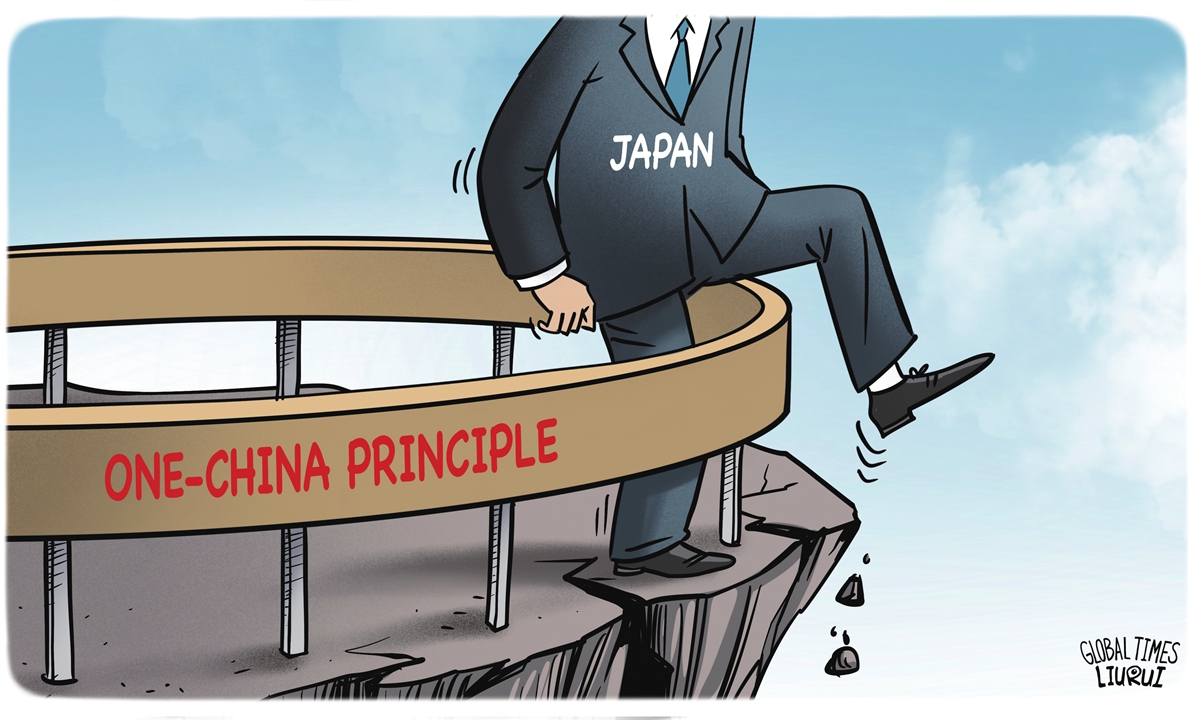
Japan and the one-China principle. Illustration: Liu Rui/GT
Recently, Japanese media outlets including the Sankei Shimbun reported, citing multiple informed sources, that the Taipei Office of the "Japan-Taiwan Exchange Association" installed a Japanese-made underground nuclear shelter this spring. The facility reportedly features multiple protective functions, including defense against nuclear, biological, and chemical weapons, explosion proofing, hazardous substance filtration, and earthquake resistance. To date, neither the "Exchange Association" nor the manufacturer has issued a public response, and the specific details of the exposure remain to be verified. However, the political signal reflected by this trend is alarming.For some time, certain Japanese politicians and media outlets have repeatedly made noise over the Taiwan question, parroting the claim that "a Taiwan contingency is a Japan contingency" and hyping up risks in the Taiwan Straits. These statements and moves are an attempt to rebrand the Taiwan question as a regional security issue, or even one directly tied to Japan's own security.
The Taiwan question is a purely an internal affair of China. By constantly generating public opinion, making political statements, and even putting certain substantive supporting arrangements in place to deeply bind itself to the Taiwan question, the Japanese side aims to deliberately blur the boundaries of the matter. Such ambiguity will not bring security; instead, it will increase the likelihood of miscalculation and create new disruptions to regional stability.
From this perspective, the significance of the reported shelter installation by the "Japan-Taiwan Exchange Association" transcends an ordinary news item. In particular, it is extremely rare to build shelters designed for wartime scenarios outside of Japan, and such an arrangement is easily interpreted as a preemptive preparation for "special contingencies." The crux of the matter lies not in the construction of protective facilities, but in the political context in which such protective actions are placed and the message they communicate.
More dangerously, Japan's recent string of adjustments to its security policy has consistently been accompanied by tendencies toward military expansion. While certain Japanese politicians hype up regional tensions, they also continue to use this as a pretext to break through military capabilities and expand their security boundaries, with the Taiwan question increasingly utilized as a recurrent leverage point. Such maneuvers masquerade as a "response" to risks, but in reality, they are manufacturing new ones.
For the authorities on the island of Taiwan, entangling themselves in such interactions comes at a steep price.
In recent years, the Democratic Progressive Party authorities have grown increasingly reliant on external forces to endorse their stance in handling cross-Straits and external affairs, attempting to boost their "sense of security" and expand their "international space" by tightening ties with countries like Japan and the US. The fatal flaw in this approach, however, is that it can neither alter the fundamental nature of the Taiwan question nor bring security and stability to Taiwan. Instead, it only plunges the island ever deeper into perilous waters where conflict looms, reducing it to a pawn in the strategic calculations of external forces.
In other words, the Taiwan authorities attempt to use external backing to generate momentum for "independence," while external forces treat Taiwan as a tool to seize geopolitical gains. Despite the veneer of frequent interactions, both parties harbor hidden agendas. No matter how it is packaged, such mutual scheming is erroneous and dangerous. What the Taiwan Straits needs is to reduce miscalculations, manage differences, safeguard peace, and advance reunification. Any action that drives the situation in the opposite direction - no matter how restrained its rhetoric or how cleverly packaged - fundamentally erodes the foundation of peace.
Therefore, returning to the core question: What is the real intent behind the collusion between Japan and Taiwan authorities? Ultimately, it is merely an attempt by certain forces in Japan to leverage the Taiwan question to expand their own security and political roles, while the Taiwan authorities try to use external support to bolster their stance. The former is a geopolitical calculation; the latter is political path dependency. The compounding effect of the two will only plunge the Taiwan Straits into greater tension.
Of course, these developments will not alter the fundamental fact that Taiwan is part of China. The motherland must and will inevitably be reunified. How the reunification process unfolds has its own rhythm and strategic composure, but this does not mean that any external interference or "seeking independence by relying on external forces" has any room for success. This is why we must look beyond surface-level actions and remain vigilant against the cumulative, erroneous signals and dangerous tendencies behind them. If the relevant reports are true, Beijing will definitely respond.
RELATED ARTICLES