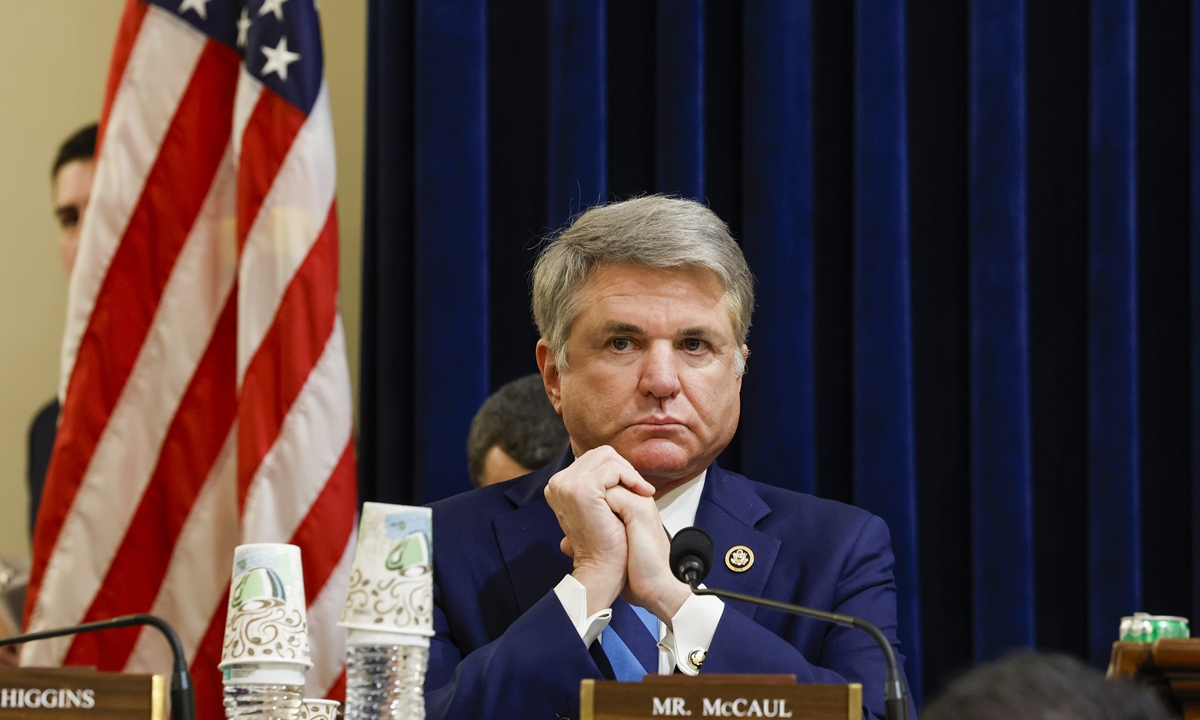
Michael McCaul Photo: VCG
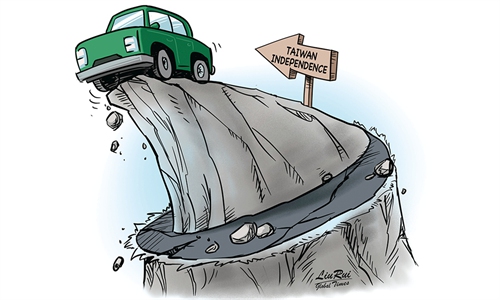
Recent signals from the US political arena on the Taiwan question have shown a clear divergence. On one side, US Secretary of State Marco Rubio stressed in a recent interview that "Any confrontation between Washington and Beijing would be catastrophic for both countries and the world." He advocated managing differences through diplomacy while maintaining competition, in order to preserve stability. On the other side, anti-China politician Michael McCaul made a provocative visit to the Taiwan region to attend the so-called Ketagalan Forum, echoing the DPP authorities by loudly promoting arms sales to Taiwan and hyping up so-called "defense commitments," continuously sending misleading signals to "Taiwan independence" forces. The coexistence of these two voices reflects a deeper contradiction in US policy toward Taiwan: whether to pursue rational competition and risk management to maintain stability in China-US relations, or to amplify differences, ignore risks and further escalate tensions to undermine the broader China-US relationship.
In terms of the power structure, it is not McCaul, who travels around making speeches, but Rubio, who sits within the White House administration and is directly involved in China-related communication and policymaking, that represents the official position of the US government. Members of Congress may make remarks, create momentum, and seize on issues for political purposes, but their remarks do not define US national strategy.
Rubio's remarks, from a standpoint of practical rationality, point to an objective reality: If China and the US were to engage in direct conflict, there would be no winners. Whether through economic decoupling or military confrontation, the ultimate costs would be borne not only by China and the US, but even by the entire world. It is precisely for this reason that Rubio adopts a tone of "delicate balance." On this basis, the US must also make it clear that this "balance" cannot mean provoking China on the Taiwan question while simultaneously demanding restraint from China. Rather, it must genuinely adhere to the one-China principle and reduce, at the root, the risk of crisis escalation. The reason is straightforward: The Taiwan question is the most sensitive, most dangerous, and most likely trigger of systemic crisis in China-US relations. Any attempt to instrumentalize, lever or use it as a bargaining chip is effectively planting mines in the path of China-US relations.
McCaul is a classic counterexample. He brandishes the so-called "Taiwan Relations Act," advocates for a new round of massive arms sales to Taiwan and strikes a pose of "standing with Taiwan to the end," as if selling more weapons and shouting louder could prove that the US still maintains its "credibility" toward its so-called allies. But McCaul does not represent strategic rationality; rather, he embodies the political inertia and interest networks of a certain faction on Capitol Hill.
Certain US lawmakers' unauthorized visits to Taiwan are not intended to maintain peace across the Taiwan Straits, but rather to stage political spectacles, coordinate with certain capital groups, and continue to capitalize on the "anti-China" narrative. For these politicians, Taiwan is merely a political bargaining chip to be repeatedly exploited; their so-called "commitments" to arms sales to Taiwan have always been based solely on their own interests and those of certain groups.
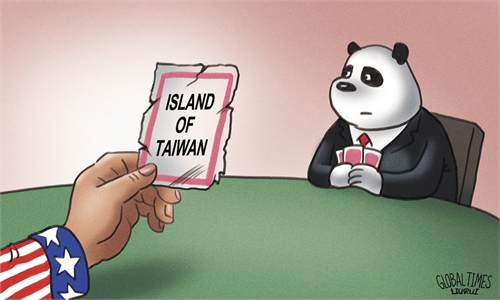
Trump's remarks following his visit to China have already laid bare the transactional nature of US policy toward Taiwan. He warned Taiwan not to try to "go independent," not wanting anyone to mistakenly believe that US backing would allow them to take reckless risks. Meanwhile, he publicly characterized arms sales to Taiwan as a bargaining chip open to negotiation and trade-offs, even going so far as to claim that "1982 is a long way, that's a big, far distance away" - referring to the 1982 "Six Assurances" under then US president Ronald Reagan.
This shows that within Trump‑style transactional thinking, Taiwan is merely a strategic asset open to bargaining - one that can be leveraged to pressure China today, and traded away for other gains tomorrow.
For those on the island who have long indulged in the fantasy of "relying on the US to seek independence," this actually speaks volumes: Washington has never acted "for Taiwan's sake," but rather "for America's sake." Precisely for this reason, McCaul's high-profile remarks may not necessarily represent Washington's final decision; rather, they amount to little more than political noise.
What truly determines the direction of China-US relations are the strategic judgments made at the level of the two countries' heads of state, as well as the White House's calibration of the line between "stability" and "confrontation." Recently, foreign media reported that US Senator Steve Daines is expected to visit Beijing again. This news may indicate that, in the view of Washington's top leadership, China and the US still need to communicate and build bridges for cooperation. McCaul's attempts to fan the flames are fundamentally out of sync with this approach.
Of course, China cannot simply turn a blind eye to the clamor raised by figures like McCaul. Whether through the sanctions previously imposed on him or the countermeasures recently taken by the Ministry of Commerce against seven US entities, China has made its stance clear: It will not yield on matters of principle, nor will it fail to respond when the US escalates provocations. China's countermeasures have been restrained, and necessary, aiming not to escalate conflict, but to draw a clear line and curb wrongful actions. If the US persists in indulging anti-China lawmakers on the Taiwan question and sliding down in the wrong direction, then further countermeasures from China would be expected.
Ultimately, the crux of the Taiwan question is not about who shouts the loudest. What McCaul represents is merely the clamor of certain anti-China politicians and interest groups in the US; Rubio, on the other hand, reflects - to some extent - the rational judgment of Washington's decision-makers: The Taiwan question must not be allowed to explode into a crisis, China-US competition must not spiral out of control, and the global dynamics certainly must not be plunged into turmoil and disorder by the performance of a few politicians. If Washington genuinely seeks to build "a constructive China-US relationship of strategic stability" with Beijing, there is only one prerequisite: properly handling the Taiwan question by reining in those anti-China lawmakers who constantly stir up trouble, generate noise, and inflame tensions and ceasing to treat Taiwan as a strategic bargaining chip.
The Taiwan question is not a game, nor is it a prop for politicians' performance. While Representative McCaul does not represent the overall stance of Washington, if Washington fails to rein in such figures, the stable foundation of China-US relations will be eroded. For the US, the truly responsible choice is not to let anti-China politicians hijack policy toward China, but to return to a path of rationality, restraint, communication, and the management of boundaries. Whoever treats the Taiwan question as a bargaining chip or a stage for political posturing risks creating consequences that could impact the entire world.
RELATED ARTICLES