The one-China principle should not be challenged; the US should be prudent about its words and actions: Hai Feng
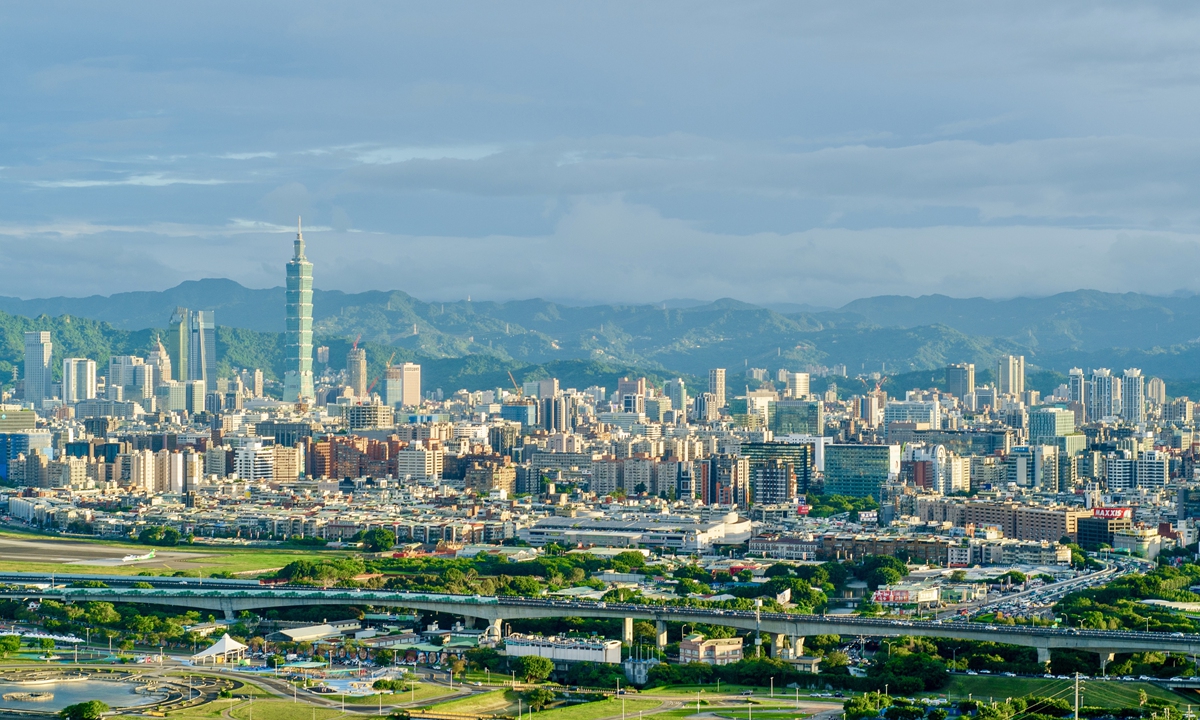
An aerial view of Taipei, Taiwan Province. Photo: VCG
Recently, the government of Papua New Guinea announced the closure of the Taipei Economic Office in Port Moresby and reaffirmed its adherence to the one-China policy. In response, the US State Department went so far as to express "deep concern," interpreting the move as Beijing's efforts to "intimidate" Taiwan island. Such a narrative confounds right and wrong, turns facts upside down and once again exposes the consistent double standards maintained by the US regarding the Taiwan question.It must first be pointed out that Papua New Guinea's decision to close the Taipei Economic Office was not made under pressure. Rather, it was a normal political choice made by a sovereign state in accordance with the one-China principle. There is but one China in the world, Taiwan is an inalienable part of China, and the Government of the People's Republic of China is the sole legal government representing the whole of China. This is not only a legal fact affirmed by UN General Assembly Resolution 2758 but also a broad consensus within the international community. To date, the vast majority of countries have established and developed diplomatic relations with China based on the one-China principle. This amply demonstrates that adherence to the one-China principle is the fundamental prerequisite and political foundation for China to develop relations with other countries, and reflects the prevailing will of the international community and the trend of the times.
Papua New Guinea's reaffirmation of the one-China principle and the corresponding arrangements made regarding Taiwan-related offices constitute a genuine respect for international law and the norms governing international relations. The US' insistence on characterizing this as Beijing's efforts to "intimidate" Taiwan island simply does not hold water. The one-China principle has become an international consensus not because of external pressure, but because it is a fact grounded in both history and law. Any attempt to repackage issues of sovereignty as a "democratic partnership" is a case of substituting concepts and serves merely as a pretext for interfering in China's internal affairs.
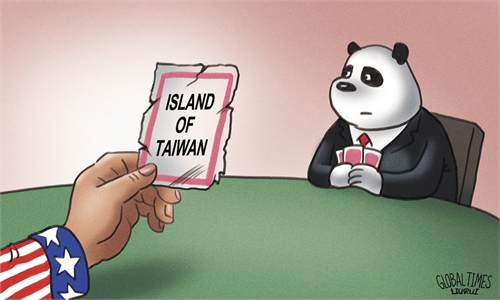
While professing adherence to the one-China policy, the US consistently hollows out and undermines this commitment through its actions on specific issues. Whenever a country handles Taiwan-related matters in accordance with the one-China principle, the US is quick to "express concern"; whenever "Taiwan independence" separatist forces attempt to challenge the bottom line, the US frequently sends the wrong signals. Ultimately, what the US truly cares about is not peace across the Taiwan Straits or the well-being of the people of Taiwan, but rather how to turn the Taiwan question into a tool and a bargaining chip to serve its strategic agenda of "using Taiwan to contain China." Such actions are precisely a major external source of the turbulence and instability in the Taiwan Straits.
It must be recognized that the Taiwan question lies at the very core of China's core interests and stands as the most important and sensitive issue in China-US relations. If this issue is mishandled, stability in China-US relations cannot be assured, nor can regional peace be guaranteed. The Taiwan question is described as an issue where "a single move could affect the whole situation" precisely because it concerns China's sovereignty and territorial integrity, leaving no room for ambiguity, testing of boundaries or crossing of red lines. If the US genuinely wishes to uphold peace and stability across the Taiwan Straits, it should not repeatedly cross the line on Taiwan-related affairs, let alone level groundless accusations against other countries for their legitimate actions in adhering to the one-China principle.
Papua New Guinea's decision once again demonstrates that the one-China principle rests on a solid international foundation and unshakeable legal grounds. The international community increasingly recognizes that the Taiwan question is not one to be manipulated at will, but a matter of serious principle concerning China's sovereignty and the global order. Respecting the one-China principle aligns with the prevailing international trend, whereas challenging or blurring it undermines regional stability and jeopardizes the overall landscape of China-US relations.
Ultimately, adherence to the one-China principle represents both an international consensus and a matter of international righteousness. If the US truly wishes to play a constructive role in maintaining peace across the Taiwan Straits and stabilizing China-US relations, it must genuinely honor the one-China principle, cease using the Taiwan question to stoke confrontation and stop sending wrong signals to "Taiwan independence" separatist forces. The Taiwan question concerns China's core interests and has far-reaching implications; it is hoped that the US recognizes the high sensitivity of Taiwan-related affairs, acts with prudence and avoids compounding its errors.
The author is an observer on international affairs. opinion@globaltimes.com.cn
RELATED ARTICLES