SCO’s ‘contributions are seen as vital for shaping the multipolar world order’: Kyrgyz scholar

SCO Illustration: Liu Rui/GT
Editor's Note:
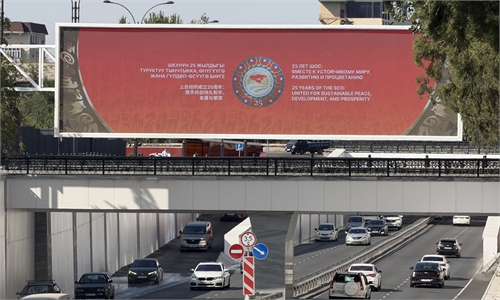
Chinese President Xi Jinping attended the 26th Meeting of the Council of Heads of State of the Shanghai Cooperation Organization (SCO) held in Bishkek on Tuesday, and paid a state visit to Kyrgyzstan upon the invitation of President Sadyr Japarov of Kyrgyzstan. As the SCO celebrates its 25th anniversary of its founding, what is the unique value of this organization today? What role do China and Kyrgyzstan play? Global Times (GT) reporter Wang Wenwen talked to Sheradil Baktygulov (Baktygulov), director of the Institute of World Policy of Kyrgyzstan, over these issues as well as China- Kyrgyzstan ties.
GT: How do you view the role of the Bishkek summit in bridging the SCO's past and future? Against the backdrop of the rapidly evolving international landscape, how do you assess the unique value of the SCO?
Baktygulov: This year's summit is a pivotal moment that bridges the SCO's foundational past and its ambitious future. Evolving from the "Shanghai Five" (China, Russia, Kazakhstan, Kyrgyzstan and Tajikistan) mechanism, the SCO has grown into a universal intraregional organization uniting 10 member states, two observer states and 15 dialogue partners.
Against a rapidly evolving international landscape marked by geopolitical fragmentation and eroding traditional security mechanisms, the SCO's unique value lies in its alternative model of cooperation widely known as the "Shanghai Spirit." These principles, which embody mutual trust, mutual benefit, equality, consultation, respect for diversity of civilizations and the pursuit of common development, demonstrate that all nations can cooperate without uniformity.
The organization's approach integrates security with development, recognizing that sustainable peace requires economic opportunity and connectivity. This unique value is reinforced by the participation of major Global South voices, whose contributions are seen as vital for shaping the multipolar world order.
GT: In a previous interview, you said that China plays a "leading role" in the development of the SCO. In your eyes, how does this "leading role" translate into action regarding specific issues such as global governance reform, regional security architecture and economic integration?
Baktygulov: The leading role of China within the SCO is translated into concrete action through a pragmatic and result-oriented approach which prioritizes sovereign equality and shared development over ideological conformity. This approach is operationalized within three interconnected pillars.
First, China is championing the reform of global governance worldwide. Due to a proactive position of China, the SCO is being considered as a key pillar of a more just, multipolar world order, representing a non-Western model of global governance reform. The Global Governance Initiative, proposed at the SCO Tianjin summit, exemplifies this by promoting sovereign equality and institutional resilience. The decision to establish the SCO Development Bank further translates this vision into action, providing a new financial mechanism to support regional integration and reduce dependency on existing Western-led financial systems, thereby reforming the global financial architecture from within.
Second, the SCO from its first days of functioning pays high attention to building a new regional security architecture. China, while being a major space and nuclear country, operationalizes the SCO security vision by moving beyond traditional military alliances to address the interconnected nature of modern threats. This is most visible in the approval of a Comprehensive Center for Addressing Security Threats and Challenges, an institutional upgrade that creates a unified structure to combat terrorism, extremism, transnational organized crime and drug trafficking. The SCO solution replaces bloc confrontation with a cooperative model of "partnership without alliance," enhancing regional stability through intelligence sharing and joint threat analysis.
Third, China is a driving force for deep economic integration. China is the obvious leader of economic development in the world. Chinese economic leadership is translated into action by financing and constructing "hard" infrastructure, like the flagship project China-Kyrgyzstan-Uzbekistan railway, which physically integrates the whole region. Simultaneously, China creates the "software" for integration by establishing new cooperation mechanisms for standardization, customs procedures and digital trade to facilitate the smooth flow of goods and capital. By initiating platforms for green energy and AI, China also guides the region toward high-quality development and stable industrial supply chains.
GT: President Xi on Friday published a signed article in Krygyz media ahead of his arrival in Kyrgyzstan. He hailed "two countries have always upheld mutual respect, good-neighborliness, mutual learning, and mutual benefit, and steadily deepened mutual trust and cooperation." How do you see these principles guiding the bilateral relationship?
Baktygulov: All the pillars are essential, and from my perspective, the most promising breakthroughs are most visible in "mutual benefit" and "heart-to-heart communication."
The domain of mutual benefit presents transformative and tangible opportunities. The flagship project here is the China-Kyrgyzstan-Uzbekistan railway, with construction on the Kyrgyz section advancing in full swing. This is a "road to prosperity" that will unlock significant economic potential for Kyrgyzstan and the broader region. This is complemented by ongoing efforts to modernize ports and enhance both "hard" and "soft" connectivity, aiming to create a seamless flow of goods and people.
Furthermore, the potential for cooperation in emerging fields is vast. As Kyrgyzstan pushes forward with its 2030 national development program, the Chinese technologies and investments can be pivotal partners in building a more modern and diversified economy.
As for the pillar of heart-to-heart communication, it provides the essential foundation for long-term success. Sustained people-to-people exchanges are being fostered through a growing network of knowledge exchange entities like the Luban Workshop, which offers vocational training. The flourishing collaboration in archaeology and cultural heritage protection, like the joint work at the Krasnaya Rechka, helps build a bridge of mutual understanding and trust. By deepening this cultural connection, both nations ensure that their partnership is deeply rooted and resilient for generations to come.
RELATED ARTICLES