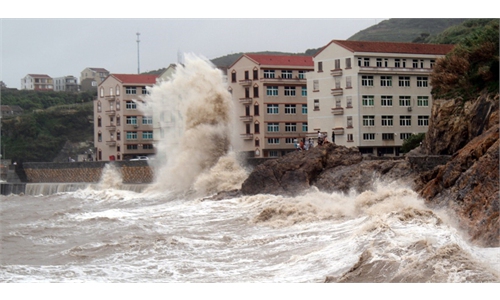
Meteorologists detail lifecycle of Typhoon Saudel as it makes rare third landfall in Fujian
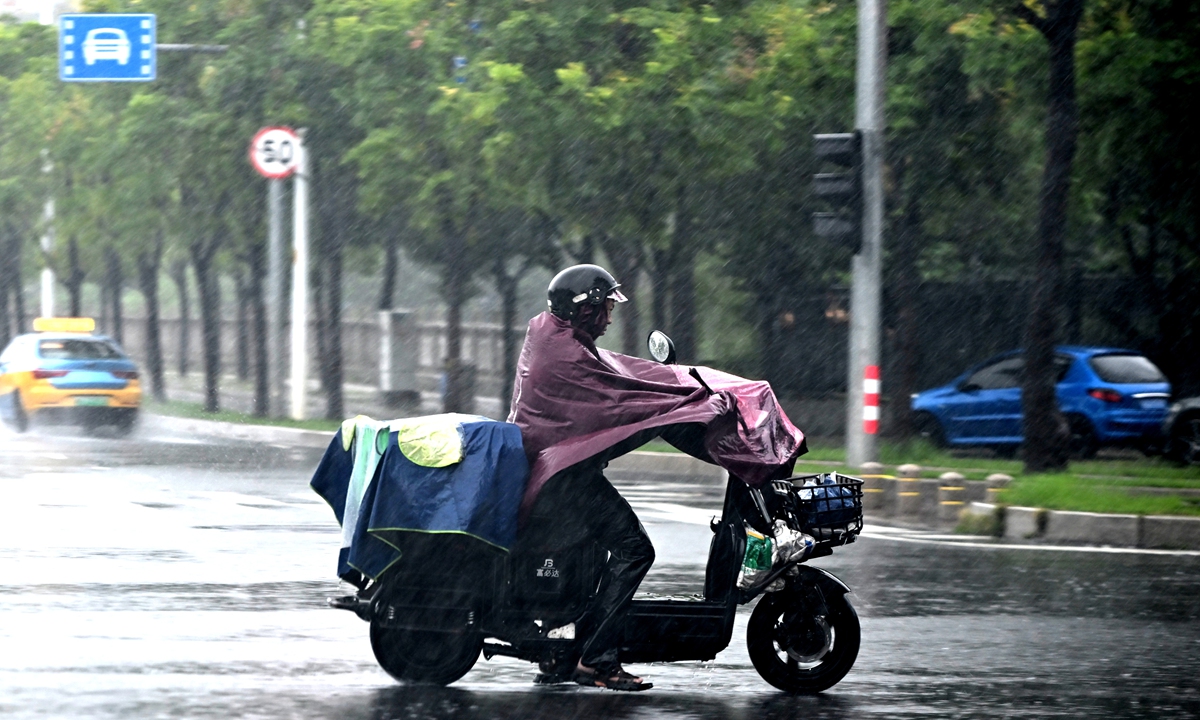
A man rides in the rain on September 3, 2026, in Fuzhou, East China's Fujian Province. Photo: IC
Typhoon Saudel, the 18th typhoon of the year, made its third landfall along the coast of East China's Fujian Province on Thursday morning. The occurrence of three typhoons - namely Typhoon Saudel, Typhoon Bavi (No. 9) and Typhoon Dolphin (No. 13) - striking the exact same coastal subdistrict in a single year is unprecedented in China's recorded meteorological history, meteorologists said.
The storm has triggered torrential rains and widespread safety precautions across several coastal provinces, with multiple cities announcing emergency school closures, local media reports showed.
According to the provincial meteorological observatory, the typhoon packed maximum sustained winds of 23 meters per second near its center during landfall.
The National Meteorological Center of the China Meteorological Administration (CMA) forecasts that the combined effects of Typhoon Saudel and its peripheral circulation will bring torrential rain to parts of eastern and southern Fujian, southern Jiangxi, eastern Guangdong, and southern and northeastern parts of island of Taiwan from 8:00 am on Thursday to 8:00 am on Friday. Extremely heavy rainfall is expected in localized areas of southeastern Fujian and eastern Guangdong.
In response to the severe weather, local governments across coastal southern China have elevated their emergency response levels.
The educational department in Fujian's Quanzhou city released a notice to all schools in the city stating that from 6:00 pm on Wednesday until the end of Thursday, all primary and secondary schools, vocational schools and kindergartens will be closed. All colleges and universities in Quanzhou are required to follow suit. During this period of school suspension, all off-campus training institutions must cease activities, the notice reads.
Fuzhou and Zhangzhou in Fujian Province, along with Shantou in Guangdong Province, issued emergency advisories urging residents to prepare for severe weather. Schools will remain closed, and Shantou authorities are on high alert for storm-related hazards.
In Guangdong's Meizhou, a typhoon blue warning remains active across eight counties and districts. The local meteorological department on Thursday urged residents to reinforce windows and temporary structures and instruct river vessels to seek immediate shelter.
Further south, the Hong Kong Observatory issued Standby Signal No. 1 early Thursday as swells began affecting local waters. Maritime operators and fishing craft have been urged to seek shelter and secure moorings, while travelers heading to Guangdong, Macao, and outlying islands are warned to anticipate transport disruptions.
Saudel initially made landfall twice along the coast of Zhejiang Province — first at Kanmen subdistrict in Yuhuan at 8:05 am, and then in Wenzhou's Longwan district at 9:10 am, per Xinhua report.
Saudel's initial landfall location in the Kanmen subdistrict was the exact same coastal spot hit earlier this year by Typhoon Bavi (No. 9) and Typhoon Dolphin (No. 13) marking the unprecedented occurrence of three typhoons striking the same subdistrict in a single year, according to the report by Xinhua News Agency citing meteorologists.
Meteorological experts note that Typhoon Saudel's uniqueness lies not just in its rare third landfall, but also in its remarkably convoluted lifecycle—a rare sequence of "landfall, dedesignation, oceanic regeneration, and re-landfall."
Sun Shao, a research scientist at the Chinese Academy of Meteorological Sciences, told the Global Times that after the two landfalls, the remnant low-pressure vortex did not fully dissipate. As the system drifted into the South China Sea, sea surface temperatures above 28 C, abundant monsoonal moisture, and a merger with a nearby tropical disturbance allowed it to reorganize into a tropical storm. Retaining its original designation, Saudel then veered back toward the mainland to complete its third landfall in Fujian.
Zhang Ling, chief forecaster at the National Meteorological Centre, told Xinhua that main factors contributing to this rare phenomenon are the strong development of El Niño this year and the favorable sea surface conditions in the typhoon source regions, which provided sufficient thermal energy for these long-range storms to sustain their intensity and strike with full force. Also, atmospheric currents over the East China Sea, combined with the subtropical high, steered all three typhoons with precision to the Kanmen subdistrict, Zhang said.
Following its third landfall, the regenerated Saudel has weakened back to a tropical storm. However, meteorologists warn that China's typhoon season is far from over. Two to three more typhoons are expected to make landfall or significantly impact China during September, per Xinhua report.
RELATED ARTICLES