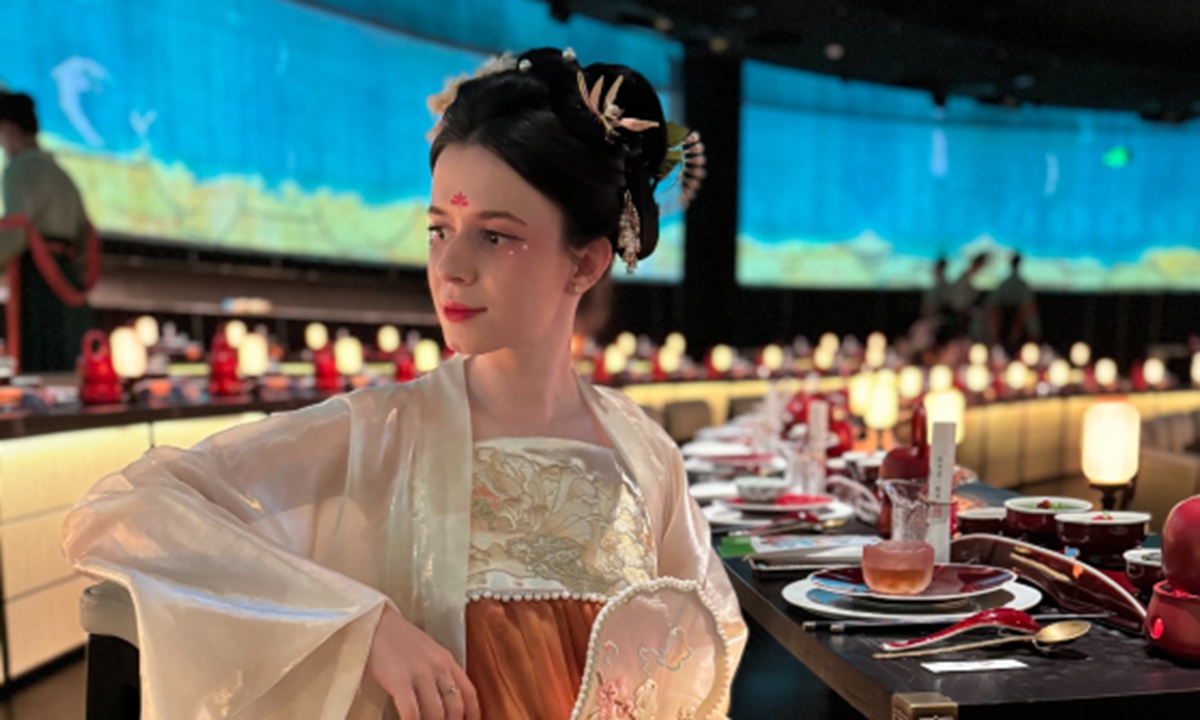
A foreign tourist in traditional Chinese clothes dines at a Chinese imperial-style banquet restaurant in Beijing. Photo: Courtesy of a Beijing restaurant
Copper lamps flicker as candlelight dances across gilded vessels. Court music rises from the corner of the hall, while attendants in crimson and black ceremonial robes move between the tables, carefully placing one delicacy after another before the guests.This is not a historical drama or a movie set. It is a Chinese-style imperial banquet - an increasingly popular immersive dining experience that combines traditional costumes, palace-style settings, recreated imperial dishes and live performances, turning foreign visitors from tourists into "foreign empresses" and "foreign ministers" for an evening.
On social media, searches for Chinese-style imperial banquets have generated over 38 million views, with foreign visitors sharing experiences from restaurants in cities across the country. It has become one of the most eye-catching additions to China tourism experience, or even another trend: Chinamaxxing.
A seat at the imperial table
For many foreign visitors, the appeal lies in the fact that such an experience is difficult to find elsewhere.
"What attracts them is simply an experience they have never had in their own countries," Sun Yiheng, who took her foreign friends to an imperial banquet in Shanghai during the summer vacation, told the Global Times.
Her friends, Sun said, found almost everything about the experience new and fascinating.
"It feels like I am personally taking part in a historical drama," visitor Irine told the Global Times. "The restaurant in China is next level."
She said many of her friends already knew about Chinese food before coming to China, but only after experiencing the banquet did they discover another side of Chinese dining culture.
A basic ticket for a Chinese-style imperial banquet can start at around 200 yuan ($29.77), while traditional costume and makeup may cost another 100 yuan and a front-row seat another 100 yuan. The most comprehensive experience can generally be enjoyed for around 500 yuan, although some really luxury restaurants in Beijing and Shanghai also provide packages that are priced at around 1,500 yuan.
Sun said her foreign friends did the math and found the price surprisingly affordable.
"If we had this kind of experience and service in our countries, this amount could be a small tip alone," Irine said.
The experience is not limited to a generic image of an ancient Chinese palace. Different cities have developed their own themes by drawing on local history and unique cultural heritage.
In Luoyang, Central China's Henan Province, the imperial banquet draws inspiration from the Tang Dynasty (618-907). Performers appear in colorful ruqun, traditional two-piece dresses, with flower-shaped ornaments painted between their eyebrows. High-altitude dances performed on wires add another dramatic touch.
A manager in the Luoyang restaurant told the Global Times that the performances incorporate Luoyang's cultural heritage, including Tang Dynasty court music and dance, as well as the poetic imagery of mountains and rivers. Guests can even interact with a performer playing the legendary poet Li Bai and receive small gifts.
The restaurant received an unusually large number of overseas visitors this summer, with some foreign tour groups booking entire sessions. Foreign tourists accounted for around 40 percent of its total summer visitors, according to the manager.
From Luoyang's banquet and Chengdu's Shu-culture banquets to imperial cuisine museums in Beijing, restaurants across China are combining food with local history, traditional costumes and live performances.
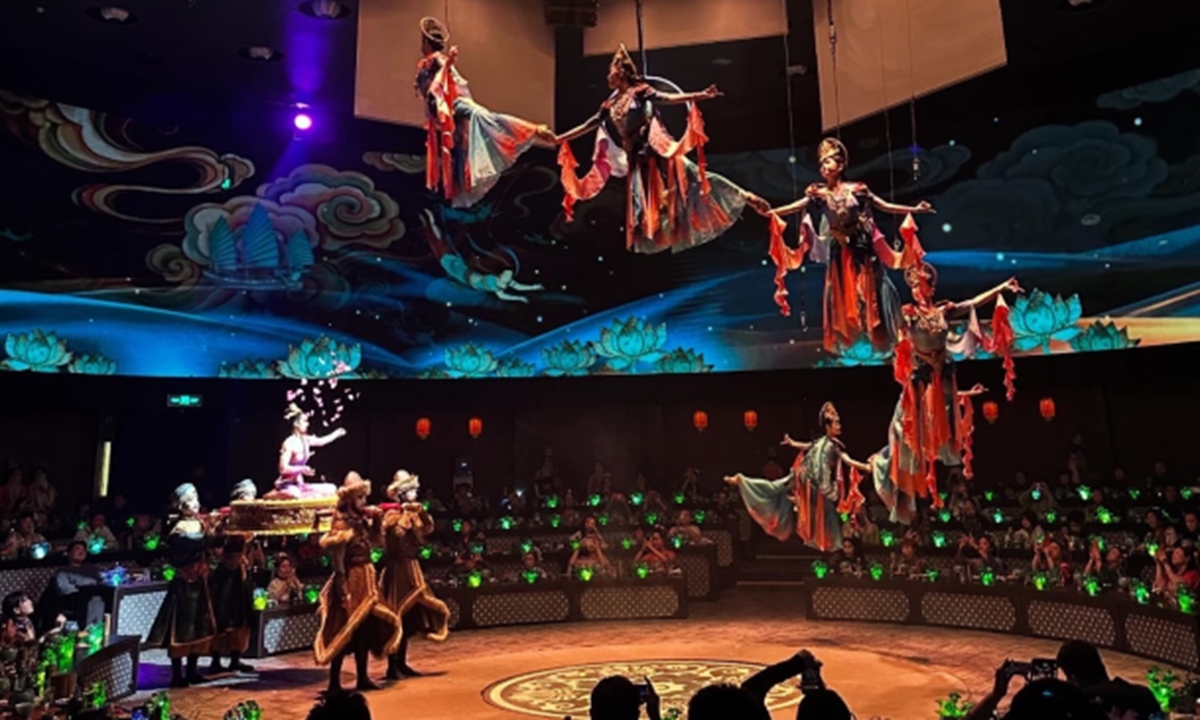
Performers present a graceful flying dance at a Chinese imperial-style banquet in Shanghai as part of the restaurant's immersive dining experience. Photo: Courtesy of YANYUE restaurant
Zhang Yi, CEO of iiMedia Research, said such experiences satisfy foreign visitors' curiosity about ancient China while giving traditional culture a younger and more participatory form of expression.The banquet, in other words, is no longer simply a meal. It is something visitors can eat, watch, wear, totally immerse in, Zhang told the Global Times.
From palace fantasies to everyday China
As clips of these banquets trend across social media, they are adding new footnotes to a broader phenomenon: Chinamaxxing.
TikTok and rednote have become powerful windows through which these fragmented cultral experiences can travel far beyond the cities where they originated. On social media, "Chinamaxxing" has emerged as a new label for the way foreign visitors are experiencing China.
According to Forbes, the term "Chinamaxxing" refers to young Western social media users experimenting with Chinese lifestyle habits, wellness practices and aesthetics - from traditional medicine to cultural rituals. On TikTok and Twitch, creators post videos documenting their attempts to "become more Chinese" - sometimes seriously, sometimes humorously.
Thanks to the visa-free policy, China's border inspection agencies handled a record 369 million inbound and outbound crossings in the first half of 2026, and visa-free entries by foreign nationals surged 30.6 percent year on year to surpass 17.8 million, accounting for 77.7 percent of all foreign arrivals, according to National Immigration Administration, Xinhua News Agency reported.
As The Guardian noted in a report on "Chinamaxxing," what is spreading globally is not China "in its full complexity," but "fragments of everyday life." The report also noted that some members of the Chinese diaspora felt the trend had "humanized Chinese culture."
From wandering through traditional food markets and grabbing breakfast from street stalls to trying public bathhouses and visiting traditional Chinese medicine clinics, foreign tourists are moving beyond simply "seeing China" toward actually experiencing it.
That may be one of the more interesting aspects of Chinamaxxing and why a Chinese traditional banquet will be popular through this trend. Foreign visitors are rediscovering things that many Chinese people have long taken for granted, Zhang said.
A palace banquet, a bowl of noodles at a neighborhood eatery or an afternoon at a bathhouse may simply be another consumption choice for a local resident. For someone visiting China for the first time, however, it can become a window into a society that cannot be fully understood through landmarks or headlines alone, Zhang noted.
At its core, Chinamaxxing reflects a simple shift: Ordinary foreign netizens are increasingly forming their impressions of China through firsthand experiences rather than second-hand narratives. They are choosing to see it for themselves - and then sharing what they find with the world, Xinhua reported.
They are sitting down at the table, making toasts, trying the cuisine and taking part in the performance. For a few hours, they are not merely watching China, but in it.
RELATED ARTICLES