IN-DEPTH / IN-DEPTH
In western Sichuan, stones, streets, and songs tell a long history of ethnic interaction and unity
Where history lives
By in Garze Published: Sep 04, 2026 11:25 PM

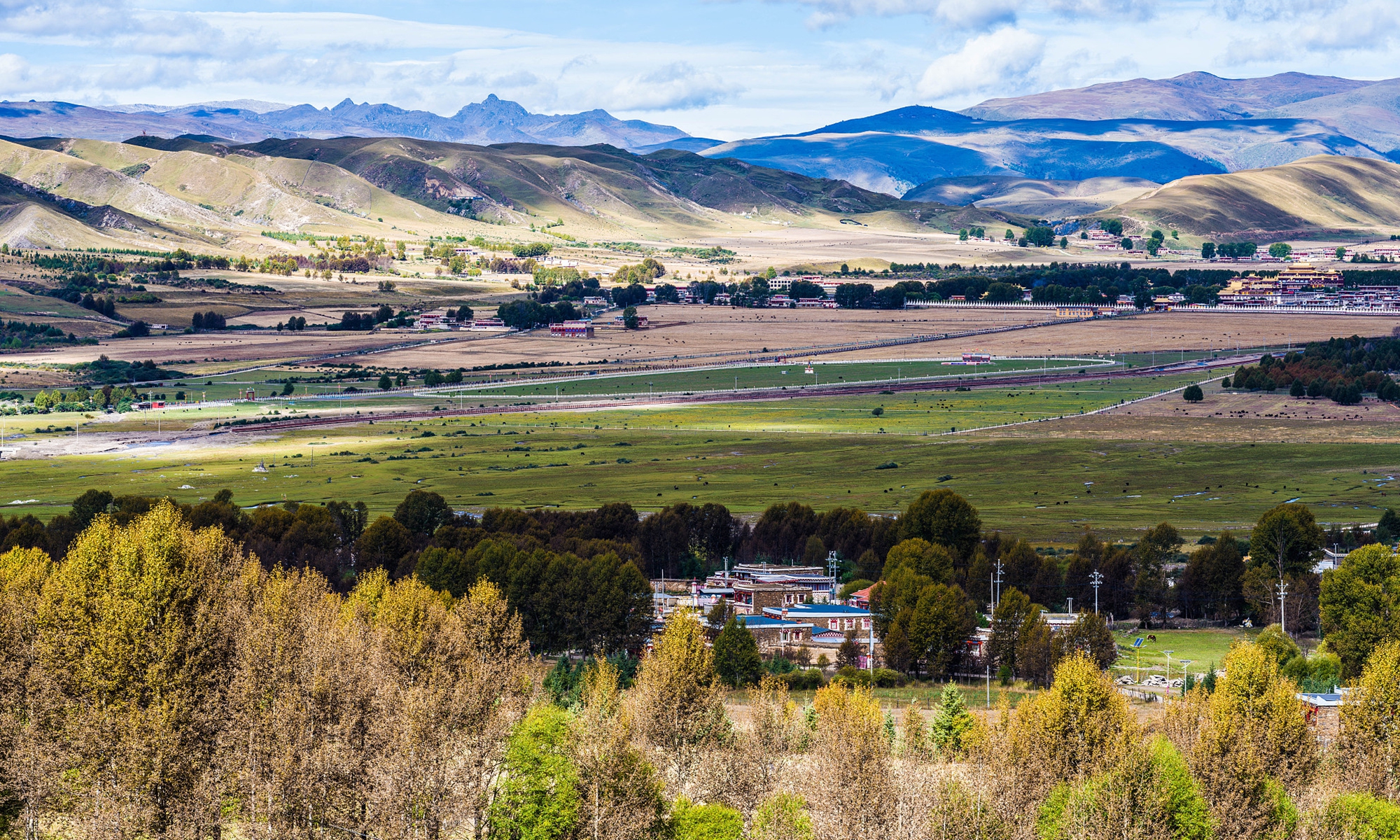
The scenery of Dawu County, Garze Tibetan Autonomous Prefecture, Southwest China's Sichuan Province Photo: VCG
On a grassy field in Taining town, the history of this part of western Sichuan not only appeared as a row of dates, but also came on horseback, in song and in the hands of craftspeople.On this summer morning, people in traditional ethnic clothing gathered on the grass, some bringing ponies with them. At temporary stands, young artisans displayed Thangka paintings and demonstrated traditional dress-making and calligraphy. Tibetan opera performers in bright costumes waited for their turn, while visitors moved between tables of carved objects, masks and butter sculptures.
Some were recognized inheritors. Others were village performers, students or apprentices still learning from relatives.
The gathering formed part of a two-day event on ethnic unity and the preservation of local history and culture, held on August 29 and 30 in Taining town, Dawu County, Garze Tibetan Autonomous Prefecture, Southwest China's Sichuan Province. More than 100 scholars, local researchers, heritage practitioners and media representatives attended, including researchers from universities and the China Tibetology Research Center.
The event came nearly two months after China's Ethnic Unity and Progress Promotion Law took effect on July 1. The law, a fundamental law governing ethnic affairs, contains chapters on fostering a shared sense of belonging for the Chinese nation, promoting interaction, exchange and integration among ethnic groups, and advancing common development.
On the ground, the question was tangible: How can a place reveal the long history of contact among different ethnic groups - and keep that history part of local life?
Walk along history
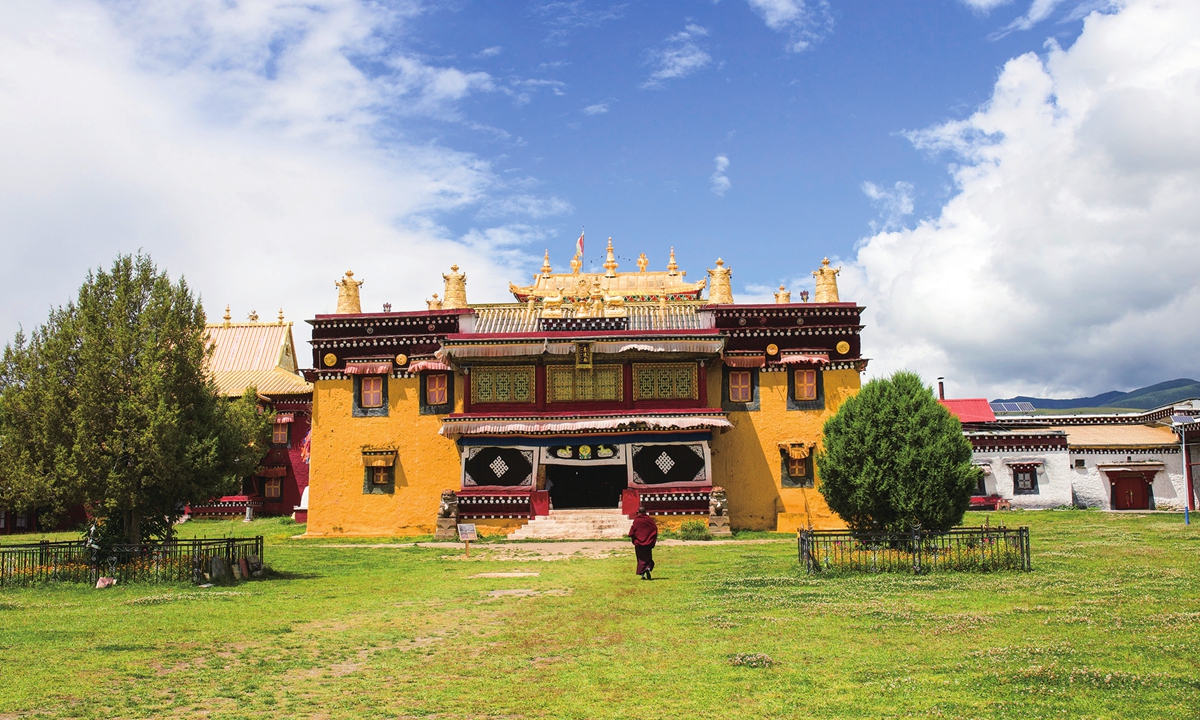
The Huiyuan Temple in Dawu County Photo: Shan Jie/GT
At Huiyuan Temple, history first appears in stone.The Qing Dynasty (1644-1911) steles preserved at the temple record its construction, the seventh Dalai Lama's residence there and the mission of Prince Guo, who was sent by the Qing court to arrange the religious leader's return to Xizang.
Built with funding from the Qing government in the late 1720s, the temple brought together court planning, Tibetan Buddhism and the work of people from different ethnic backgrounds. Its architecture also combines features associated with Buddhist buildings of other parts of China and Tibetan religious traditions.
The steles identify institutions, people, decisions and routes, preserving records of how government, religion, transport and local society interacted in a specific place. That record extends beyond Chinese-language official documents.
Veteran Tibetologist and Xizang Minzu University professor Zhou Runian, who has spent more than four decades studying and translating Tibetan-language sources, told the Global Times that such documents contain extensive records of interaction among ethnic groups.
"They record exchanges among Tibetan, Han and other ethnic groups in language, culture, history and economic life," Zhou said. "These are important historical materials for understanding how these relationships developed."
Zhou noted that Taining in Daofu County lay along the ancient Tang-Tubo route and the "Tea Horse Road." Tibetan texts, he said, record tea-horse trading in the area and the adoption of Chinese tea terms into Tibetan usage.
The same history becomes visible again a short distance away in Taining's old town.
Sections of the old earthen wall remain. Along Laoshan Street, or "Old Shaanxi Street," merchants from Shaanxi and Shanxi provinces traded or settled for more than two centuries. Nearby, the surviving walls of a temple dedicated to the deified ancient general Guan Yu, point to a public space first built by merchants from those provinces in the early Qing period.
Historical accounts say villagers used the temple for worship, meetings and communal meals, while its stage hosted both Sichuan opera and Tibetan opera.
The region's modern revolutionary history adds another layer. In 1936, the Fourth Front Army entered Dawu during the Long March, with troops later moving toward Taining. According to the 2022 Dawu yearbook, local residents served as guides and interpreters and provided grain, butter, tsampa and hides, including more than 1.4 million jin (more than 700 metric tons) of grain. A Taining branch committee and a local revolutionary government whose main participants were Tibetan and Han laborers were subsequently established.
Lajia Dangzhou, dean of the School of Marxism at Sichuan Minzu College, described Taining's Gada culture and Huiyuan Temple as "a vivid microcosm of the formation and development of the Chinese national community."
He told the Global Times that explanations of the area should begin with local evidence, and that distinctive regional cultures require deeper fieldwork, research and interpretation before their historical and contemporary value can be properly explained.
Heritage stays
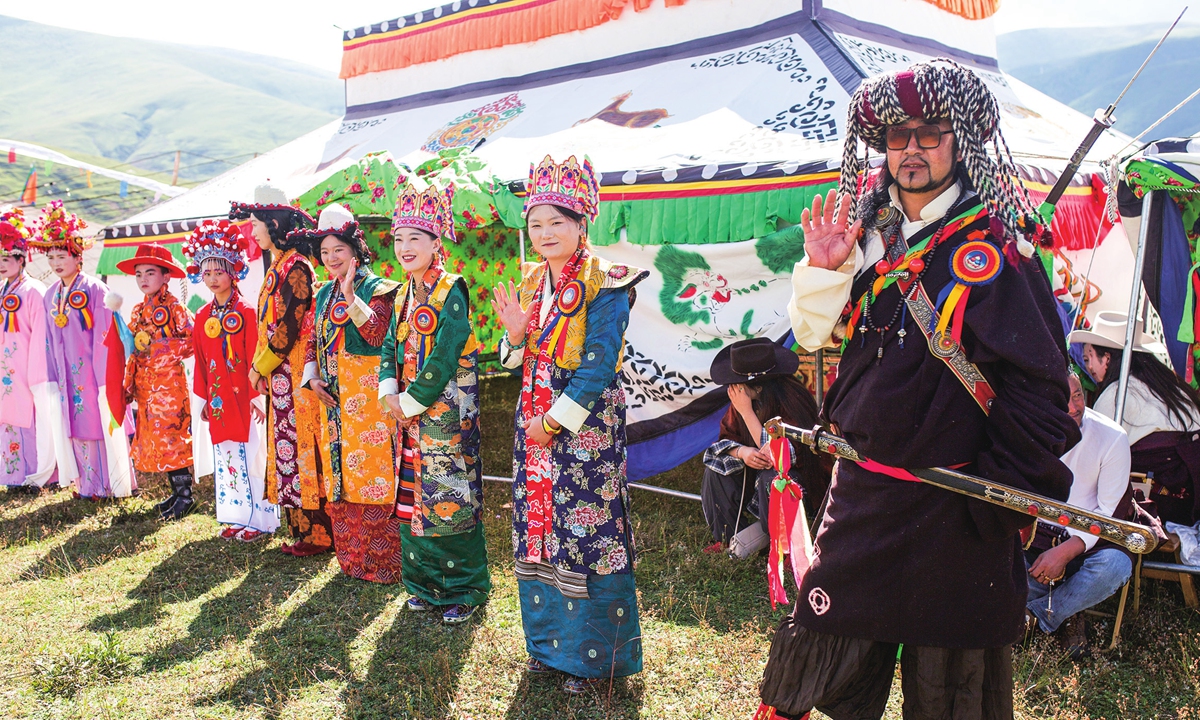
People in Tibetan costumes wave to visitors in Taining town, Dawu County, on August 29, 2026. Photo: Shan Jie/GT
The grassland gathering showed the other half of the story.At one stand, a young Thangka artist, Sherab Nyima, explained that he began learning from his uncle when he was in the fifth grade. He and a cousin now work under the same teacher. A small painting can take them about three days; larger works by their teacher may require close to a year.
On the table were mineral colors prepared from stone. Some of the stone had been gathered locally before being ground and mixed by the teacher. Preparing the pigments required another level of experience that the younger artists said they had not yet mastered.
Sherab Nyima and his cousin mainly sell their paintings in person at a nearby scenic area. "Some tourists come in and ask, 'What is this?'" the young artist told the Global Times. "That shows we still have more work to do in introducing Thangka to people."
Lajia Dangzhou believed that tourism needs to be supported by fieldwork and scholarship, so that the stories presented to visitors remain rooted in evidence and local experience.
Nowadays, livestreaming offers a way to reach people who may never enter a Thangka studio, Sherab Nyima said. "Though not so many people are watching right now, I will continue to do so."
Nearby, the Tibetan opera troupe brought the same questions into performance. Its members are local villagers who rehearse during quieter periods in the agricultural calendar and perform around the Tibetan New Year and at other community occasions. Some participate voluntarily alongside their regular jobs.
One 24-year-old performer had asked for leave from her job at a milk tea shop to join the event. She had been learning with the troupe for two or three years, but her connection with the opera began much earlier.
"When I was little, I would go and listen whenever there was a performance," she told the Global Times. "I could not understand what they were singing then, but I thought the voices were beautiful and the clothes were beautiful. I wanted to wear them too."
Now she can understand the stories. Its tunes, costumes and performance rhythms carry characteristics of the local Muya community, while the stories draw from the classic Tibetan opera repertoire.
Teenagers also took part, including a 14-year-old girl who played a young Tibetan princess and was preparing for her first public performance.
"I feel very lucky to have been chosen from among so many girls," the young performer told the Global Times. "My dream is to share our performances with people around the world one day."
RELATED ARTICLES