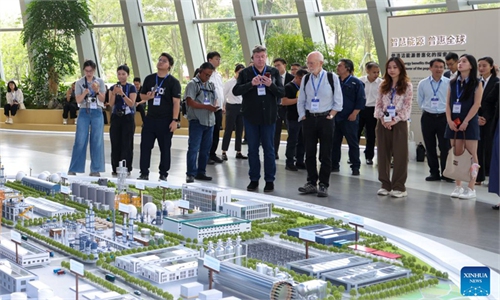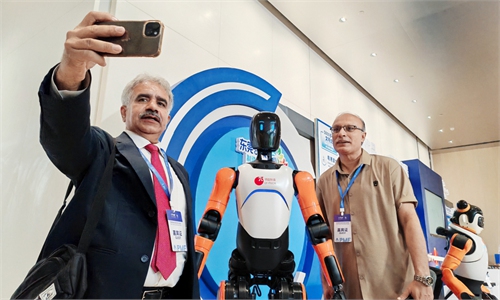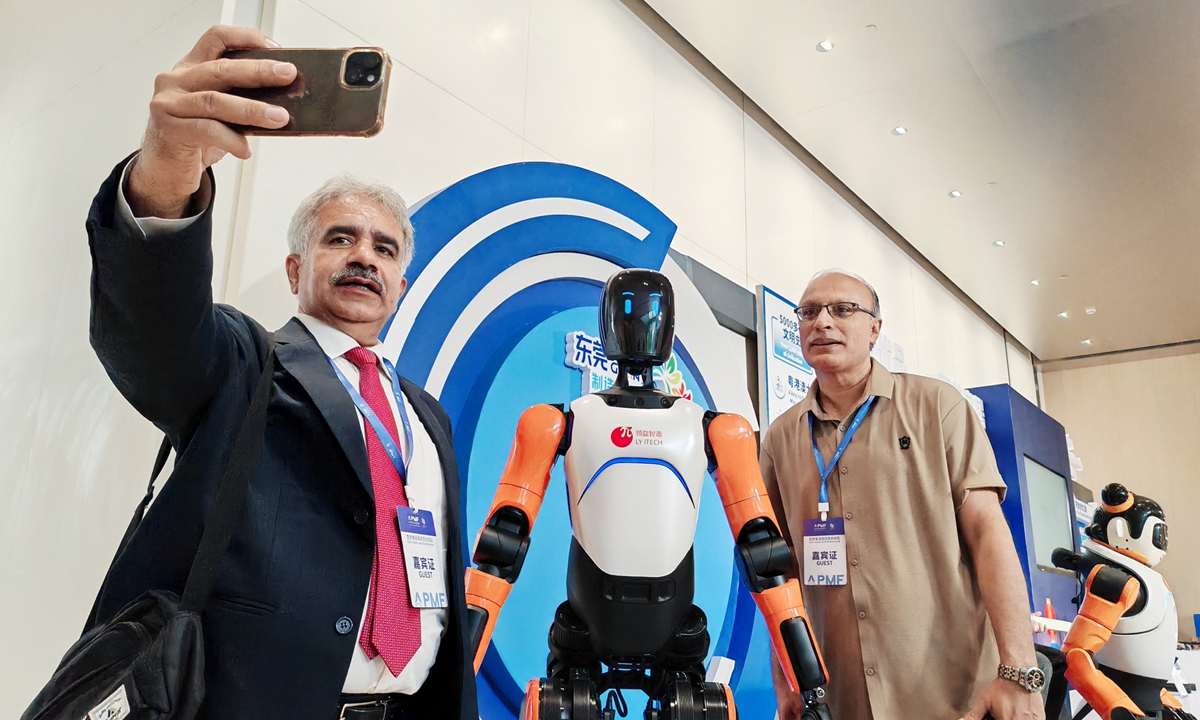
International guests take selfies with robots in Dongguan, South China’s Guangdong Province, on September 3, 2026. Photo: Guan Kejiang/GT
Why can a media forum bring together representatives from more than 40 countries and regions in Shenzhen, South China’s Guangdong Province?
Because the world is looking beyond the forum itself to a broader reality unfolding at an accelerating pace: how innovation is transforming a Chinese city, and how openness is connecting China with the Asia-Pacific and the wider world.
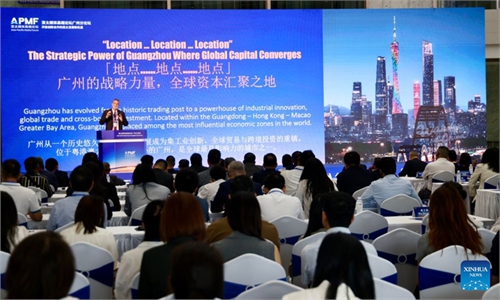
On Saturday, the Asia-Pacific Media Forum opened in Shenzhen under the theme “Building a Path to Shared Prosperity for the Asia-Pacific Community: Media Consensus and Action.” More than 400 representatives attended, while 16 media and organizations from China and abroad jointly formed the Organizing Committee of the Asia-Pacific Media Partnership Program.
On the surface, it is a gathering for media exchange. At a deeper level, however, it addresses a question of our time: As the global economy faces growing uncertainty, the information environment becomes increasingly complex and artificial intelligence (AI) reshapes the landscape of communication, how can the Asia-Pacific foster greater understanding and expand cooperation to promote shared prosperity?
Shenzhen, in many ways, offers an ideal window through which to explore that question.
The world sees Shenzhen for more than its speed
Over the past four decades, Shenzhen has transformed from a landscape of farmland and rural paths into a modern international metropolis defined by its skyscrapers, concentrated industries and vibrant innovation. The scale of that transformation is itself a microcosm of China’s path to modernization.
But today, the world’s interest in Shenzhen is no longer focused simply on the extraordinary pace of its development. Increasingly, it is about the innovation capabilities the city is building. As Kostas Oikonomou, senior vice-president at CNN, put it, if CNN were to produce a special report on Shenzhen, “innovation” would inevitably be at its heart.
What makes Shenzhen so compelling to international media is that it offers the world a more concrete, multidimensional and authentic picture of China. New-energy vehicles moving through its streets, technologies being continuously refined in laboratories, and manufacturing capabilities rapidly advancing on production lines – alongside a steady stream of emerging industries and new applications – have made Shenzhen more than a symbol of “China speed.” It has become a symbol of “China innovation,” while also fueling the imagination of what the future might look like.
A media forum – a conversation about the future of the Asia-Pacific
The Asia-Pacific is one of the world’s most dynamic economic regions, and home to some of the most concentrated networks of industrial and innovation chains, as well as major consumer markets.
Yet the more interconnected the region becomes, the more important mutual understanding is. And the closer cooperation grows, the more important it is to maintain stable expectations. Today, protectionism, geopolitical tensions and technological change are unfolding simultaneously. Perceptions of one another are sometimes obscured by stereotyped narratives, distorted by fragmented information or driven off course by emotionally charged rhetoric. Many disagreements stem not entirely from genuine conflicts of interest, but also from information asymmetry and a lack of mutual understanding.
The role of the media, therefore, is not merely to report what happens, but also to help different societies see one another more clearly. The media should be more than a “mouthpiece” or an “amplifier”; it should also serve as a “bridge” and a “window” connecting.
Telling the story of an open and interconnected Asia-Pacific is not about simply recounting what has been seen and heard or repeating slogans. It means showing, accurately, comprehensively and in depth, how regional cooperation takes shape, how collaborative innovation is put into practice, and how people across the Asia-Pacific benefit from it. Only when the public can see the shared benefits that cooperation brings can openness gain a stronger social foundation.
That is also why the forum has called for greater cooperation in areas such as joint reporting, technological innovation and talent development. Every additional channel of communication between media organizations can help remove a layer of misunderstanding between countries and regions; every step toward a more accurate public understanding of one another can provide another foundation of trust for regional cooperation.
Truth matters more than ever in the age of AI
The resonance generated by the forum also needs to be understood against a broader backdrop: AI is profoundly reshaping the news and media industry.
AI can make news production more efficient, content distribution more intelligent and access to information more convenient. But it can also amplify problems such as deepfakes, outrage bait and algorithmic bias. An explosion of information does not necessarily make the truth clearer; faster communication does not necessarily mean stronger trust.
Ikonomou stressed that AI and other emerging technologies must serve accuracy, transparency, depth and truth. These are precisely the principles the media must safeguard. Technology may change how news is produced and disseminated, but it cannot replace the values and judgment at the heart of journalism.
The future of the media will not ultimately be determined by how flashy the tools it uses are. It will still depend on whether it respects facts, professionalism and the public.
In this sense, the Asia-Pacific Media Forum is discussing more than the transformation of the media industry itself. It is also exploring how to build a more credible, rational and human-centered public discourse environment for regional cooperation.
The rise of a city can serve as a model of development; a dialogue at a forum can become a starting point for greater understanding. The world needs to see Shenzhen as it truly is. More importantly, through Shenzhen, it can see a China that continues to open up, keeps innovating and moves forward hand in hand with the world.
RELATED ARTICLES