MAZU system and satellites provide real-time info as China shares disaster monitoring data with Nepal on daily basis
By , Zhang Wanshi and Li Xundian Published: Sep 06, 2026 10:35 PM

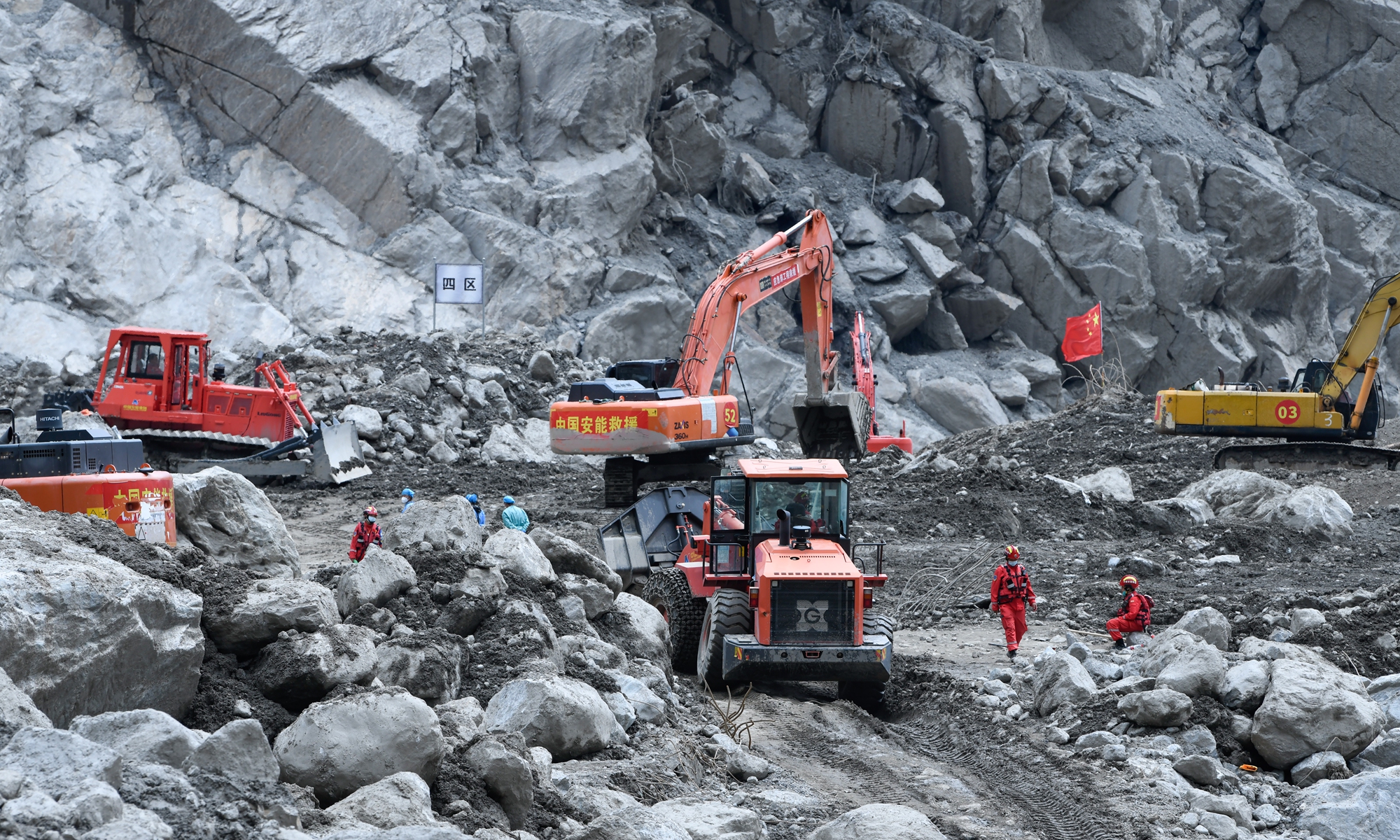
Rescuers, using heavy-duty equipment including excavators and loaders, forge ahead at the core area of mudslide-hit Gyirong Port in Southwest China's Xizang Autonomous Region on September 5, 2026. Photo: CNS Photo
When some major media outlets worldwide spotlighted a Chinese survivor who was miraculously rescued in Nepal on Saturday following the recent mudslide disaster, China-Nepal cooperation in emergency support mechanism for disaster prevention and mitigation continued. The Global Times learned from the Chinese Embassy in Nepal on Sunday that the Chinese side is sharing relevant monitoring information with Nepal on a daily basis, with hydrological information provided through a daily special briefing mechanism.
As a press conference on Sunday, the emergency rescue command center in Southwest China's Xizang Autonomous Region said that through the China-Nepal disaster prevention information-sharing mechanism, China provides Nepal with information on weather, hydrology, glacial lakes and glaciers on a daily basis.
On August 26, an ice-rock avalanche in Nepal unleashed a devastating debris flow at the China-Nepal border region. The Nepal 8.26 mudslide disaster that struck Gyirong Port in China's Xizang has left 43 people dead and 519 missing as of 6 pm Saturday. Two people had been rescued and 993 personal belongings recovered, said the command center.
The press conference also revealed that foreign reporters from the US, UK, Russia, India, Pakistan, Singapore, Brazil and other countries have been invited for on-site reporting at Gyirong Port on September 5-6. They also attended the briefing in Xizang on Sunday.
Muhammad Asghar from Associated Press of Pakistan, who is invited, told the Global Times that "this is remote area and very difficult to reach. Even international media team took one and a half day to arrive. In such a situation, the response of Chinese rescue teams was amazing. They are working round the clock for rescue and relief efforts. I highly appreciate Chinese government for allowing foreign journalists to visit this area."
So far, a 24-hour hotline for families of the missing foreign nationals has received 675 phone calls, while the one for domestic receiving 507 calls.
Close communication
Chinese meteorological authorities are working closely with their Nepalese counterparts to develop a Nepal-customized version of China's intelligent meteorological early warning system called MAZU, providing support for emergency rescue and post-disaster recovery efforts, the Chinese embassy told Global Times, noting that relevant updates are currently being issued on a daily basis, and in the event of an emergency, the Chinese side will promptly issue an early warning to Nepal.
The China Meteorological Administration (CMA) said in its latest post shared with the Global Times that global real-time monitoring products are integrated into the Nepal-customized version of China's intelligent meteorological early warning system, MAZU, providing real-time data support to the Nepalese side.
the CMA promptly activated its emergency data service mechanism in response to the challenges posed by the complex terrain, sparse observation stations and limited access to overseas data in the affected areas. It also continued to conduct real-time monitoring and analysis while providing technical support.
At the request of the Nepalese side, the CMA has further strengthened its support for cross-border data products, according to the administration.
Currently, the National Meteorological Information Center's global 5-kilometer hourly real-time analysis products have been integrated into MAZU, while its 1-kilometer high-resolution, multi-source integrated real-time analysis products covering temperature, humidity, wind and precipitation have also been integrated into the Nepal-customized version of MAZU to provide real-time services to the Nepalese side, the administration said.
Following the disaster, the CMA activated the emergency support mechanism for international users of Fengyun meteorological satellites for disaster prevention and mitigation (FY_ESM), strengthening intensified satellite observations and multi-source data analysis. Leveraging MAZU, the CMA provided Nepal with multi-source satellite data and products from Fengyun-3, Fengyun-4 and other satellites, supporting cross-border disaster monitoring and emergency meteorological services between China and Nepal, according to a separate public post sent to the Global Times on Sunday by the administration.
China and Nepal are friendly neighbors and important partners. In the face of the debris-flow disaster, the close cooperation between China and Nepal demonstrates the spirit of standing by each other and sharing weal and woe, which also reflects the two countries' commitment to building a community with a shared future as well as their strategic partnership of cooperation, some Chinese experts said.
China has almost provided Nepal with real-time information so that we remain alert for potential future disaster, Nepali Foreign Minister Shisir Khanal told the Xinhua News Agency in a recent interview.
China expressed support for Nepal at different levels immediately after the disaster, Khanal said, adding that as Nepal's needs emerged, the country requested relief supplies and technical assistance from China, and the Chinese side responded positively, Xinhua said.
"We are extremely grateful for the very proactive support that the government of China has given to us at this point," Khanal said, per Xinhua.
"It's unfortunate that we had a natural calamity. That is a catastrophic disaster. This is beyond our capacity. I, on behalf of my country and our government, would like to express sincere condolences to the people and government of China for this catastrophic disaster, and appreciate the government and people of China for their continuous support," Sharachchandra Bhandary, executive editor of Nepal's National News Agency, told Chinese media, in a video reposed by the embassy on Sunday.
"They have provided us [a] substantial amount of money, equipment and other things required for rescue and other operations," the Nepali media representative said.
At the same time, it's unfortunate that some sections of Western media have politicized this disaster. This is totally unfounded, he noted.
In addition to information-sharing, China has proactively provided relief supplies, including much-needed items such as drones, equipment and reagent for DNA testing, and equipment for water purification and lighting. China has also sent tunnel rescue experts and DNA experts, per previous releases from relevant Chinese authorities.
"China's provision of various forms of assistance and support to Nepal demonstrates its sense of responsibility as a major country," Tian Guangqiang, an assistant research fellow with the National Institute of International Strategy at the Chinese Academy of Social Sciences, told the Global Times. During the disaster relief efforts, people from all sectors of both countries supported and helped each other, highlighting not only the friendship between the two countries, but also their spirit of standing together in times of adversity, he noted.
Monitoring and early warning
Focusing on Gyirong Port and the areas affected by the disaster, the National Satellite Meteorological Center (National Center for Space Weather) promptly initiated intensified observations using the Fengyun-4B satellite, according to CMA. It made comprehensive use of products including Fengyun-4 cloud imagery animations, convective initiation monitoring, precipitation estimates, Fengyun-4C lightning monitoring and Fengyun-3G precipitation data to continuously track regional precipitation and weather developments.
Meanwhile, the center coordinated with relevant agencies to obtain high-resolution satellite data from the Gaofen, Huanjing and Ziyuan satellite series, among others, to dynamically monitor the upstream ice and rock avalanche area and river channels. It produced pre- and post-disaster 3D imagery, river channel change maps and spatial distribution maps of barrier lakes for quantitative analysis, providing reference for disaster assessment, on-site rescue operations and meteorological services.
In response to the needs of the Nepalese side, China has further strengthened its international services using Fengyun meteorological satellites. Currently, the service system customized for Nepal has been connected in real time with Fengyun satellite products, including rapid-scan imagery and satellite-based lightning monitoring, the Chinese authority said.
The rapid-scan imagery offers high temporal and spatial resolution, enabling the clear capture of detailed cloud structures and localized weather features. Combined with its high-frequency updates, it effectively supports real-time monitoring of rapidly developing convective weather and lightning activity in Nepal, helping the Nepalese side track the evolution of precipitation systems and severe convective weather across a broader and more continuous spatial area.
As of now, Chinese meteorological authorities have produced more than 10 English-language monitoring and analysis reports based on multi-source satellite remote-sensing data, and have continued to provide Nepal with satellite monitoring products and technical support, the CMA said.
"The disaster reached Gyirong Port in just about six to seven minutes, leaving an extremely narrow window for early warning," said Zou Changxin, deputy director general of Nanjing Institute of Environmental Sciences, Ministry of Ecology and Environment of China. He said the key challenges lie in gaps in field monitoring, the complexity of disaster mechanisms and technological limitations.
While it is difficult to achieve precise warnings immediately before such disasters, we can still strengthen overall risk prevention and control by improving monitoring systems and cross-border cooperation, Zou told the Global Times.
"The latest disaster response demonstrated that sharing satellite imagery, remote-sensing and hydrological data can effectively support joint disaster assessment and emergency response, but the current volume and frequency of China-Nepal data sharing remain limited," he added.
RELATED ARTICLES