How a remote Guizhou town carries the quiet weight of governance
By Published: Sep 07, 2026 02:45 PM

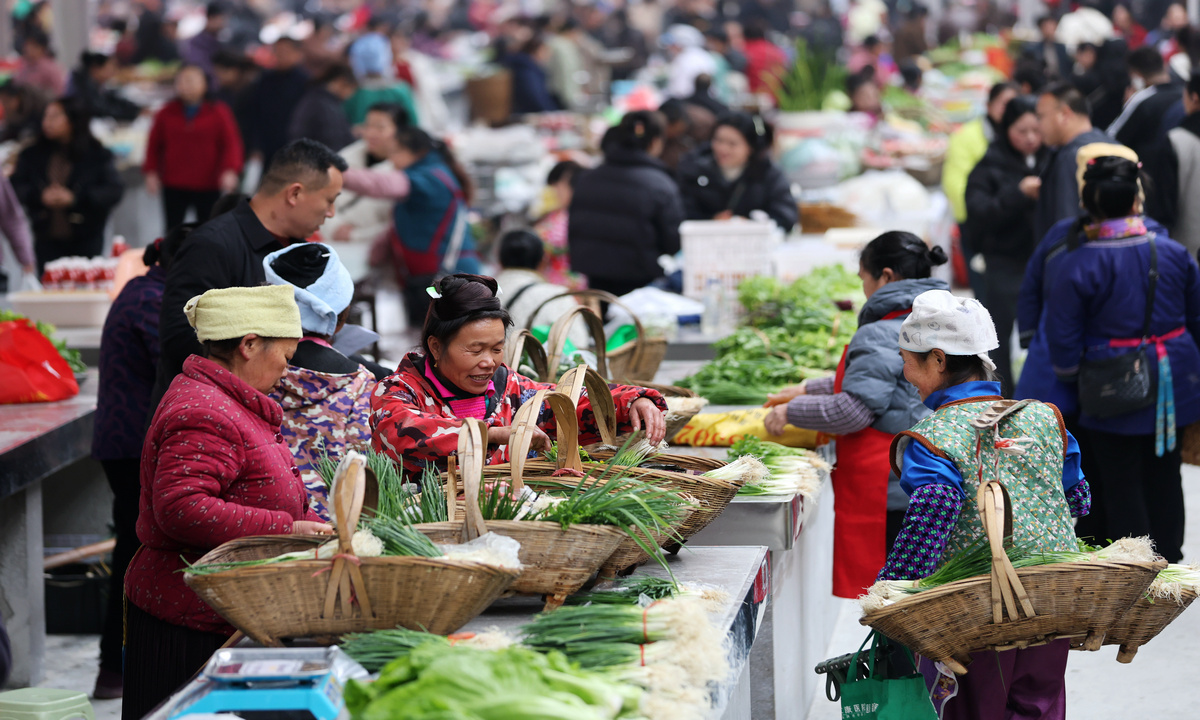
Vendors sell fresh vegetables at a farmer's market in Rongjiang, Qiandongnan Miao and Dong Autonomous Prefecture in Southwest China's Guizhou Province, on January 18, 2026. The upgraded market, offering 302 stalls across six themed zones, helps boost the livelihoods of local farmers. Photo: VCG
In a small town in Southwest China's Guizhou Province, I was jolted awake by a swell of noise - the clatter of carts, the crackle of tarps being unfurled and a rising tide of voices that seemed to pull the whole town out of its slumber.It was Sunday, the weekly ritual market day, I learned from locals, when the entire town makes a silent pact to converge and turn the narrow streets into a living, breathing organism.
Under the morning light, stalls stretched in unbroken lines along the street - fruit piled high in glistening mounds, vegetables still beaded with dew, butchers' cleavers falling with a steady, rhythmic thump. Locals moved through the crowd with practiced ease, bamboo baskets strapped to their backs, haggling good-naturedly as they tossed their picks over their shoulders - potatoes, chilies, vegetables that I've rarely seen in northern China, a couple of pounds of pork. As their baskets grew heavier, their faces grew lighter. The shouts of vendors, the clink of scale weights, the burst of laughter when old acquaintances ran into each other - all of it swirled together into a sonic tapestry that only a small Chinese town could produce.
I stood at the edge for a long while, letting it wash over me, and it dawned on me: This isn't just a market; this is life itself, setting up its own stall - messy, raucous, and yet, strangely, the most reassuring thing you could ever witness in a small Chinese town.
As a media person who has spent years traversing China's vast landscape and witnessing its urban and rural transformations firsthand, I know better than most that this bustling scene of "everyday normalcy" carries, beneath its surface, a quiet weight of governance and an entire era's worth of hard-won progress.
The towering piles of vegetables, the fresh cuts of meat on the chopping boards, the fish leaping in bamboo baskets - none of this abundance was accidental. It was the quiet, seamless work of a food supply network that spans cities and countryside alike. From farmlands to mountain markets, with uninterrupted chains and smooth logistics, even this small town, tucked deep in the folds of Guizhou's remote hills, can count on a bountiful feast arriving at its doorstep every Sunday morning without fail.
What is more touching is that this whole cycle repeats itself, week after week, to the point that locals take it entirely for granted. It is precisely this "taking for granted" that means that an enormous and intricate system has quietly melted into the daily life of ordinary people.
And that life is settled and secure. There is no frantic hoarding, no anxious glance at empty shelves, no whispered worry about what tomorrow might bring. Grain prices hold steady; meat prices remain fair; and with that stability, ordinary people find the bedrock upon which they can plan their lives, raise their children and look forward to the market day next week without a trace of unease.
This kind of certainty is not something the world can take for granted. In many places across the globe, food inflation, supply chain disruptions and economic volatility have turned daily shopping into a source of anxiety rather than reassurance. Yet, here, in the weekly morning market in a Guizhou town, or perhaps scattered across China, this certainty has become the most unremarkable, most taken-for-granted part of life.
Looking deeper, this weekly spontaneous gathering is, in its own way, a gentle expression of China's rural governance at work. There are no grand slogans, no overt mobilization and no visible hand directing the crowd. Amid the hubbub of the marketplace, grass-roots governance is present, safeguarding fairness, protecting safety and keeping the arteries of commerce flowing without interruption.
As such, a small Sunday market becomes a mirror reflecting the confidence of a vast nation, the tranquil stability of its people's daily lives, and, above all, the enduring vitality of rural China as it navigates the path of modernization.
As I was about to leave the streets and continue my trip, a woman beside me smiled and gestured toward a stall piled high with glossy eggplants. I couldn't buy anything, but I carried with me a quiet conviction that the truest measure of a nation's progress is not found in grand statistics, but in scenes like this: ordinary, messy, beautiful and utterly alive.
The author is an opinion editor of the Global Times. wangwenwen@globaltimes.com.cn
RELATED ARTICLES