IN-DEPTH / IN-DEPTH
Rice and shrimp: A farming method from Shanghai's Chongming Island has found new ground in Cambodia, quietly improving the lives of local farmers
Fields of change
By Published: Sep 08, 2026 09:41 PM

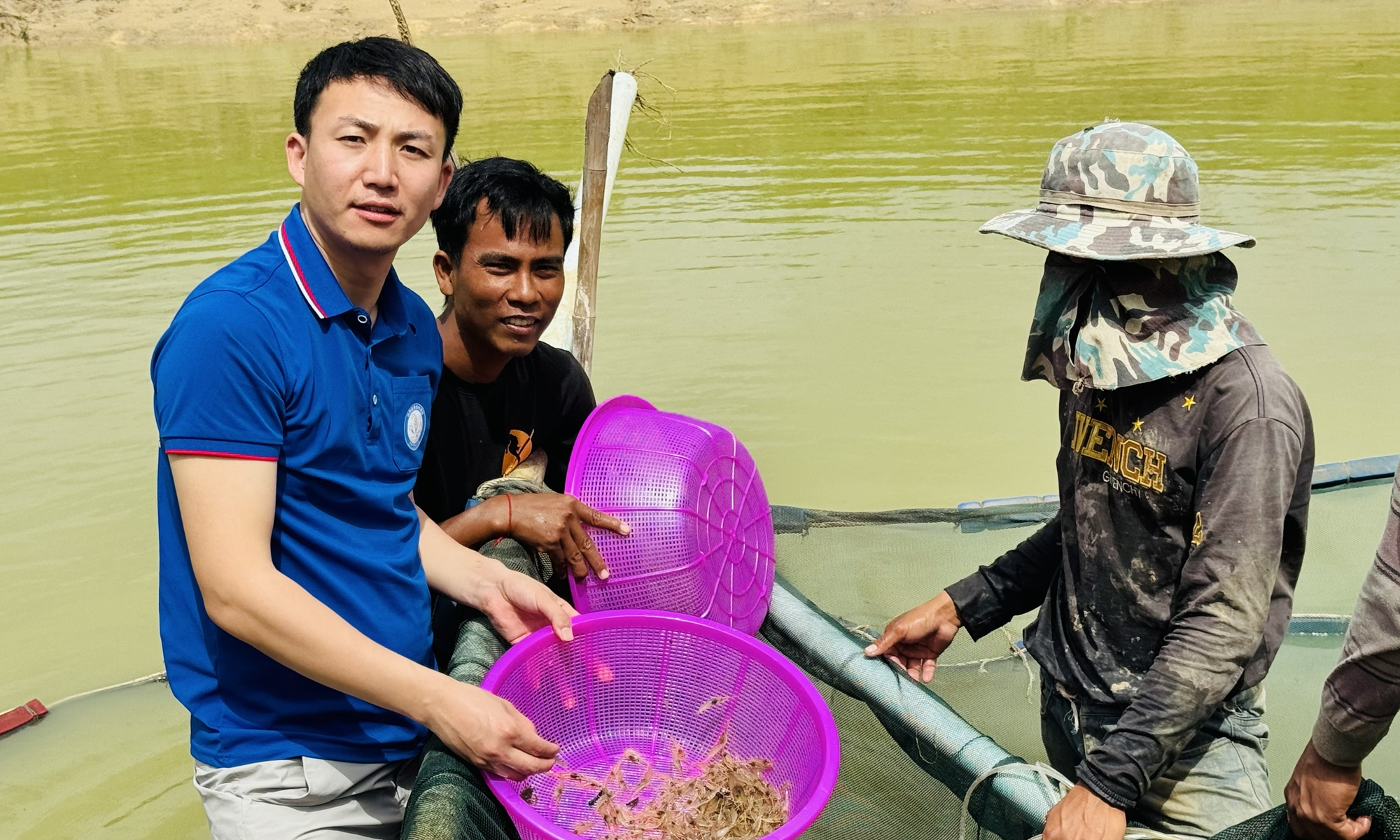
Zhang Dongdong (left) trains local farmers in Cambodia's Takeo province on August 16, 2026. Photo: Courtesy of Zhang Dongdong
Editor's NoteFive years ago, China launched the Global Development Initiative, a people-centered call for inclusive, shared prosperity. Today, that vision is visible in everyday lives across the Global South.
In a Tanzanian village, primary school children now enjoy daily "soya milk time" - a cup of fresh soy milk from local beans. Chinese agricultural cooperation has linked higher yields, higher farmer incomes and better child nutrition. In Peru's Andes, a small "warm-heart boat" powered by a Chinese-built hydropower station has shortened a day-and-a-half mountain trek to 40 minutes. In Cambodia, shrimp-farming techniques refined on Shanghai's Chongming Island are transforming rice fields in Takeo province, lifting both survival rates and household incomes.
These modest projects show how the Global Development Initiative reaches ordinary people. This week, we invite readers to follow the soybeans, the boat and the shrimp.
In August, Cambodia was sweltering under the heat.
Beside a rice paddy in central Kampong Thom province, Zhang Dongdong crouched on a muddy embankment, with the lower half of his trousers covered in sludge. Across from him stood local farmer Ngok Senghong. With great care, Ngok untied a bag of shrimp fry, preparing to release them into a small irrigation ditch dug along the edge of the paddy.
For Zhang, a teacher from Shanghai Ocean University (SHOU) and a core member of its rice-shrimp farming project in Cambodia, this has become one of the most familiar scenes since he began living in Cambodia full-time this year.
"Previously, I would come for short visits, staying for 10 or 15 days at a time," Zhang told the Global Times. "When I left, I sometimes still felt unsettled."
So when he was asked earlier this year to remain in Cambodia for a full year, he did not hesitate.
Since 2021, SHOU has brought China's well-developed rice-shrimp symbiotic farming model to Cambodia. More than four years on, Cambodia's Takeo province has expanded from just four households at the outset to 46 participating farms, while Kampong Thom, which only got started this year, already has eight households involved.
For an ordinary farming household, annual income from a single paddy could rise from less than $1,000 to around $3,000. Behind that transformation are Chinese experts like Zhang, and their countless days and nights spent in Cambodia, knee-deep in paddy mud, patiently passing on knowledge and skills to the locals.
Rooted in the paddies
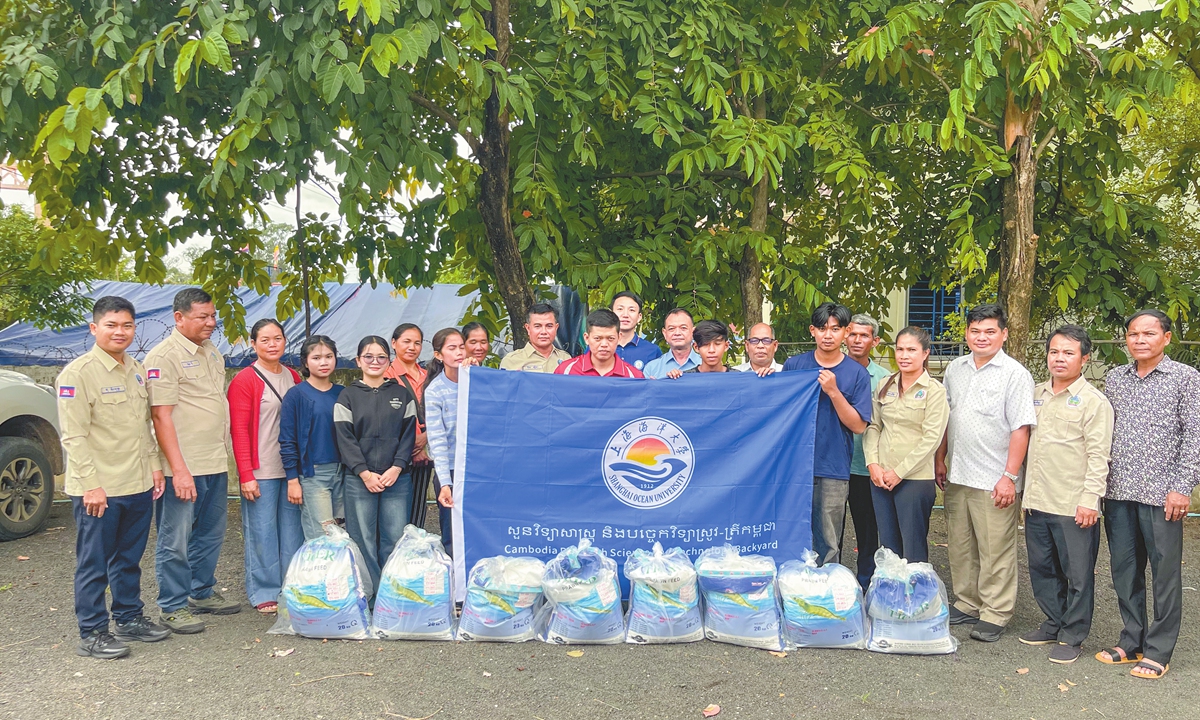
Members of the rice-shrimp farming project send shrimp fry and feed to farmers in Cambodia's Kampong Thom province on August 15, 2026. Photo: Courtesy of Zhang Dongdong
One day in early June, Zhang flew alone into Phnom Penh, the country's capital city. Unlike previous trips when he had come with project teams, this time he would be based in Cambodia for a full year.The climate was much damper than Shanghai's, and the mosquito bites made the adjustment even harder. "At night, it itched so much I couldn't sleep," Zhang recalled.
What ultimately convinced Zhang to stay, despite the inconveniences of daily life, was that the cooperation project had reached a critical stage. Over the past few years, he had come to Cambodia three or four times a year, each time for one or two weeks. But some key moments - when the shrimp larvae should be released, how to coordinate the rice harvest with the shrimp catch - were difficult to cover fully during short visits.
"This year, being here full time means I can follow the whole process from stocking to harvest, and that gives me peace of mind," Zhang told the Global Times.
He now lives in Phnom Penh and works full time at the Royal University of Agriculture, traveling to the two provinces involved in the project at least once a week. The drive from Phnom Penh to Takeo province takes about two and a half hours; to Kampong Thom, three to four hours.
On the way to local paddies, Zhang has gotten used to opening a translation app in the vibrating car and turning technical points into Khmer.
"Communication is a bit slow, but everyone is well intentioned. If something doesn't come across, we just smile, and things can still be made clear," Zhang said.
Trust between Chinese experts and local farmers has also been built gradually. When the project team first arrived, the farmers were still somewhat reserved around Zhang and his colleagues. Now, when Zhang shows up at the paddies, they will proactively point at the water and gesture to share how much the shrimp ate the day before, or whether color of the water had changed.
Ngok, 37, lives in Kampong Thom province. Before 2025, she knew nothing about rice-shrimp farming. When she first heard that shrimp could be raised in rice fields, Ngok was skeptical.
"But, I thought, if others can do it, I should try too," she told the Global Times. "Chinese experts wouldn't lie to us."
In 2025, Ngok made a special trip to a demonstration farm for the project in Takeo province. When she arrived, she saw for the first time what rice-shrimp farming actually looked like: narrow ditches dug along the three sides of the paddy, with just enough water for the shrimp to move around.
Rice and shrimp at the same time? Ngok crouched by the paddy and watched for a long time. Back in Kampong Thom, she dug her own paddy. On the day she first released shrimp larvae into her rice field, Ngok stood at the edge of the paddy, both excited and uneasy. "Back then, I really was quite nervous," she recalled with a smile.
Adapting to local conditions
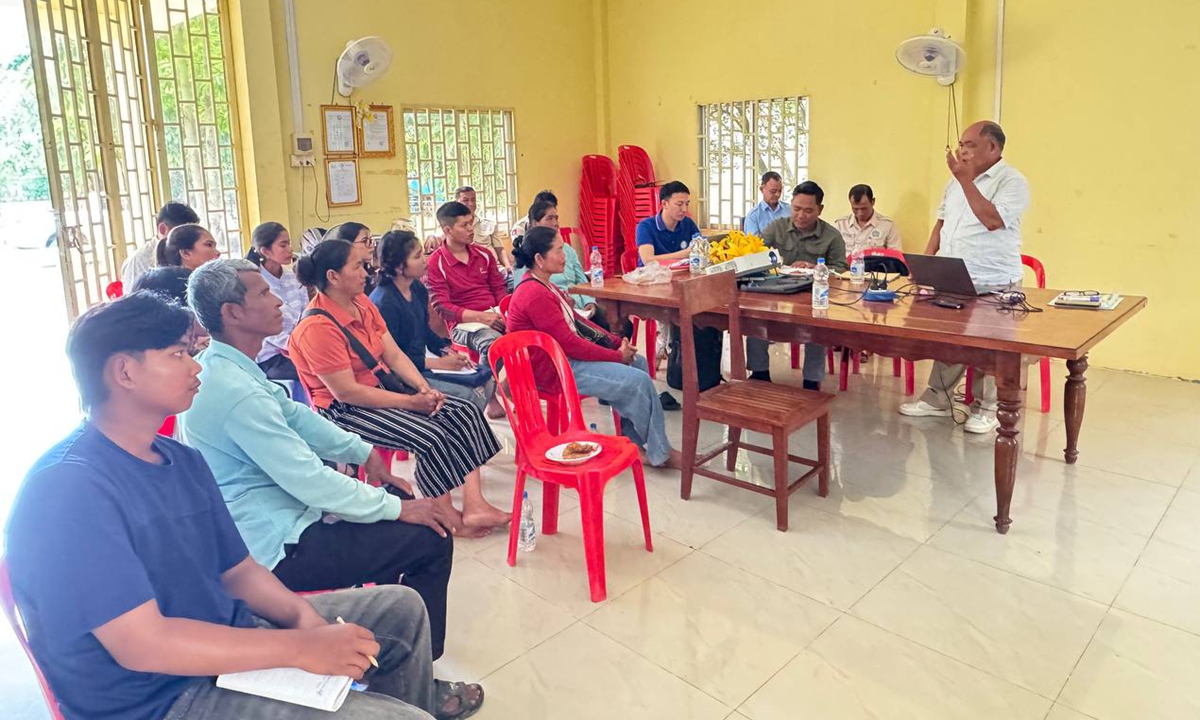
A lecture is held by the rice-shrimp farming project in Cambodia's Kampong Thom province on August 15, 2026. Photo: Courtesy of Zhang Dongdong
Rice-fish integrated farming has a history of more than one thousand years in China. At a base on Shanghai's Chongming Island, at the mouth of the Yangtze River, SHOU has already refined a more advanced version of the model. But when it comes to Cambodia, simply transplanting that experience does not work."In China, farmers have rich experience with rice-shrimp farming, the supporting infrastructure is complete, roads are convenient and transporting shrimp fry takes very little time," Zhang told the Global Times. "But in Cambodia, we were starting from scratch."
The first challenge in bringing the technology to Cambodia was the lack of basic infrastructure. Zhang said that in the two provinces where the project was piloted, many paddies had no electricity, making aerators, pumps and other equipment unusable.
The only option was to adapt to local conditions.
Where there was no electricity, Chinese experts introduced solar-powered pumps so farmers could draw water in and drain it out. Where sandy soil caused severe seepage, they taught farmers to dig paddies deeper and retain more water. As road conditions were poor and transporting shrimp fry took a long time, they reduced stocking density to cut losses along the way.
Beyond the technical hurdles, winning farmers' trust was even harder. At first, when the project was promoted, local farmers had never seen shrimp raised in rice paddies, and few were willing to try.
To help farmers take that first step, the project team came up with a plan: In the first year, participating farmers would receive shrimp fry for free; if they succeeded, then in the second year they would still get half for free, while the other half would have to be purchased with their own money.
"Some people won't value something if they get it for free, and they may not care about doing a good job," Zhang explained. "But when they've put in their own money, they take it seriously."
The strategy worked. After the first four households in Takeo province succeeded, neighboring farmers saw the real profits and began coming to learn.
In Kampong Thom province, after Ngok succeeded, some villagers started showing curiosity, and one by one they came to learn from her. And she was more than willing to teach them.
Now, more and more people in Ngok's village call her "master."
"They're all learning shrimp farming from me. I've suddenly earned a lot of respect," Ngok laughed and told the Global Times. "I'm quite famous in my area now."
Harvesting hope
Ngok was named one of the project's model farmers this year.
In the past, she was busy throughout the whole year, however, she still earned less than $1,000 annually. Now, her paddy is expected to generate about $3,000 a year.
The change is not unique to Ngok's family. Across the two involving provinces, dozens of local farmers have increased their incomes through rice-shrimp farming. According to the project team's calculations, a paddy of 0.2-0.67 hectares can nearly triple annual income after adopting the rice-shrimp integrated model.
The jointly built China-Cambodia "Fish and Rice Corridor" is an important consensus reached by the two countries and a key part of agricultural cooperation under the China-proposed Belt and Road Initiative. And the rice-shrimp farming project, undertaken by SHOU, is a practical measure carried out within this framework.
In 2021, Wu Xugan, a SHOU professor, led a team to Cambodia to start this project there; In 2024, professor Hu Qingsong helped improve local survival rate of shrimp fry with smart fishery skills.
In March 2025, the first meeting on China-Cambodia "Fish and Rice Corridor" was held in Beijing. At the meeting, the Cambodian delegation expressed their gratitude for the project for helping Cambodian farmers reduce poverty, according to the website of SHOU.
For the farmers involved, the project's impact on their daily lives have been deeply tangible. Ngok said she feels immense appreciation for the Chinese experts.
"They came to the paddies to give guidance, and they also donated shrimp fry and feed to us," she told the Global Times. "They helped me, and I will pass on the technology to more people."
As for the future, Zhang was full of anticipation. He said the project has already piloted crab farming and tilapia farming in some rice fields in Cambodia.
"I hope that when I come back in a few years, the car will be able to drive straight to the paddy," Zhang said, painting a vivid picture. "People will be catching shrimp and crabs by the lush, green paddy. Some will drive in from the city to buy directly at the paddy, then have it cooked on the spot, just like the rural agritourism farms we have in China."
By the edge of a paddy, Zhang crouched down and measured the water level with his hands. The setting sun turned the flooded fields gold, while in the distance, farmers were digging new paddies, fresh soil being turned over and the air heavy with moisture.
Bred at the mouth of the Yangtze River, these shrimp fry have traveled more than 2,000 kilometers to find a new home, and finally taken root in the rice fields along the Mekong.
RELATED ARTICLES