IN-DEPTH / IN-DEPTH
Practitioners' Insights: From 'garbage mountain' to green factory, China-Kyrgyz cooperation writes new chapter in global ecological governance
Editor's Note:
This year marks the 25th founding anniversary of the Shanghai Cooperation Organisation (SCO). The SCO Summit was held in Bishkek, the capital of Kyrgyzstan, from August 31 to September 1.
Chinese President Xi Jinping solemnly put forth the Global Governance Initiative (GGI) at the SCO Tianjin Summit held in September last year. Over a year, a series of practical measures have taken root, and the GGI is being translated from a Chinese proposal into international practice.
At the SCO Plus Meeting in Bishkek, President Xi pointed out that the SCO "takes it as its mission and responsibility to make the global governance system more just and equitable." How should we understand the substance and significance of the GGI in greater depth? How can the "Shanghai Spirit" be further strengthened to guide the reform and improvement of global governance?
In the 28th installment of the special series "Decoding the Book of Xi Jinping: The Governance of China," the Global Times, along with the People's Daily Overseas Edition, continues to invite Chinese and foreign scholars, translators of Xi's works, practitioners with firsthand experience and international readers to engage in in-depth discussions on the above-mentioned theme.
This is the 26th installment of "Practitioners' Insights." We visit Bishkek, the capital of Kyrgyzstan, to explore how a China-Kyrgyzstan waste-to-energy project is turning a long-standing "garbage siege" into a new starting point for green development. Beyond treating waste and generating power, the project is also cultivating local technical talent, transferring technology and experience, and demonstrating how practical cooperation can create lasting benefits for local communities while offering a tangible example of how green solutions can contribute to global ecological governance.
Inside the plant's laboratory, 23-year-old Medetbekova Kumushai Tinchitikovna bends over laboratory instruments, carefully testing water quality and chemical-agent indicators. A few years ago, she knew nothing about the solid-waste environmental protection industry. Today, she has grown into a chemical analyst at this benchmark project.
In her view, the modern plant where she works has solved the long-standing problem of Bishkek being "besieged by garbage." It is both a livelihood project that improves the urban living environment and a practice in green development. It has also shown young people the possibility of pursuing careers that develop in step with their city, country and even the wider region.
Such possibilities are a microcosm of the continuously expanding cooperation within the SCO.
In the article "Carry Forward the Shanghai Spirit and Build an SCO Community with a Shared Future" included in Volume V of Xi Jinping: The Governance of China, Chinese President Xi emphasized that "We have embraced the vision of innovative, coordinated, green, open and shared development, synergized our national development strategies and regional cooperation initiatives, and nurtured new growth drivers for our cooperation in areas such as the economy, trade, connectivity, energy, agriculture, finance, and sci-tech innovation. "
In Volume IV of Xi Jinping: The Governance of China, President Xi pointed out that "We SCO countries are all at a critical stage of development. Being close to each other and sharing common interests are our unique strengths... We need to continue to promote trade and investment liberalization and facilitation, and ensure secure and orderly flow of people, goods, capital and data. We should create growth drivers that promote cooperation, such as the digital economy, green energy and modern agriculture."
For Medetbekova, the SCO visions have translated into a real job, steadily improving skills and new possibilities in life. "I feel very fortunate to work here," she said. "Working here, I have not only seen broad prospects for my own career development, but also personally felt the solid step my country has taken in environmental governance and experienced the unprecedented opportunities brought by green cooperation in Central Asia."
Ending half a century of 'garbage siege'
Medetbekova has vivid memories of Bishkek's past environmental problems. "Before the plant was built, garbage was everywhere and the air smelled terrible."
For a long time, Bishkek relied mainly on a single municipal solid-waste landfill to dispose of household waste. Over the years, as the city's population grew, the landfill was expanded six times, while accumulated garbage, foul odors and dust plagued local residents. In recent years, as the city developed and the need for environmental protection became increasingly urgent, Kyrgyzstan began looking for new ways to treat solid waste. The China-Kyrgyzstan waste treatment and power generation project emerged against this backdrop.
After the project officially began operations at the end of 2025, Medetbekova noticed quiet changes all around her. Less and less garbage was being dumped casually along roadsides, and the odors that once hung over the surrounding area had also diminished markedly. Today, when she looks out from the laboratory window, the old landfill is still not far away, but the plant below is bright and clean, with equipment operating in an orderly manner.
At the Bishkek waste treatment and power generation project, the Global Times reporter watched through a glass partition as a huge grab crane lifted about 5 tons of household waste from a refuse pit and fed it into an incinerator operating at about 1,000 C. The garbage tumbles and burns in the furnace, producing steam that drives a turbine to generate electricity - turning what was once an environmental burden into usable energy.
Song Qiming, deputy general manager of China's Hunan Junxin Environmental Protection Co., Ltd., which invested in, built and operates the project, told the Global Times that during construction, the Chinese team did not simply copy its experience from China. Instead, it adjusted the technical route, equipment and design plan to local conditions, including the climate, waste composition and calorific value.
"Local conditions are different from those in China, so we could not simply transplant what we do in China without any changes. We carried out extensive surveys in the early stage because we wanted to make the solution better suited to this place," Song said.
The project's construction also faced challenges. Kyrgyzstan sits at a high elevation and has bitterly cold winters. Temperatures at the project site can fall to -20 C in winter, while builders also had to contend with frozen-ground periods and collapsible loess geology. Transporting large equipment across the Tianshan Mountains also made cross-border logistics a construction challenge.
The construction team erected insulated shelters with internal heating to ensure concrete work could continue in severe cold, adjusted construction techniques for the special geological conditions and established a dedicated communication mechanism to coordinate equipment, vehicles and customs clearance during cross-border transportation.
This approach of adapting measures to local conditions is also reflected in the plant's details. The project applies strict flue-gas emission standards, while the plant's design incorporates elements of local culture. The company also regularly holds public open days, allowing local residents to enter the plant and see with their own eyes how garbage is treated.
For Akylbekov Aktan Bektashovich, such changes that people can "see with their own eyes" are more convincing than any explanation.
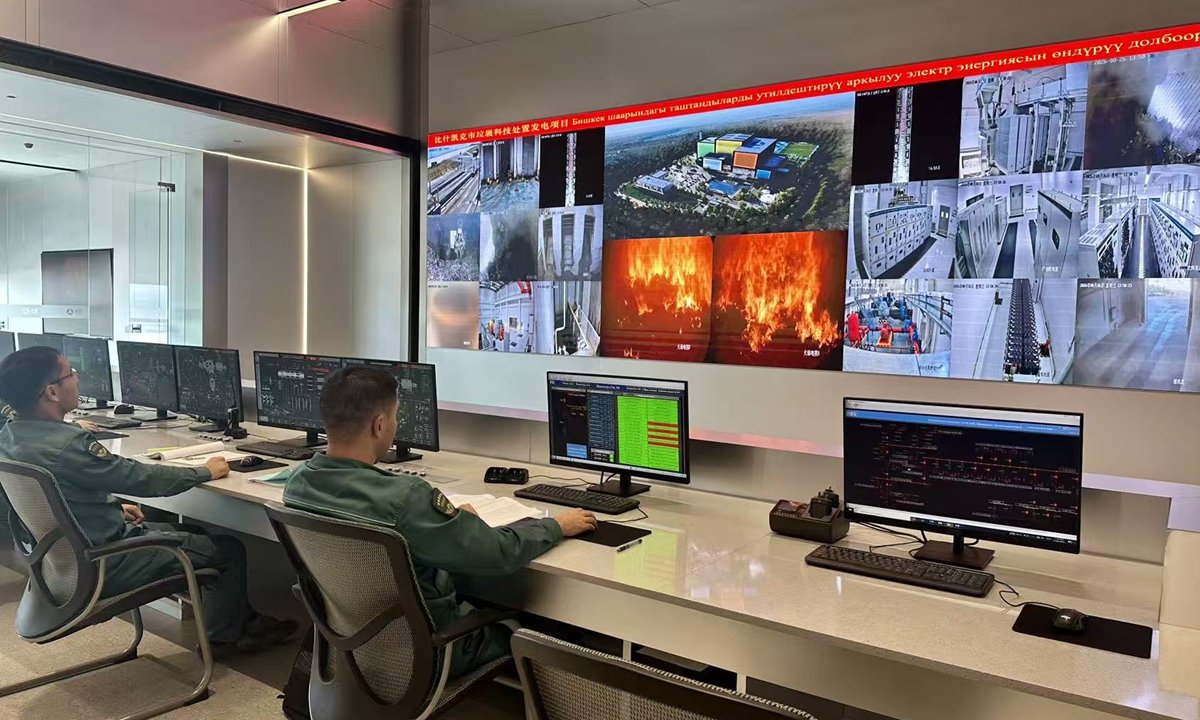
Akylbekov, 25, is a centralized control operator at the waste treatment plant. He now works daily in the central control room, monitoring data from waste feeding, incineration, flue-gas purification and power generation. During the plant's public open days, many local residents have toured the facility, and Akylbekov has witnessed long-held public prejudices fade.
"In the past, local people thought waste treatment meant dirty, messy and smelly conditions. Now, when people come into the plant, they see that it is very clean and that the treatment process is also very strict. Many people have changed their views," he said.
According to the Xinhua News Agency, the Bishkek waste treatment and power generation project has an overall planned daily waste-treatment capacity of 3,000 tons. At its current stage, the project can treat 1,000 tons of waste per day, supply about 146 million kilowatt-hours of electricity to the grid annually and reduce carbon emissions by up to 100,000 tons a year.
Sowing seeds of technology
Waste-to-energy incineration is an emerging field in Kyrgyzstan that was starting from almost zero. Local universities do not offer dedicated programs directly aligned with the field, and relevant technical personnel are also very limited. The company can only recruit graduates from related fields such as automation, machinery, electrical engineering, electric power, water treatment and thermal energy, and then retrain them for specific positions.
Likewise, Medetbekova was entering an entirely new field. She studied biology at university and had no hands-on foundation experience in chemical laboratory work. After joining the project as a fresh graduate, she encountered a work system she had never dealt with before.
The person who introduced her to the field was Palati Nurjan, head of the chemical analysis team. Palati is from Kizilsu Kirgiz Autonomous Prefecture in Northwest China's Xinjiang Uygur Autonomous Region and graduated from China University of Petroleum. He had worked in a laboratory position at a waste-incineration project in China. After arriving in Kyrgyzstan, he reorganized the experience he had accumulated in China to fit the local plant's actual conditions, prepared bilingual Chinese-Kyrgyz materials and taught local employees step by step, from laboratory safety to water-quality testing and chemical-agent analysis.
At work, Palati often points to the old landfill not far outside the window and tells his apprentices how the area had long been plagued by garbage. The laboratory data produced by young local employees such as Medetbekova are crucial to whether the boiler and flue-gas purification system can operate steadily and whether the plant can truly deliver its environmental benefits.
"This is not just a job for making money. It can genuinely change the environment around us," Palati said. Medetbekova and her young colleagues took those words to heart, and they became an internal motivation for them to delve deeper into the technology.
There are no shortcuts in training. Palati first performs the entire procedure while Medetbekova watches and takes notes. Then, she carries out the procedure under his observation. From experimental procedures, safety rules and the use of protective equipment to testing water quality and chemical agents, he demonstrates each task again and again, and they review it repeatedly.
Today, Medetbekova can independently complete laboratory tasks, including testing water quality and chemical agents and filling out analysis reports, providing data support for the stable operation of the production system.
In the central control room, Akylbekov has undergone similar growth. Through on-site instruction and a simulation training system, Chinese engineers have local employees repeatedly practice equipment operation and troubleshooting, so they gain experience before operating independently.
Outside work, Chinese and local colleagues get along well. During festivals and holidays, the Chinese team invites local employees to share meals and celebrate together. Akerbekov said his Chinese colleagues are "very patient and responsible." Whenever he encounters something he does not understand, they patiently explain it to him until his questions have been answered and any doubts clarified. "I hope to work here for a long time, keep learning new technologies and also see this city become more developed and improved."
Building a new model for green cooperation
Song arrived in Bishkek in July 2025. Over more than a year, he has personally witnessed tangible changes around the old landfill: The rotten smell of garbage in the air has greatly diminished, dust has decreased markedly, scattered piles of garbage on city streets have become increasingly rare and household waste is being efficiently absorbed and treated.
Song acknowledged that as overseas projects move forward, it is inevitable that some people will take a wait-and-see attitude, holding onto doubts and aprehension. "Only when a comprehensive solution suited to local national conditions is actually implemented, when improvements to the environment can be seen and felt, and when local people truly benefit, can we provide the most convincing answer. Only then can cooperation have the vitality for sustained development," he said.
After the project went into operation, its strong demonstration effect quickly spread outward, which gave him a real sense of satisfaction and accomplishment. Similar projects at Issyk-Kul and Osh in Kyrgyzstan are advancing one after another, while the team is further planning a large solid-waste treatment project in Almaty, Kazakhstan. Delegations from Belarus, Iran and several other countries have also made special visits to the plant for tours and inspections, hoping to draw on its solid-waste governance experience.
In Kyrgyzstan, the Global Times reporter saw that what one plant changes is never simply where garbage goes. A young laboratory analyst has gone from unfamiliarity and anxiety when first facing instruments and equipment to being able to carry out tests independently. A local operator has grown from a learner standing in front of the equipment into an operator capable of independently operating and maintaining it. A team of Chinese engineers has brought technology, expertise and standards to the project, helping build local capacity for its long-term operation. Waste treatment has thus become more than an environmental protection project; it has also become an ongoing transfer of technology, talent and development concepts.
From the waste-to-energy plant in Bishkek and onward across the broader expanse of Central Asia, proven practices for global ecological governance, borne on the tailwinds of the SCO, are spreading far and wide.
This year marks the 25th founding anniversary of the Shanghai Cooperation Organisation (SCO). The SCO Summit was held in Bishkek, the capital of Kyrgyzstan, from August 31 to September 1.
Chinese President Xi Jinping solemnly put forth the Global Governance Initiative (GGI) at the SCO Tianjin Summit held in September last year. Over a year, a series of practical measures have taken root, and the GGI is being translated from a Chinese proposal into international practice.
At the SCO Plus Meeting in Bishkek, President Xi pointed out that the SCO "takes it as its mission and responsibility to make the global governance system more just and equitable." How should we understand the substance and significance of the GGI in greater depth? How can the "Shanghai Spirit" be further strengthened to guide the reform and improvement of global governance?
In the 28th installment of the special series "Decoding the Book of Xi Jinping: The Governance of China," the Global Times, along with the People's Daily Overseas Edition, continues to invite Chinese and foreign scholars, translators of Xi's works, practitioners with firsthand experience and international readers to engage in in-depth discussions on the above-mentioned theme.
This is the 26th installment of "Practitioners' Insights." We visit Bishkek, the capital of Kyrgyzstan, to explore how a China-Kyrgyzstan waste-to-energy project is turning a long-standing "garbage siege" into a new starting point for green development. Beyond treating waste and generating power, the project is also cultivating local technical talent, transferring technology and experience, and demonstrating how practical cooperation can create lasting benefits for local communities while offering a tangible example of how green solutions can contribute to global ecological governance.
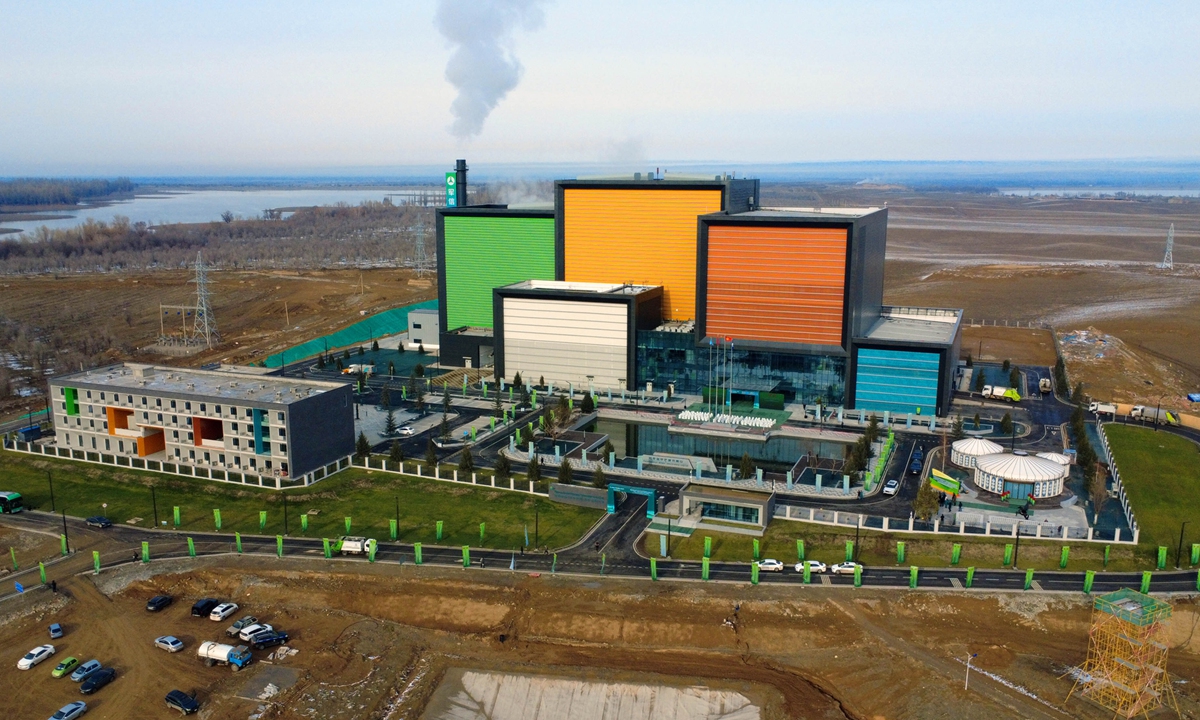
A view of Central Asia's first waste-to-energy plant, built through cooperation between China and Kyrgyzstan, in Bishkek, the capital of Kyrgyzstan Photo: VCG
After a roughly 40-minute drive north from downtown Bishkek, the capital of Kyrgyzstan, the city's skyline gradually gives way to low-rise homes. Around a bend, a modern complex suddenly comes into view across the green grassland. Green, blue, yellow, white, and orange structures overlap in vivid blocks of color. It resembles a cluster of giant, brightly colored boxes resting quietly at the grassland's edge. Few would guess that it is Central Asia's first waste-to-energy incineration project.Inside the plant's laboratory, 23-year-old Medetbekova Kumushai Tinchitikovna bends over laboratory instruments, carefully testing water quality and chemical-agent indicators. A few years ago, she knew nothing about the solid-waste environmental protection industry. Today, she has grown into a chemical analyst at this benchmark project.
In her view, the modern plant where she works has solved the long-standing problem of Bishkek being "besieged by garbage." It is both a livelihood project that improves the urban living environment and a practice in green development. It has also shown young people the possibility of pursuing careers that develop in step with their city, country and even the wider region.
Such possibilities are a microcosm of the continuously expanding cooperation within the SCO.
In the article "Carry Forward the Shanghai Spirit and Build an SCO Community with a Shared Future" included in Volume V of Xi Jinping: The Governance of China, Chinese President Xi emphasized that "We have embraced the vision of innovative, coordinated, green, open and shared development, synergized our national development strategies and regional cooperation initiatives, and nurtured new growth drivers for our cooperation in areas such as the economy, trade, connectivity, energy, agriculture, finance, and sci-tech innovation. "
In Volume IV of Xi Jinping: The Governance of China, President Xi pointed out that "We SCO countries are all at a critical stage of development. Being close to each other and sharing common interests are our unique strengths... We need to continue to promote trade and investment liberalization and facilitation, and ensure secure and orderly flow of people, goods, capital and data. We should create growth drivers that promote cooperation, such as the digital economy, green energy and modern agriculture."
For Medetbekova, the SCO visions have translated into a real job, steadily improving skills and new possibilities in life. "I feel very fortunate to work here," she said. "Working here, I have not only seen broad prospects for my own career development, but also personally felt the solid step my country has taken in environmental governance and experienced the unprecedented opportunities brought by green cooperation in Central Asia."
Ending half a century of 'garbage siege'
Medetbekova has vivid memories of Bishkek's past environmental problems. "Before the plant was built, garbage was everywhere and the air smelled terrible."
For a long time, Bishkek relied mainly on a single municipal solid-waste landfill to dispose of household waste. Over the years, as the city's population grew, the landfill was expanded six times, while accumulated garbage, foul odors and dust plagued local residents. In recent years, as the city developed and the need for environmental protection became increasingly urgent, Kyrgyzstan began looking for new ways to treat solid waste. The China-Kyrgyzstan waste treatment and power generation project emerged against this backdrop.
After the project officially began operations at the end of 2025, Medetbekova noticed quiet changes all around her. Less and less garbage was being dumped casually along roadsides, and the odors that once hung over the surrounding area had also diminished markedly. Today, when she looks out from the laboratory window, the old landfill is still not far away, but the plant below is bright and clean, with equipment operating in an orderly manner.
At the Bishkek waste treatment and power generation project, the Global Times reporter watched through a glass partition as a huge grab crane lifted about 5 tons of household waste from a refuse pit and fed it into an incinerator operating at about 1,000 C. The garbage tumbles and burns in the furnace, producing steam that drives a turbine to generate electricity - turning what was once an environmental burden into usable energy.
Song Qiming, deputy general manager of China's Hunan Junxin Environmental Protection Co., Ltd., which invested in, built and operates the project, told the Global Times that during construction, the Chinese team did not simply copy its experience from China. Instead, it adjusted the technical route, equipment and design plan to local conditions, including the climate, waste composition and calorific value.
"Local conditions are different from those in China, so we could not simply transplant what we do in China without any changes. We carried out extensive surveys in the early stage because we wanted to make the solution better suited to this place," Song said.
The project's construction also faced challenges. Kyrgyzstan sits at a high elevation and has bitterly cold winters. Temperatures at the project site can fall to -20 C in winter, while builders also had to contend with frozen-ground periods and collapsible loess geology. Transporting large equipment across the Tianshan Mountains also made cross-border logistics a construction challenge.
The construction team erected insulated shelters with internal heating to ensure concrete work could continue in severe cold, adjusted construction techniques for the special geological conditions and established a dedicated communication mechanism to coordinate equipment, vehicles and customs clearance during cross-border transportation.
This approach of adapting measures to local conditions is also reflected in the plant's details. The project applies strict flue-gas emission standards, while the plant's design incorporates elements of local culture. The company also regularly holds public open days, allowing local residents to enter the plant and see with their own eyes how garbage is treated.
For Akylbekov Aktan Bektashovich, such changes that people can "see with their own eyes" are more convincing than any explanation.
Akylbekov, 25, is a centralized control operator at the waste treatment plant. He now works daily in the central control room, monitoring data from waste feeding, incineration, flue-gas purification and power generation. During the plant's public open days, many local residents have toured the facility, and Akylbekov has witnessed long-held public prejudices fade.
"In the past, local people thought waste treatment meant dirty, messy and smelly conditions. Now, when people come into the plant, they see that it is very clean and that the treatment process is also very strict. Many people have changed their views," he said.
According to the Xinhua News Agency, the Bishkek waste treatment and power generation project has an overall planned daily waste-treatment capacity of 3,000 tons. At its current stage, the project can treat 1,000 tons of waste per day, supply about 146 million kilowatt-hours of electricity to the grid annually and reduce carbon emissions by up to 100,000 tons a year.
Sowing seeds of technology
Workers conduct operations at Central Asia's first waste-to-energy plant, built through cooperation between China and Kyrgyzstan, in Bishkek, capital of Kyrgyzstan on August 26, 2026. Photo: Ma Jingjing/GT
"Our country never had a plant like this before, so all the technology was completely new to me." For Akylbekov, joining the plant meant not only getting a new job, but also learning an entirely new set of solid-waste treatment technologies from scratch.Waste-to-energy incineration is an emerging field in Kyrgyzstan that was starting from almost zero. Local universities do not offer dedicated programs directly aligned with the field, and relevant technical personnel are also very limited. The company can only recruit graduates from related fields such as automation, machinery, electrical engineering, electric power, water treatment and thermal energy, and then retrain them for specific positions.
Likewise, Medetbekova was entering an entirely new field. She studied biology at university and had no hands-on foundation experience in chemical laboratory work. After joining the project as a fresh graduate, she encountered a work system she had never dealt with before.
The person who introduced her to the field was Palati Nurjan, head of the chemical analysis team. Palati is from Kizilsu Kirgiz Autonomous Prefecture in Northwest China's Xinjiang Uygur Autonomous Region and graduated from China University of Petroleum. He had worked in a laboratory position at a waste-incineration project in China. After arriving in Kyrgyzstan, he reorganized the experience he had accumulated in China to fit the local plant's actual conditions, prepared bilingual Chinese-Kyrgyz materials and taught local employees step by step, from laboratory safety to water-quality testing and chemical-agent analysis.
At work, Palati often points to the old landfill not far outside the window and tells his apprentices how the area had long been plagued by garbage. The laboratory data produced by young local employees such as Medetbekova are crucial to whether the boiler and flue-gas purification system can operate steadily and whether the plant can truly deliver its environmental benefits.
"This is not just a job for making money. It can genuinely change the environment around us," Palati said. Medetbekova and her young colleagues took those words to heart, and they became an internal motivation for them to delve deeper into the technology.
There are no shortcuts in training. Palati first performs the entire procedure while Medetbekova watches and takes notes. Then, she carries out the procedure under his observation. From experimental procedures, safety rules and the use of protective equipment to testing water quality and chemical agents, he demonstrates each task again and again, and they review it repeatedly.
Today, Medetbekova can independently complete laboratory tasks, including testing water quality and chemical agents and filling out analysis reports, providing data support for the stable operation of the production system.
In the central control room, Akylbekov has undergone similar growth. Through on-site instruction and a simulation training system, Chinese engineers have local employees repeatedly practice equipment operation and troubleshooting, so they gain experience before operating independently.
Outside work, Chinese and local colleagues get along well. During festivals and holidays, the Chinese team invites local employees to share meals and celebrate together. Akerbekov said his Chinese colleagues are "very patient and responsible." Whenever he encounters something he does not understand, they patiently explain it to him until his questions have been answered and any doubts clarified. "I hope to work here for a long time, keep learning new technologies and also see this city become more developed and improved."
Building a new model for green cooperation
Song arrived in Bishkek in July 2025. Over more than a year, he has personally witnessed tangible changes around the old landfill: The rotten smell of garbage in the air has greatly diminished, dust has decreased markedly, scattered piles of garbage on city streets have become increasingly rare and household waste is being efficiently absorbed and treated.
Song acknowledged that as overseas projects move forward, it is inevitable that some people will take a wait-and-see attitude, holding onto doubts and aprehension. "Only when a comprehensive solution suited to local national conditions is actually implemented, when improvements to the environment can be seen and felt, and when local people truly benefit, can we provide the most convincing answer. Only then can cooperation have the vitality for sustained development," he said.
After the project went into operation, its strong demonstration effect quickly spread outward, which gave him a real sense of satisfaction and accomplishment. Similar projects at Issyk-Kul and Osh in Kyrgyzstan are advancing one after another, while the team is further planning a large solid-waste treatment project in Almaty, Kazakhstan. Delegations from Belarus, Iran and several other countries have also made special visits to the plant for tours and inspections, hoping to draw on its solid-waste governance experience.
In Kyrgyzstan, the Global Times reporter saw that what one plant changes is never simply where garbage goes. A young laboratory analyst has gone from unfamiliarity and anxiety when first facing instruments and equipment to being able to carry out tests independently. A local operator has grown from a learner standing in front of the equipment into an operator capable of independently operating and maintaining it. A team of Chinese engineers has brought technology, expertise and standards to the project, helping build local capacity for its long-term operation. Waste treatment has thus become more than an environmental protection project; it has also become an ongoing transfer of technology, talent and development concepts.
From the waste-to-energy plant in Bishkek and onward across the broader expanse of Central Asia, proven practices for global ecological governance, borne on the tailwinds of the SCO, are spreading far and wide.
RELATED ARTICLES