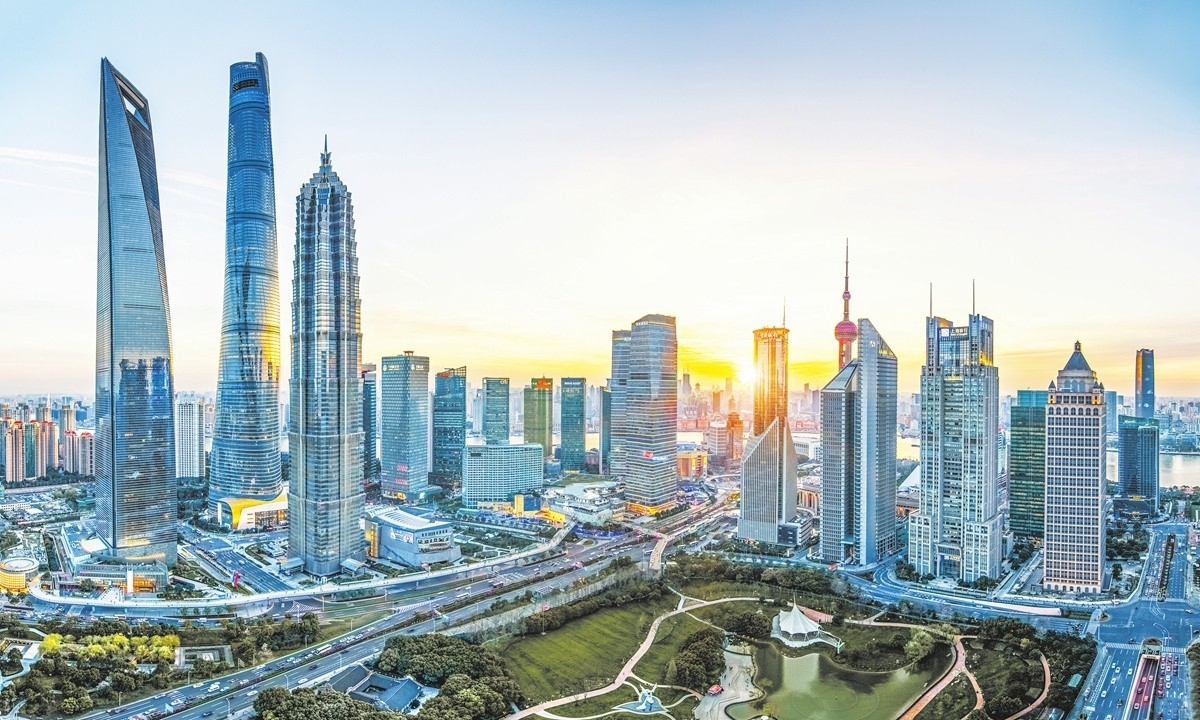
A view of Lujiazui, Shanghai Photo: VCG
For the first time, the Outline of the 15th Five-Year Plan includes "building a financial powerhouse" in China's five-year national plan, which is of milestone significance. Building China into a financial powerhouse would not only support the development of the domestic real economy, but also help better safeguard the collective interests of the Global South and contribute to building a fairer and more equitable international financial governance system.
The State Council Information Office held a press conference on Thursday on implementing the 15th Five-Year Plan (2026-30) in the financial sector and building China into a financial powerhouse. Senior officials from four major financial regulators - the People's Bank of China, the National Financial Regulatory Administration, the China Securities Regulatory Commission and the State Administration of Foreign Exchange - appeared together at the event. This high-profile conference sends a clear signal: building a financial powerhouse has been placed in a highly prominent position within the overall national strategy.
For the first time, the Outline of the 15th Five-Year Plan includes "building a financial powerhouse" in China's five-year national plan, which is of milestone significance. Finance is the lifeblood of the national economy and crucial for the country's core competitiveness. Over the past more than 40 years, China's financial system has successfully supported industrial catch-up and export-led growth. Building a financial powerhouse represents an endogenous requirement of China's economic development. Its purpose is to better serve high-quality economic development and provide solid underpinning for fully building a modern socialist country.
For enterprises and the public, stronger finance means installing more efficient "blood vessels" for the real economy, enabling small and medium-sized enterprises to access "patient capital" more easily. For the country, a strong financial system can better back high-level self-reliance and strength in science and technology, industrial upgrading and the "going global" of enterprises. Meanwhile, only with improved financial regulation, more robust risk prevention and control, and a firm hold on the bottom line of forestalling systemic risks can the national economy operate with greater stability.
China's financial system is deeply integrated into the global economy and carries great significance for the world. As of the end of June 2025, the total assets of China's banking system ranked first in the world. As the world's second-largest economy and largest trader in goods, China has long maintained a leading position in foreign exchange reserves, providing solid support for global trade settlement, cross-border investment and financing, and supply chain stability. Improvements in the convenience of cross-border use help a growing number of countries reduce exchange rate risks and cut transaction costs. Steady advances in sci-tech finance, green finance, inclusive finance, pension finance and digital finance - in particular the sound development of the digital yuan and the global rollout of a multi-tiered yuan clearing network - deliver accessible and affordable financial public goods to Belt and Road partner countries and the Global South.
China's drive to build a financial powerhouse injects precious stability into a world undergoing profound changes amid turbulence. The finance of major powers constitutes an integral part of global finance. At present, global economic recovery remains sluggish, unilateralism and protectionism are resurgent, and vulnerabilities in the global financial system are rising. As the world's second-largest economy, China has kept its currency basically stable and resolutely safeguarded the bottom line against systemic risks. This in itself constitutes a fundamental contribution to global financial stability and economic growth.
China's voice in international financial governance still does not match its economic size, pace of development, and position in global industrial and supply chains. China has long maintained its position as the world's largest manufacturing country in terms of overall scale, making the country a key hub in global production and supply chains. Yet in international financial institutions such as the International Monetary Fund and the World Bank, China's quota and voting power still lag significantly behind its economic contribution.
In recent years, the internationalization of the yuan has steadily advanced, with central banks or monetary authorities in more than 80 countries and regions including it in their foreign exchange reserves. Still, there remains considerable room for the yuan to increase its share of global foreign exchange reserves and international payments and settlements. This gap between China's voice and its economic strength constrains its ability to better safeguard its own interests and contribute more effectively to global development.
The existing international financial system is no longer fully capable of meeting the demands of economic globalization and the development of multilateralism. The Bretton Woods system established after World War II played an important role in maintaining global financial stability. However, as emerging markets and developing countries have risen collectively, the system's shortcomings in terms of representation and inclusiveness have become increasingly prominent. Therefore, building China into a financial powerhouse would not only support the development of the domestic real economy, but also help better safeguard the collective interests of the Global South and contribute to building a fairer and more equitable international financial governance system.
Building China into a financial powerhouse is an urgent task of far-reaching significance. Recently, the 15th Five-Year Plan for Building China into a Financial Powerhouse was officially released. It sets out the goal of developing a modern financial system with Chinese characteristics while also offering a Chinese approach to improving global financial governance. China's efforts to accelerate the building of a financial powerhouse will not only better serve Chinese modernization, but also enable it to share development gains with other countries and inject momentum into global financial stability and economic growth.