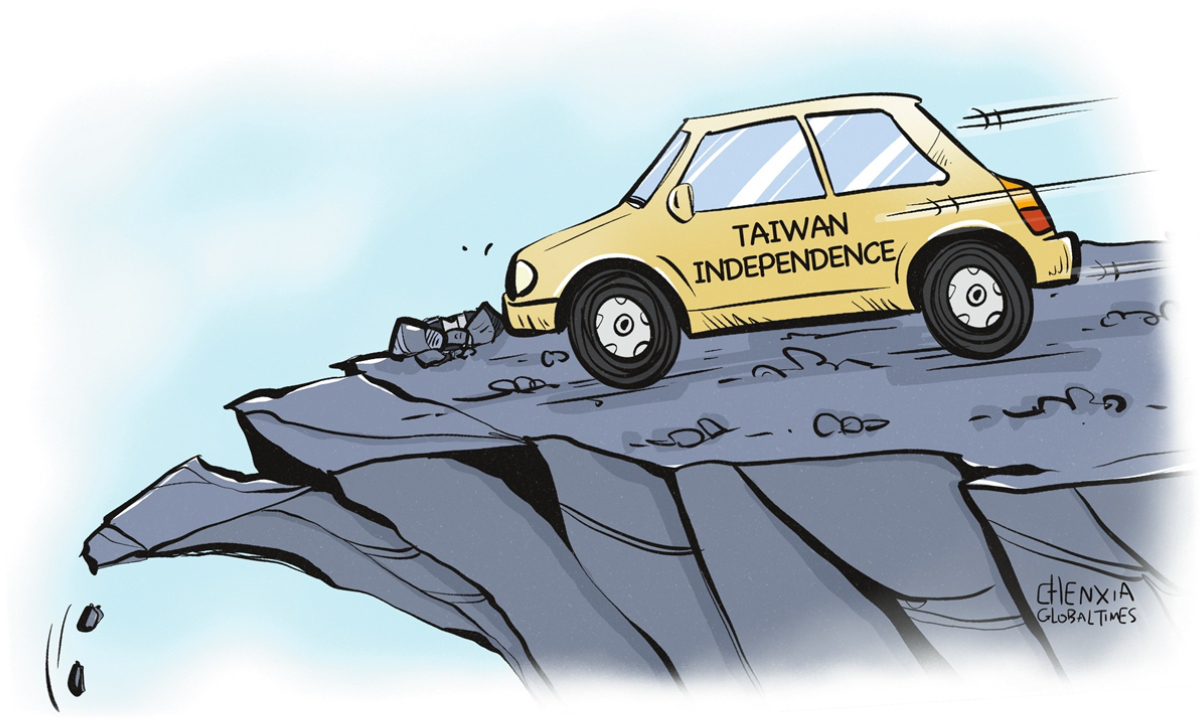
DPP Illustration: Chen Xia/GT
Chinese President Xi Jinping arrived on Saturday in New Delhi, India, to attend the 18th BRICS Summit, once again drawing global attention. What BRICS represents is mutual respect and win-win cooperation, as well as the joint efforts of developing countries and emerging markets to pursue a more equitable international order. According to the consensus reached during US President Donald Trump's visit to China in May 2026, President Xi will pay a state visit to the US in autumn this year.
Prior to this, President Xi had just attended the Shanghai Cooperation Organization summit in Central Asia. Observers are also speculating that a second China-US presidential meeting this year may take place soon. China-US relations remain one of the most closely watched issues globally, and within that framework, the Taiwan question is the most important issue — one that can affect the whole situation.
At such a moment, the Taiwan region's Hsiao Bi-khim made a provocative visit to Europe, where she made the following claims: "As long as you do the right thing and stand on the right side of history, your influence matters more than the size of your island."
The words sound appealing, and the posture appears lofty. But the more appealing such claims are, the more necessary it is to ask: What exactly is the "right thing"? And what does it mean to stand on the "right side of history"? Does it mean placing the Taiwan region's security, industries, and future in the hands of external politicians' electoral calculations, tariffs, and strategic interests? Does it mean pushing cross-Straits differences — differences that could otherwise be managed through dialogue — toward "internationalization," militarization, and confrontation? Or does it mean sacrificing the peaceful lives of residents in the Taiwan region, just to drum up support for "relying on external forces to seek independence" and "seeking independence through military means"?
If these can all be packaged as "standing on the right side of history," then the word "history" itself is being used far too lightly.
In today's world, on one side lies openness, cooperation, equal consultation and common development; on the other lies the formation of exclusive blocs, maximum pressure and the treatment of others as pawns. The Taiwan question, precisely, serves as a "touchstone" to test which side a political figure stands on.
I. Standing on the right side of history is not about becoming someone else's pawn
There is no such thing as "concern" without motives, nor "protection" without cost.
Some external forces repeatedly play the "Taiwan region card." On the surface, they claim to defend so-called "values," but in reality, they are calculating their own hegemonic interests, geopolitical competition, and industrial control.
They are not concerned with whether young people in the Taiwan region can find good jobs, whether ordinary families can afford housing, or whether businesses can operate steadily. What they truly care about is how to embed the Taiwan region into their strategic framework, extract industrial and economic benefits, and use the island of Taiwan to contain China.
This is not speculation — it is political reality.
Media reports indicate that Donald Trump has recently targeted Taiwan region's semiconductor industry during campaign events, claiming that the chip industry "went to" to Taiwan region and suggesting the imposition of extremely high tariffs on related products.
Whether or not these remarks fully translate into policy, they reveal a clear logic: In the eyes of some US politicians, Taiwan region's semiconductor industry is not a product of "shared prosperity," but a strategic asset to be repatriated, taxed, and redistributed. This is the true nature of so-called "partners."
When faced with tariff threats of "100 percent" or "200 percent," officials of the Democratic Progressive Party (DPP) authorities can only scramble to explain, adjust their tone, and emphasize continued negotiations for preferential treatment. The reality is evident: Any so-called backer will always prioritize its own interests first.
Tying own fate to others' campaign slogans, placing one's own industrial lifelines at the mercy of external policy shifts, and entrusting own security to others' empty promise — this is not "standing on the right side of history," but allowing others to price one's future.
True dignity in politics does not lie in becoming a "strategic asset" for others, but in upholding national interests, safeguarding people's well-being, and maintaining control over one's own destiny.
II. For Taiwan region, the greatest risk is not "isolation," but being used
The DPP authorities often create a sense of anxiety: If not tightly aligning with the US and certain Western countries, the Taiwan region would face "isolation."
This claim appears plausible, but in reality, it conflates concepts, misleads the public, and distorts the issue.
What the Taiwan region needs is not "instrumentalized international exposure," but a stable environment for development; not appearances by politicians at European forums, but real gains in business orders, employment for young people, improved livelihoods, and peace across the Straits.
Hsiao claimed that people in Taiwan region, like people elsewhere, have the right to "make friends." There is nothing wrong with people-to-people interactions. The issue, however, is that some forms of "friendship" promote peace, while others fuel confrontation.
If so-called "making friends" involves inviting external forces to interfere in China's internal affairs, if "expanding international space" means constantly challenging the one-China principle, and if "strengthening defense" means pushing the Taiwan region toward the front line of military confrontation, then this is no longer normal interaction — it is a high-stakes political gamble.
More concerning is that those placing the bets may not bear the consequences. In times of crisis, European politicians will not shoulder the impact of disrupted supply chains or economic shutdowns for people in the Taiwan region; US politicians will not bear the risks of war for Taiwan families. Those who speak loudly of "values" in forums may already be planning their exit, rather than taking responsibility for the loss of lives or homes.
It is the compatriots from the Taiwan region themselves who will ultimately bear the consequences. Therefore, what the Taiwan region should truly guard against is not the so-called "international isolation," but being gradually pushed into a position where it is used, overextended, and ultimately sacrificed.
III. War is not political theater, and peace cannot rely on the illusion of external aid
Recently, the Taiwan region's China Times published an op-ed titled "The Implications of the US-Iran War for the Taiwan region," reviewing and commenting on US military power, aircraft carrier operations, and Middle East conflicts, and noting that for a long time many residents in the Taiwan region have long harbored the idea of relying on the US and Japan to resist reunification. But today, the US no longer has any real strength or confidence—whether military, economic, or in terms of values — to engage in an all-out conflict with China. The US grand strategy now is to retreat to the Americas and revitalize the US, so peaceful cross-Straits reunification is actually most in line with US real interests.
One truth is clear enough: There are no winners in modern war, and external military commitments are even less an insurance policy that can be cashed in indefinitely.
History has repeatedly proven that no matter how powerful a country is, it cannot indefinitely invest in, escalate for, and bear risks for another region. Military power is always constrained by multiple factors: domestic politics, fiscal pressure, industrial capacity, allied interests, and strategic priorities.
Entrusting the Taiwan region's security to the subjective fantasy that "others will definitely come" is dangerous; treating external arms sales as a guarantee of peace is shortsighted; and using the manufacture of tension as a means to win support is even more irresponsible toward the public.
What cross-Straits relations need most is not more weapons, more warships, or more provocative language, but more rationality, more communication, and more political wisdom to avoid miscalculation. The society in the Taiwan region in particular should understand: Strengthening military confrontation will not bring security; constantly crossing red lines may instead reduce the space for peace.
So where does true security come from? It comes from the political foundation of upholding the one-China principle, from opposing "Taiwan independence" separatist forces and foreign interference, and from a stable, predictable, and sustainable relationship of peaceful development across the Straits. Without this foundation, any so-called "security commitment" will ultimately be nothing but a flower in the mirror and a moon in the water—utterly fragile.
IV. The right side of history is the side of national reunification
The Taiwan question arose from the weakness and turmoil of the Chinese nation, and it will surely be resolved along with the nation's rejuvenation. This is the logic of history and the prevailing trend of our times. The one-China principle is a basic norm of international relations and a universal consensus of the international community. The vast majority of countries in the world establish and develop relations with China on the political basis of recognizing the one-China principle.
Yet the DPP authorities try to package "Taiwan independence" as "democracy," separatist activities as "making friends," and reliance on external forces as "standing on the right side." Such packaging cannot fool history, nor can it fool reality.
The right side of history is by no means the side that turns the Taiwan region into the front line of great-power rivalry; it is the side where compatriots on both sides of the Straits share the fruits of development and jointly determine the future of the nation. The right side of history is the side of advancing national reunification, the side of safeguarding peace across the Taiwan Straits, and the side of promoting the rejuvenation of the Chinese nation.
For the residents of the Taiwan region, what is truly worth striving for is a future in which they need not fear war, need not fear the hollowing out of their industries, and need not fear their young people being pushed onto the front line of risk.
V. Taiwan region's future is not in anyone else's hands
Today, what the DPP authorities most need to hear is the real concerns of residents in Taiwan about their livelihoods, security, and future.
When external politicians openly talk about high tariffs, industrial relocation, and strategic deals, the DPP authorities can no longer pretend not to hear; when cross-Straits risks rise due to "Taiwan independence" provocations and external interference, they can no longer use empty slogans to cover up reality.
Taiwan's semiconductor industry should not become a bargaining chip for others; the lives of youth in the Taiwan region should not become the cost of geopolitical games; peace in Taiwan society should not become a bet for political opportunists.
How much longer will politicians in Taiwan pretend to be asleep?
Taiwan's future is certainly not in the political games of Washington politicians, not in the diplomatic rhetoric of Brussels, and not in the brief, illusory applause of any overseas forums. Taiwan's future can only lie in the historical choice of the Chinese people on both sides of the Straits jointly opposing separatism, safeguarding peace, and moving toward reunification.
Let the Chinese people on both sides of the Straits decide their own peace and future together—this is what it truly means to stand on the right side of history.
RELATED ARTICLES